China Competes with US in Space... US and China Mars Probes to Enter Orbit Around February Next Year
China to Build Manned Base on Moon... Chang'e 6, 7, 8 Launch Countdown
[Asia Economy Beijing=Special Correspondent Jo Young-shin] China's unmanned lunar probe 'Chang'e 5' returned to Earth at 1:59 a.m. on the 17th (Beijing time) carrying soil and rock samples from the lunar surface. This is the third time lunar surface samples have been collected, following the United States and Russia (former Soviet Union).
Major Chinese media outlets, including the state-run Xinhua News Agency, extensively reported the safe return of the lunar probe, celebrating that China has taken a step closer to the goal of becoming a space power advocated by Chinese President Xi Jinping.
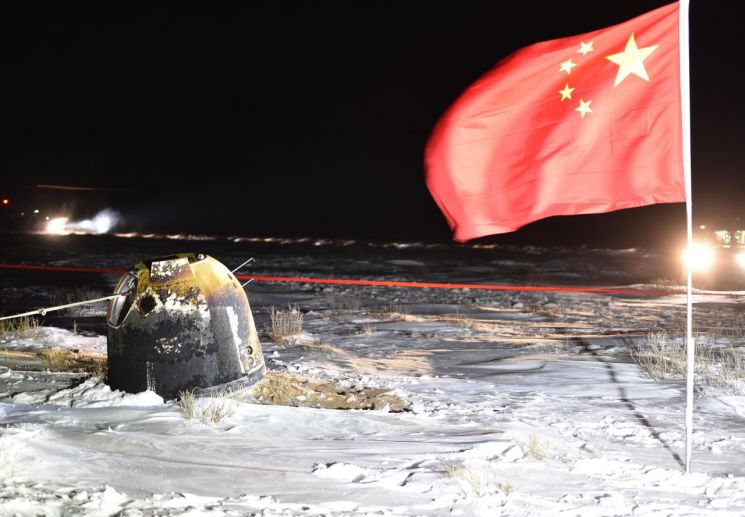
Chang'e 5 was launched from Earth on the 24th of last month aboard the Long March 5 carrier rocket, and on the 1st of this month, the lander separated from the main body and landed in the area known as the 'Sea of Storms' on the Moon. It successfully drilled a hole 2 meters deep and collected 2 kg of soil and rock samples from the lunar surface.
After completing its mission, the lander took off on the 3rd, docked with the return vehicle orbiting the Moon on the 6th, and then returned to Earth. The lunar soil brought back by the Soviet Union's 'Luna 24' exploration robot in 1976 was only 330 grams.
Xinhua News Agency evaluated China's space development technology, stating that it "recorded the successful conclusion of the three-stage lunar exploration plan started in 2004, including orbiting, landing, and sample collection."
◇ Accelerating China's Space Development = China is achieving results 44 years after starting its space development program. On January 3rd last year, China sent the 'Chang'e 4' probe to the far side of the Moon, which humanity had never visited before. Because the Earth's rotation period and the Moon's orbital period are the same, humanity had never directly seen the far side of the Moon before Chang'e 4 landed there.
To enable Chang'e 4's landing on the far side of the Moon, China launched a dedicated communication satellite (Queqiao) into lunar orbit. This satellite acts as a relay to facilitate communication between Earth and Chang'e 4.
On July 23rd, China launched the Mars probe 'Tianwen 1.' Tianwen 1 consists of an orbiter, a lander, and a rover. It is known that China's Mars probe is expected to enter Mars orbit around February next year.
If China's Tianwen 1 successfully lands on Mars, China will become the third country to achieve a Mars landing, following the United States and Russia (former Soviet Union).
◇ Space Hegemony between the United States and China = In the 1960s, the United States and the Soviet Union competed over space development technology. During the Cold War, the rivalry between the two countries was beyond imagination. Fifty years later, the United States and China are competing for space hegemony. The United States, which has been ahead of China in space exploration, established the Space Force in December last year.
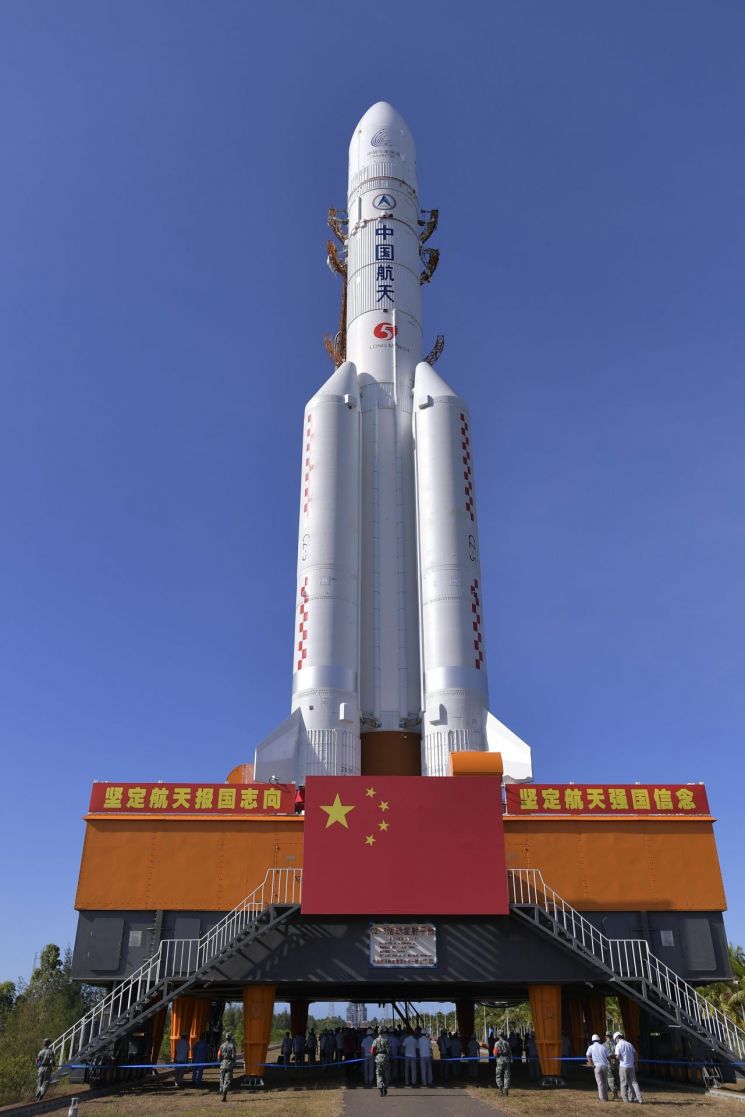
Shortly after China's Mars probe launch, the United States also launched its fifth Mars probe. The U.S. Mars probe, launched about a week later, is expected to arrive in Mars orbit around mid-February next year.
China appears to be focusing on the Moon. China has plans to send Chang'e 6 and 7 to the lunar south pole starting in 2023.
Additionally, around 2027, China plans to send Chang'e 8 to the Moon to collect preliminary data for manned landings. China aims to build a research base on the Moon where humans can live.
© The Asia Business Daily(www.asiae.co.kr). All rights reserved.


















