4 of 8 Disciplinary Reasons Recognized
Suspension Instead of Dismissal or Resignation... Political Burden and Preparation for Court Litigation
Prosecutor General Yoon Predicts Legal Disputes... Likely to File Cancellation Lawsuit and Suspension of Execution Request
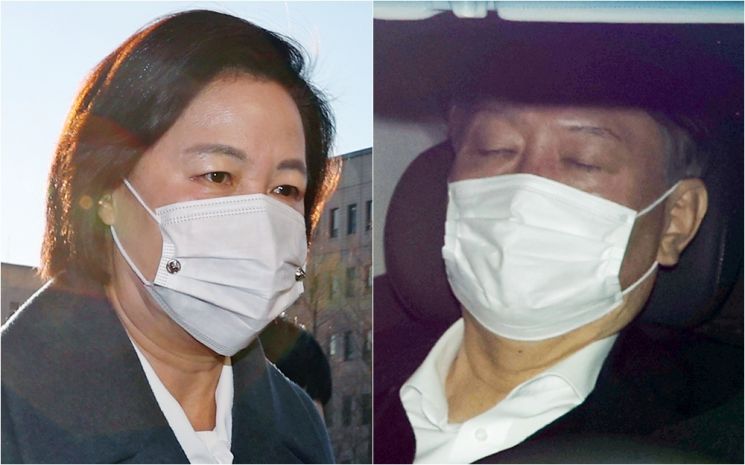 Minister of Justice Choo Mi-ae (left) and Prosecutor General Yoon Seok-youl. [Image source=Yonhap News]
[Asia Economy Reporter Choi Seok-jin] The Ministry of Justice Disciplinary Committee (Disciplinary Committee) decided on the 16th to impose a relatively light "suspension" instead of dismissal or removal on Prosecutor General Yoon Seok-yeol. This appears to be a choice made in consideration of the strong backlash within the prosecution and political circles, as well as the upcoming legal battles.
In particular, considering that Prosecutor General Yoon has only seven months left in his term, it was judged that even a "two-month suspension" would effectively make it impossible to perform the duties of the Prosecutor General normally. Therefore, instead of dismissal or removal, which would require the immediate appointment of a successor and cause a heavier impact, a suspension decision with relatively less fallout was made.
Although Prosecutor General Yoon reported to work normally on the 16th, if President Moon Jae-in approves the disciplinary proposal upon the recommendation of the Minister of Justice, Yoon will become a "figurehead Prosecutor General."
Since Prosecutor General Yoon has already declared legal countermeasures, the battlefield of the Chu-Yoon conflict has shifted to the courts. Meanwhile, the prosecution must adapt to changes including the launch of the High-ranking Officials' Crime Investigation Office (Hogeumgongjikja Beomjoe Susacheo, Gongsoocheo) while enduring setbacks in investigations such as the nuclear power plant case amid the "absence of a Prosecutor General."
◆ Four Reasons Recognized After 17 Hours and 30 Minutes of Marathon Meeting
The Disciplinary Committee, which held the second review session on the disciplinary action against Prosecutor General Yoon from 10:34 a.m. the previous day, decided on a "two-month suspension" after a marathon meeting lasting 17 hours and 30 minutes until 4 a.m., well past midnight. This is the first disciplinary decision against a sitting Prosecutor General in constitutional history.
Minister of Justice Chu Mi-ae filed disciplinary charges against Prosecutor General Yoon on the 24th of last month, citing six major and eight detailed reasons.
The Disciplinary Committee recognized four disciplinary reasons among them: ▲ preparation and distribution of documents analyzing the judiciary, ▲ obstruction of inspection in the Channel A case, ▲ obstruction of investigation in the Channel A case, and ▲ inappropriate remarks concerning political neutrality.
On the other hand, for two reasons?▲ inappropriate exchanges with media company owners and ▲ violation of cooperation obligations regarding inspections?the committee decided not to consider them as disciplinary reasons despite acknowledging their existence. For two other reasons?▲ information leakage related to the Channel A case inspection and ▲ obstruction of inspection in the former Prime Minister Han Myeong-sook case?the committee ruled no charges.
The Disciplinary Committee conducted witness examinations for seven of the eight adopted witnesses, excluding Shim Jae-cheol, Director of the Ministry of Justice's Prosecution Bureau. Particularly, much time was spent on the witness examination of Han Dong-soo, head of the Supreme Prosecutors' Office Inspection Department, who is related to the judiciary analysis documents, the Channel A case, and the Han Myeong-sook case.
After the witness examination ended at 7:30 p.m. the previous day, Prosecutor General Yoon's side requested a third session to prepare final statements based on the witness testimonies, but this was rejected. Ultimately, Yoon's side refused to make final statements, and the Disciplinary Committee resumed the meeting around 9 p.m., deciding on a "two-month suspension" after intense debate lasting several hours.
After the early morning meeting, Acting Chairman of the Disciplinary Committee Jeong Han-jung stated, "We continued discussions because there was no consensus on the severity of the punishment, ranging from dismissal to six months suspension or four months suspension."
◆ Why Suspension Instead of Dismissal or Removal
Before the second review session, opposition politicians and legal circles widely expected the Disciplinary Committee to impose a two to three-month suspension instead of the initially anticipated heavy punishments such as dismissal or removal.
During the disciplinary request process, various procedural issues surfaced, increasing criticism of Minister Chu both inside and outside the prosecution, negatively affecting President Moon Jae-in's approval ratings. From the perspective of the Blue House and Minister Chu, forcibly removing Prosecutor General Yoon immediately could provoke a strong backlash, which they wanted to avoid.
Additionally, the court's earlier decision to suspend the execution of Minister Chu's order to suspend Yoon due to procedural flaws likely influenced the decision.
In applying for a suspension of the execution of the suspension order, Prosecutor General Yoon's side is expected to challenge the Disciplinary Committee's rejection of recusals and avoidance requests against members suspected of strong partiality, such as Deputy Minister of Justice Lee Yong-gu, and to criticize the committee's unilateral witness selection of Director Shim Jae-cheol, which deprived them of the opportunity for cross-examination.
◆ Likely to File Cancellation Lawsuit After Presidential Approval
The Prosecutor Disciplinary Act stipulates that in the case of suspension, the President executes the punishment upon the recommendation of the Minister of Justice. Since President Moon has expressed his intention to accept the Disciplinary Committee's decision, it is expected that approval of the disciplinary action will be granted soon.
Meanwhile, Prosecutor General Yoon stated through his special attorney Lee Wan-gyu on the morning of the same day, "This is an illegal and unfair measure based on unlawful procedures and baseless reasons to oust a fixed-term Prosecutor General, severely damaging the prosecution's political neutrality, independence, and the rule of law. We will correct the wrongdoing according to the procedures prescribed by the Constitution and laws."
Ultimately, if President Moon approves the disciplinary action, Prosecutor General Yoon is highly likely to immediately file a lawsuit at the Seoul Administrative Court seeking cancellation of the suspension order and simultaneously request a suspension of its execution.
Furthermore, once the case is assigned to a judge, Yoon is expected to request a constitutional review of the provisions of the Prosecutor Disciplinary Act that form the basis of the disciplinary action.
Considering the time required for the lawsuit to be finalized, the court's decision on the suspension of execution will determine whether Prosecutor General Yoon can perform his duties during the remaining seven months of his term.
However, since the "damage to Prosecutor General Yoon"?which is the standard for judging the necessity of suspension of execution?is relatively lighter for a "two-month suspension" compared to dismissal or removal, it is difficult to predict what decision the court will make.
Setbacks in Government Investigations Inevitable... Prosecution's Position Narrows
Even if Prosecutor General Yoon takes legal action, if the suspension order remains effective, Deputy Prosecutor General Cho Nam-gwan will act as Prosecutor General.
Due to the absence of the Prosecutor General, investigations into cases involving the Blue House and ruling party, such as the Ulsan mayoral election interference case, the Optimus Asset Management fund fraud case, and allegations of manipulation of the economic feasibility evaluation of the Wolseong nuclear power plant, are expected to lose momentum.
With the amendment of the Prosecution Service Act, the prosecution's direct investigation scope has already been limited to six areas: corruption, economy, public officials, elections, defense industry crimes, and major disasters. As investigation authority over high-ranking officials shifts to the High-ranking Officials' Crime Investigation Office (Gongsoocheo), the prosecution's position is expected to shrink further, intensifying the sense of crisis within the prosecution.
© The Asia Business Daily(www.asiae.co.kr). All rights reserved.
![User Who Sold Erroneously Deposited Bitcoins to Repay Debt and Fund Entertainment... What Did the Supreme Court Decide in 2021? [Legal Issue Check]](https://cwcontent.asiae.co.kr/asiaresize/183/2026020910431234020_1770601391.png)















