Long-term Low Carbon Development Strategy (LEDS) and National Greenhouse Gas Reduction Target (NDC) Confirmed
Expansion of Renewable Energy-based Electricity and Hydrogen Production and Utilization, Energy Efficiency Improvement, etc.
Ministry of Environment "Core Carbon Neutrality Policies to be Established in Phases by the End of 2021"
"Enhanced 2030 NDC to be Submitted to the UN within Moon Government's Term"
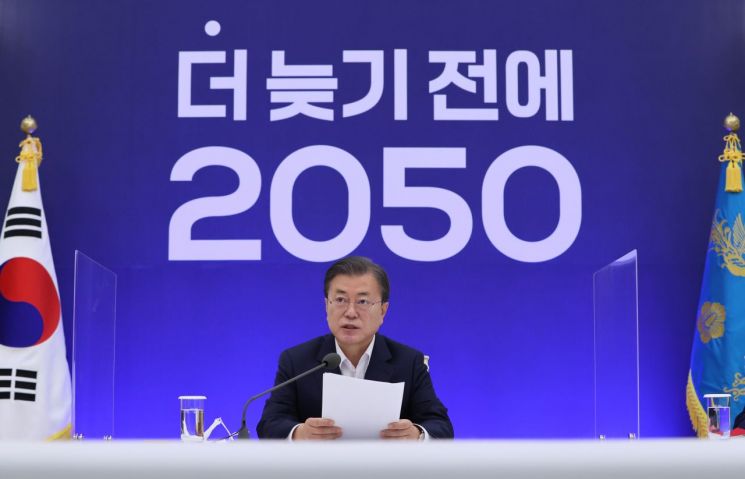
[Asia Economy Reporter Moon Chaeseok] The Ministry of Environment announced that the government proposals for the '2050 Long-term Low Carbon Development Strategy (LEDS)' and the '2030 National Greenhouse Gas Reduction Target (NDC)' were finalized at the Cabinet meeting on the 15th.
LEDS and NDC are planned to be translated into English by the end of this year and then submitted to the United Nations.
The Ministry of Environment explained, "LEDS presents a long-term vision and national strategy to achieve carbon neutrality (net zero carbon emissions) by 2050, while the NDC includes a binding greenhouse gas reduction target that commits to reduction implementation by 2030 to the international community."
The international community, through the Paris Agreement adopted in 2015, pledged to limit the global average temperature rise to within 2℃ above pre-industrial levels, and further to below 1.5℃.
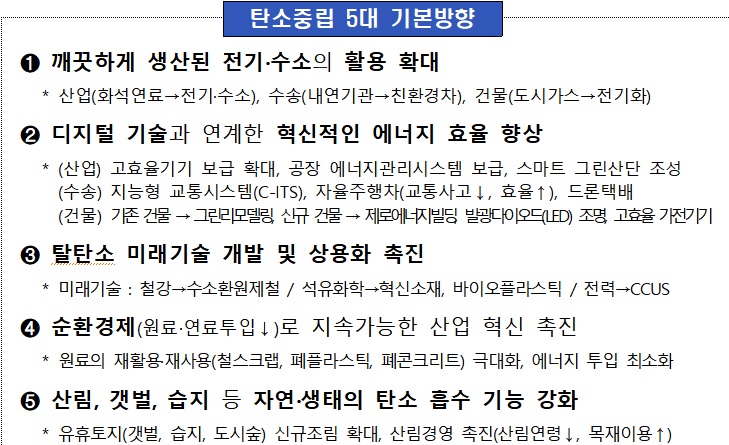
The title of the government proposal for LEDS is 'Republic of Korea 2050 Carbon Neutral Strategy for Realizing a Sustainable Green Society.' It contains five basic directions and sector-specific implementation strategies.
The sector-specific strategies for energy, industry, transportation, buildings, and agriculture, forestry, and fisheries focus on energy transition (from coal and nuclear power to new and renewable energy), commercialization of new technologies, and expansion of eco-friendly vehicles.
In the energy supply sector, the plan proposes ▲transition to a renewable energy power supply system such as solar and wind power ▲supplementing renewable energy with fossil fuel power generation linked to carbon dioxide capture technology ▲establishing a low-cost and stable hydrogen energy supply system ▲actively considering complementary measures such as the Northeast Asia grid.
In the industrial sector, it promotes ▲commercialization of future new technologies such as hydrogen reduction steelmaking and bioplastics ▲promotion of smart industrial complexes ▲improving the reuse rate of recycled materials such as steel scrap, waste plastics, and waste concrete.
For transportation, it expands transportation means powered by clean energy sources such as electricity and hydrogen. In sectors where eco-friendly vehicle adoption is difficult, the use of biofuels will be expanded.
In the building sector, it increases the use of energy-efficient products and promotes the spread of renewable energy within buildings such as solar and geothermal to realize 'building energy self-sufficiency.'
To implement policies, institutional frameworks will be established. Institutional foundations such as funding, systems, and policies will be built to realize carbon neutrality in the public sector. Policy improvement plans reflecting carbon price signals such as emissions trading schemes, taxation, and charges will be reviewed.
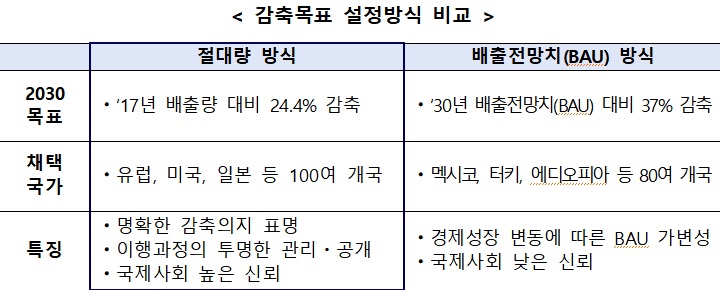
Regarding the NDC, the target was changed from '37% reduction compared to the 2030 emission forecast' to '24.4% reduction compared to 2017 emissions.'
The emission forecast method can change frequently depending on economic conditions. The absolute amount method is easier to manage transparently during the target implementation process.
To prepare supplementary reduction target implementation measures, plans for international carbon markets and carbon sink utilization were included. To increase reduction implementation, the share of overseas reductions was reduced and the domestic share was expanded.
The Ministry of Environment stated, "It clearly indicated that it will actively review raising the 2030 greenhouse gas reduction target by 2025."
The Ministry of Environment said it will take follow-up measures such as ▲establishing a refined '2050 Carbon Neutral Scenario (multiple options)' by June next year ▲preparing core carbon neutrality policy tasks by the end of next year and reflecting them in the national plan ▲submitting the upgraded '2030 NDC' to the UN within the Moon Jae-in administration.
Minister of Environment Cho Myung-rae emphasized, "The government will do its best to implement carbon neutrality with a clear direction and confidence," and added, "We ask for active participation from both the industry and the public."
© The Asia Business Daily(www.asiae.co.kr). All rights reserved.
![User Who Sold Erroneously Deposited Bitcoins to Repay Debt and Fund Entertainment... What Did the Supreme Court Decide in 2021? [Legal Issue Check]](https://cwcontent.asiae.co.kr/asiaresize/183/2026020910431234020_1770601391.png)


















