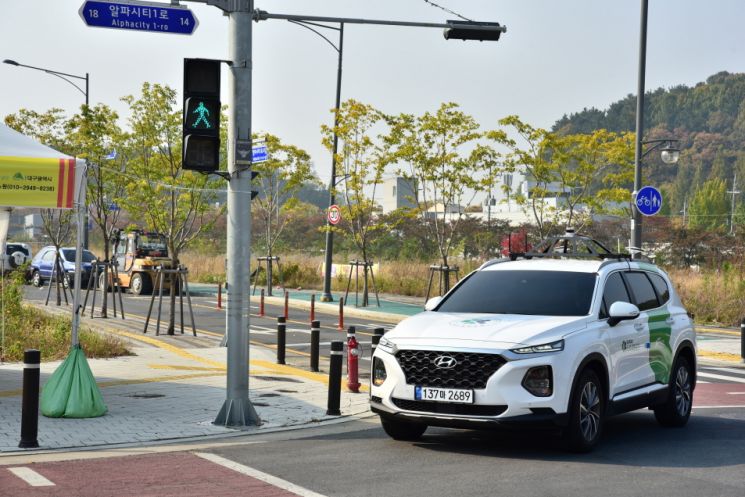
[Asia Economy Reporter Moon Jiwon] The Ministry of Land, Infrastructure and Transport (MOLIT) has announced ethical guidelines for autonomous vehicles, cybersecurity guidelines, and Level 4 production and safety guidelines.
On the 15th, MOLIT held separate press conferences at the Korea Press Center and El Tower to unveil the related guidelines.
These guidelines were prepared ahead of the full-scale commercialization era of autonomous vehicles to ensure the ethicality of autonomous vehicle driving algorithms and to respond to hacking threats against autonomous vehicles. The guidelines are advisory rather than mandatory and will be published as government publications.
The ethical guidelines focus on the principle that autonomous vehicles must be designed and manufactured to prioritize the protection of human life.
The guidelines state that autonomous vehicles should "prioritize protecting human life over property" and "minimize human casualties when accident avoidance is impossible."
Additionally, ethical standards for autonomous vehicle users are presented, such as "ensuring that autonomous vehicle operation does not infringe on others' freedoms and rights" and "receiving safety education for proper operation."
MOLIT explained, "The ethical guidelines are expected to serve as a judgment standard for the ethics of autonomous vehicles in the future, as well as an incentive system that can induce ethical behavior from manufacturers and users."
Based on the international automotive cybersecurity standards established in June, MOLIT also prepared cybersecurity guidelines containing recommendations for automobile manufacturers.
According to the recommendations, manufacturers must establish a cybersecurity management system and manage automotive cybersecurity according to that system.
Manufacturers are advised to recognize and analyze risks through risk assessment procedures and mitigate risk levels through security measures. They are also recommended to conduct verification procedures to confirm the adequacy of security measures.
The guidelines also include provisions to consider the security status of suppliers and partners and to share related information with dedicated automotive cybersecurity agencies.
MOLIT plans to revise related laws and establish mandatory cybersecurity standards based on these guidelines.
Level 4 autonomous vehicle production and safety guidelines have also been prepared.
The government has completed the system for commercializing Level 3 autonomous vehicles this year and is promoting policies to establish a foundation for the commercialization of fully autonomous vehicles, including Level 4 safety standards, by 2024.
Level 3 refers to partial autonomous driving requiring driver intervention in specific situations, while Level 4 refers to full autonomous driving where the system is responsible for all driving operations.
The Level 4 autonomous vehicle production and safety guidelines were developed mainly based on research results from the Autonomous Vehicle Convergence Future Forum. They consist of three areas?system safety, driving safety, and safety education and ethical considerations?and 13 safety items.
The system safety area includes recommendations to minimize design errors and malfunctions of autonomous vehicles and to ensure safety against cyber threats.
The driving safety area aims to minimize accident risks through safe interactions with various road environments and traffic objects during operation.
Safety education and ethical considerations cover content for the proper manufacturing and operation of autonomous vehicles. Detailed contents of each guideline announced this time can be found on the MOLIT website.
© The Asia Business Daily(www.asiae.co.kr). All rights reserved.

















