Similar to Red Cross donation tax bills
Citizens express frustration, "Is this a sneaky fundraising?"
Cheong petition: "Please eliminate Red Cross giro slips"
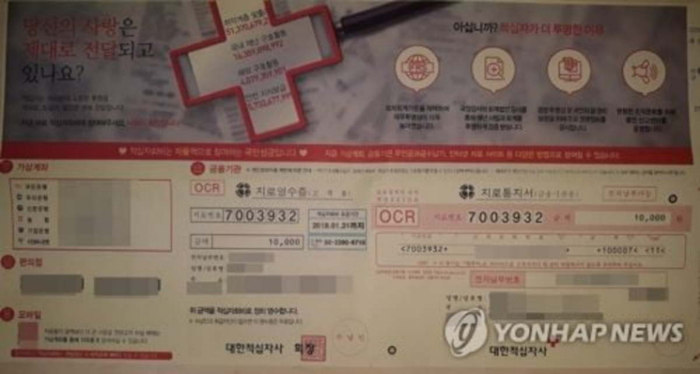 Red Cross donation slip. It resembles utility bills such as tax notices, leading to criticism that it may prevent recognition of the payment as a donation.
 [Image source=Yonhap News]
[Asia Economy Reporter Han Seung-gon] # Mr. Kim, in his 60s, was outraged upon realizing that the notice sent by the Korean Red Cross was not a tax payment or utility bill. Mr. Kim said, "I thought the giro slip was the same as a tax bill and that I had to pay it unconditionally," adding, "I only recently found out that this is not the case." He raised his voice, saying, "I am not against fundraising for the underprivileged, but it is absurd that the fundraising is conducted in the form of a bill that the public must pay."
Every December, there are various disputes surrounding the Korean Red Cross's fundraising notices. The Red Cross designates the two months from December to January as the "intensive fundraising period" and sends giro slips that resemble tax bills. The recipients are all household heads aged 25 to under 75, regardless of income.
During this period, the Red Cross sets the amount at 10,000 KRW for individuals, 30,000 KRW for sole proprietors, and 50,000 KRW for corporations, sending notices to each household and business. These giro slips not only resemble tax or utility payment forms but also trigger a second notice in February if unpaid.
However, the sending of giro slips itself is done without individual consent, and because the form is similar to utility bills, it can be mistaken as a mandatory tax payment, which remains a persistent issue.
As a result, some people pay money thinking they are paying taxes rather than donating to help the underprivileged. They end up donating without even realizing it.
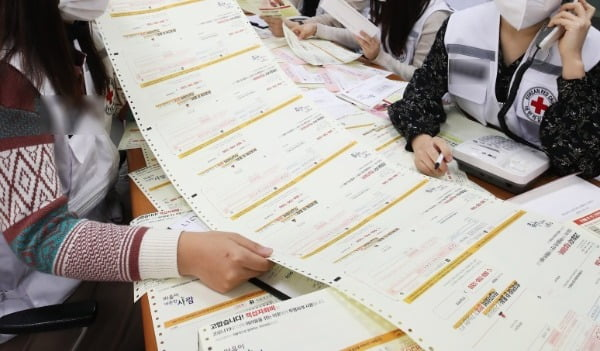
Citizens criticized that the Korean Red Cross's fundraising methods need to be completely reformed.
Mr. Lee, a man in his 30s, said, "Young people like us rarely pay through bills and use smartphones instead, but the older generation still pays via giro. The Red Cross fundraising notice looks exactly like a tax bill, so people perceive it as a mandatory tax and pay money," pointing out the issue. He added, "If it is a request for donations, it should be clearly stated that it is a donation, not a tax."
Mr. Park, a man in his 50s, said, "It is wrong to fundraise in a form similar to tax bills," and urged, "It should be corrected quickly." He also raised his voice in criticism, saying, "If people mistakenly pay donations thinking they are taxes and request refunds, they should be reimbursed."
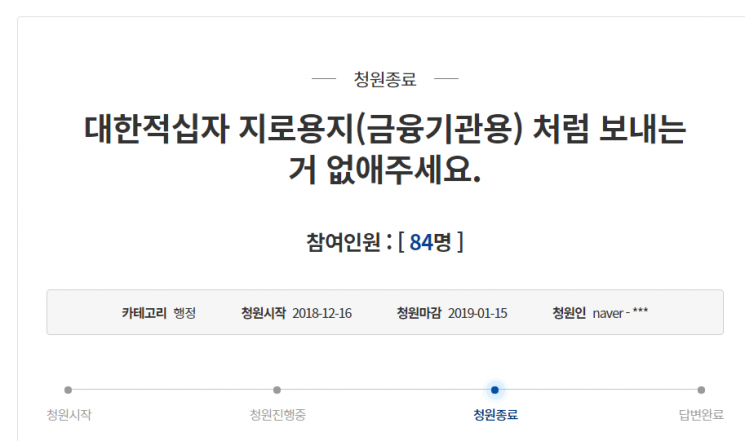
As citizens' complaints continued, a petition was submitted to the Blue House requesting the modification or abolition of this fundraising format.
One petitioner opposed the Korean Red Cross's giro slip fundraising, stating, "The giro slips sent look exactly like utility bills, causing confusion that they must be paid compulsorily like taxes."
On December 18 last year, a high school student filed a constitutional complaint through a lawyer regarding the "Korean Red Cross membership giro notice." Another constitutional complaint on the same issue was filed again in March this year.
However, despite citizens' discomfort, the Red Cross has been sending more giro notices. The number of notices sent increased from about 17.04 million in 2014 to over 20.7 million in 2018. The cost of producing and sending the notices also rose from 2.854 billion KRW in 2014 to 3.637 billion KRW as of June 2018. The total cost of sending giro slips amounted to 18.453 billion KRW.

In response, the Red Cross explained on its website about using giro slips for fundraising and the confusion with utility bill payments.
The Red Cross stated, "We clearly indicate the phrase 'Voluntary National Donation' at the top of the giro slip to prevent misunderstanding as a tax." Regarding the reason for using giro slips, they explained, "Giro can be used at all bank branches and ATMs as payment counters, making it convenient. It is also a payment method that easily identifies the participant and is used in various places."
Meanwhile, as controversy over the fundraising method continued, the Red Cross decided to abolish this fundraising method starting in 2023. At the National Assembly Health and Welfare Committee's audit held in October, former Korean Red Cross Chairman Park Kyung-seo revealed that an internal task force (TF) was activated to discuss the matter and that the method would be eliminated within three years at the latest.
© The Asia Business Daily(www.asiae.co.kr). All rights reserved.
![Clutching a Stolen Dior Bag, Saying "I Hate Being Poor but Real"... The Grotesque Con of a "Human Knockoff" [Slate]](https://cwcontent.asiae.co.kr/asiaresize/183/2026021902243444107_1771435474.jpg)


















