Securing Heat Dissipation Path with Aluminum Oxide Nanoparticles
Clue to Improving Device Lifespan
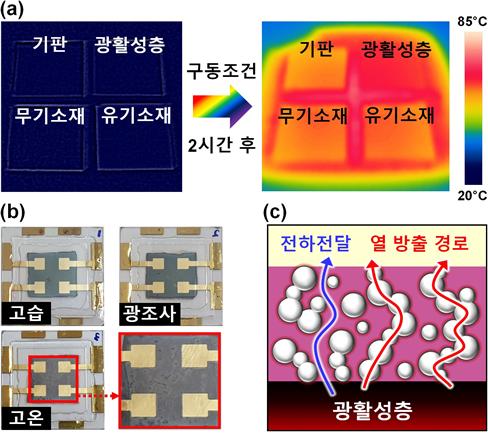
[Asia Economy Reporter Hwang Junho] A technology has been developed to effectively dissipate heat that causes performance degradation in next-generation solar cells such as perovskite solar cells, organic light-emitting diodes (OLEDs), and organic transistors. This technology is expected to contribute to commercialization by extending the lifespan of organic electronic devices.
According to the Korea Research Foundation on the 11th, Professor Park Tae-ho's research team from the Department of Chemical Engineering at POSTECH developed a cooling system using an aluminum oxide-conductive polymer composite material that can effectively dissipate heat inside devices. The related research paper was recently published in Energy & Environmental Science, an international journal in the energy field.
The research team created a structure within the organic electronic device using aluminum oxide nanoparticles that conduct heat well, allowing heat to escape, and incorporated conductive polymers to enable charge movement. This created separate pathways for heat and charge transfer.
Recently, electronic devices using flexible and highly processable organic materials have been developed. However, organic materials have low thermal conductivity, causing heat to accumulate inside the device and degrade performance. This research provides a solution to that problem.
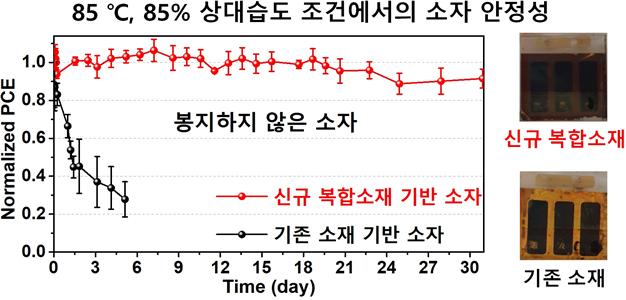
The research team applied the heat-dissipating composite material developed through this process to perovskite solar cells. As a result, the device's performance improved more than threefold under high temperature and high humidity conditions. Perovskite solar cells use perovskite (ABX3) materials as the photoactive layer and are attracting attention as next-generation solar cells due to their excellent photoelectric properties.
The research team stated, "We plan to continue follow-up research to apply this technology to next-generation electronic devices such as organic light-emitting diodes and organic transistors."
© The Asia Business Daily(www.asiae.co.kr). All rights reserved.


















