Not Included in KEPCO's Regular Board Meeting Agenda... Temporary Board Meeting Also Uncertain
Industry: "Fuel Cost Linkage System Will Likely Extend Beyond the Year Due to Economic Policy"
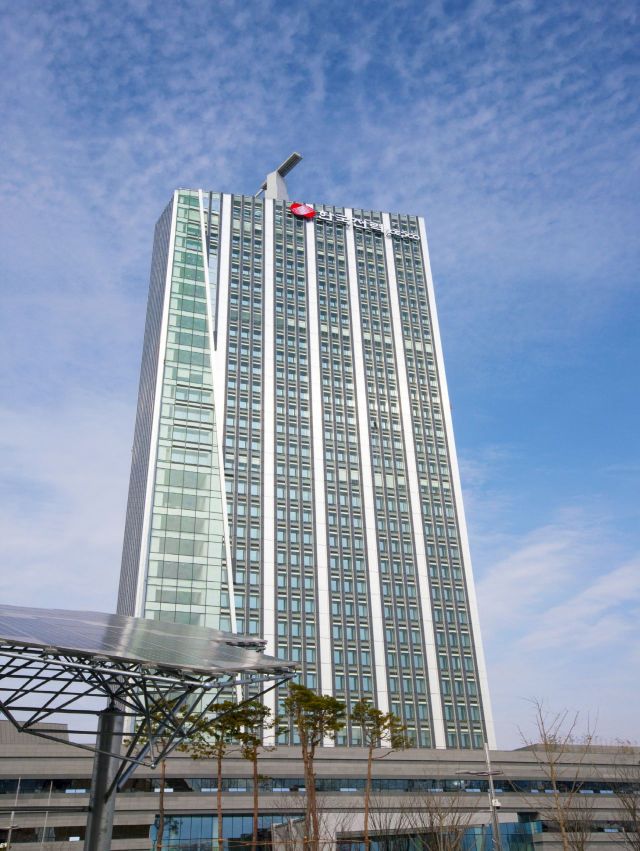 A view of the Korea Electric Power Corporation headquarters in Naju, Jeollanam-do. (Photo by Korea Electric Power Corporation)
[Asia Economy Reporter Moon Chaeseok] Korea Electric Power Corporation (KEPCO) has made it virtually impossible to prepare a revised electricity tariff plan within this year by not submitting the electricity reform agenda at the regular board meeting held on the 11th.
According to KEPCO, the regular board meeting was held at 10 a.m. at the Yangjae Art Center in Seocho-gu, Seoul. The announcement of the electricity tariff reform was not included in the agenda of this board meeting.
KEPCO had initially planned to announce the electricity tariff reform plan by the first half of this year, but postponed it to the second half due to weakened justification caused by the contraction of energy demand from the COVID-19 pandemic and the windfall benefits from falling oil prices (fuel cost reduction → cost decrease).
KEPCO announced in June that it would prepare the electricity tariff reform plan by the second half of this year and obtain government approval. To keep this promise, the electricity tariff reform plan must pass the board meeting, then go through a complex process including review by the Consumer Expert Committee, consultation with the Ministry of Economy and Finance, and deliberation by the Electricity Committee.
Although it is possible to hold another extraordinary board meeting during the remaining period of this year to discuss the electricity tariff reform plan, the likelihood seems slim. A KEPCO official said, "There is no set schedule for an extraordinary board meeting," adding, "Since December is still left, we will cooperate with the government as much as possible."
In the energy industry, there is a view that KEPCO's announcement of the electricity tariff reform system within this year is practically off the table.
An industry insider said, "Since the introduction of the fuel cost linkage system for electricity tariffs is expected to be included in the government's economic policy direction, it is considered difficult for KEPCO to announce the tariff reform system this year," adding, "This year, with low oil prices, is the right time to introduce the fuel cost linkage system, but the absence of this agenda at the regular board meeting following last month is evidence that an announcement within this year is unlikely."
The delay in the electricity tariff reform despite its necessity is because the government is concerned about increasing the burden on the public amid the COVID-19 situation.
The Blue House and the ruling party have consistently expressed the position that payment deferrals for electricity bills should be more aggressively promoted for special disaster areas and small business owners. Earlier, Kim Sang-jo, Chief of the Blue House Policy Office, said during a report to the National Assembly's Steering Committee, "We are preparing a comprehensive plan to prevent additional increases in electricity tariffs."
However, with President Moon Jae-in's declaration of Carbon Neutrality 2050 (achieving net zero carbon emissions by 2050), long-term electricity tariff reform appears inevitable. To realize carbon neutrality, the government plans to increase the share of expensive new and renewable energy and liquefied natural gas (LNG) power generation, while reducing the relatively cheaper shares of nuclear and coal power in the upcoming 9th Basic Plan for Electricity Supply and Demand.
If the fuel cost linkage system is introduced, electricity tariffs will naturally have to rise. KEPCO has long argued that a fuel cost linkage system, which flexibly reflects international fuel cost fluctuations in electricity tariffs, should be introduced to enhance financial stability.
In this regard, the government presented a kind of exit strategy called "fair transition" in the '2050 Carbon Neutral Promotion Strategy' announced on the 7th. It includes provisions to establish a job compensation system for workers in the coal-fired power generation sector who suffer losses due to the energy transition.
© The Asia Business Daily(www.asiae.co.kr). All rights reserved.
![Clutching a Stolen Dior Bag, Saying "I Hate Being Poor but Real"... The Grotesque Con of a "Human Knockoff" [Slate]](https://cwcontent.asiae.co.kr/asiaresize/183/2026021902243444107_1771435474.jpg)











