[Asia Economy Reporter Kim Hyewon] There is an opinion that economic cooperation among South Korea, China, and Japan should adhere to the principle of separating politics and economics during the Joe Biden U.S. administration era.
The Korea Chamber of Commerce and Industry (KCCI) presented two basic principles?separation of politics and economics, and strengthening the foundation of economic cooperation?in its report titled "Biden Administration and the Direction of Korea-China-Japan Economic Cooperation" on the 10th. The five sectoral tasks identified were responding to COVID-19, concluding a Korea-China-Japan currency swap agreement, promoting a Korea-China-Japan Free Trade Agreement (FTA) and participating in the Comprehensive and Progressive Agreement for Trans-Pacific Partnership (CPTPP), cooperation in the Fourth Industrial Revolution, and revitalizing private exchanges.
Lee Sung-woo, head of the Global Economic Cooperation Strategy Team at KCCI, said, "The new policy directions of the Biden administration, such as economic stimulus, green initiatives, and the revival of multilateralism, will have a significant impact on Korea, China, and Japan. Although each country may have different positions on these changes, as neighboring countries, it is time for the three nations to establish an economic cooperation direction that allows them to respond to COVID-19 and pursue common interests through mutual understanding and changes in perception, and to implement practical tasks accordingly."
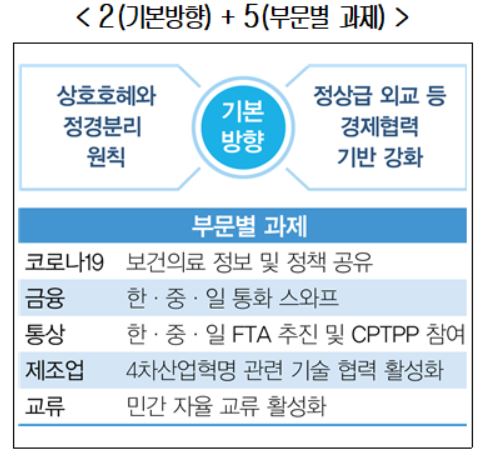
The Basic Direction Should Uphold Mutual Benefit and the Principle of Separating Politics and Economics
The report argued that to prevent weakening economic cooperation among the three countries, Korea, China, and Japan must adhere to the principles of mutual benefit and separation of politics and economics. The three countries are very important economic partners and inseparable neighbors, accounting for about 20% of the world's gross domestic product (GDP) and trade, thus holding significant economic weight. The report pointed out that the fundamental premise of economic cooperation should be to prevent political, diplomatic, and military issues such as historical recognition or territorial disputes from adversely affecting economic relations among the three countries.
The report also emphasized that efforts to strengthen the foundation of Korea-China-Japan economic cooperation should be a basic direction. Above all, it is necessary to steadily promote the Korea-China-Japan summit meetings to evaluate economic cooperation achievements among the three countries and reach comprehensive agreements on implementation plans. Based on this, existing sectoral consultative bodies?more than 60 in areas such as regional affairs, trade, and energy?should be strengthened.
Expand Cooperation Such as Joint Vaccine Procurement to Overcome COVID-19
Biden particularly emphasized unity to overcome COVID-19 in his victory speech. As the demand for sharing information and policies in the health sector related to managing infectious diseases like COVID-19 has increased among Korea, China, and Japan, cooperation in healthcare is important. The report proposed as sectoral tasks strengthening fast-track cooperation for preventing the spread of COVID-19 and human mobility, as well as seeking cooperation to secure stability in joint vaccine procurement and pharmaceuticals.
Furthermore, as the non-face-to-face economy rapidly expands due to the COVID-19 crisis, a sharp growth in e-commerce is expected. The report predicted that cooperation possibilities are higher in new industries or service sectors than in traditional manufacturing sectors, due to narrowing technological gaps and increasing similarity in export structures among the three countries. Facing the need to strengthen competitiveness in the service industry, all three countries should activate discussions and seek cooperation measures for service sector liberalization and development.
Korea-China-Japan Currency Swap to Resolve Exchange Rate Uncertainty
The report identified currency cooperation among Korea, China, and Japan as an economic cooperation task. Although global economic uncertainty has eased with Biden’s election, it is expected that the Korean won will relatively strengthen due to the Biden administration’s expansive monetary and fiscal policies, and the current account deficit may persist for a considerable period. Additionally, a financial safety net must be prepared to respond to unforeseen crises like COVID-19.
Korea and China have signed a currency swap agreement worth $59 billion over five years, but the currency swap between Korea and Japan has not reached a new agreement after the previous contract was suspended. Although the Chiang Mai Initiative Multilateralization (CMIM) amendment has enabled ASEAN+3 (Korea, China, Japan) to work on stabilizing regional financial markets, Korea can only withdraw up to its contribution amount, so alternatives to supplement this are necessary.
Recovery of Multilateralism and Maintaining a Tough Stance on China
Regarding trade, the report suggested promoting a Korea-China-Japan FTA or additional participation in the CPTPP. The Biden administration is expected to pursue trade policies based on multilateralism while maintaining a tough stance on China. While defending existing systems such as the World Trade Organization (WTO), if the U.S. returns to the CPTPP, China’s influence over Regional Comprehensive Economic Partnership (RCEP) member countries may be limited, and Korea’s strategic position could become difficult.
Therefore, it is necessary for all three countries to minimize positioning risks through trilateral or bilateral FTAs mediated by RCEP. Moreover, the report emphasized that Korea, which pursues an outward-oriented economy, should consider joining the CPTPP.
Green New Deal Cooperation and Activation of Private Autonomous Exchanges Are Also Necessary
The Biden administration, which pledged to rejoin the Paris Climate Agreement within 77 days, is expected to make eco-friendly infrastructure and the energy industry key investment sectors for securing new growth engines and economic stimulus. Korea, China, and Japan, which also advocate green new deal and eco-friendly policies, need to explore areas of mutual competition and cooperation in line with Biden’s green policies.
In particular, although the three countries are each promoting important policies centered on Fourth Industrial Revolution technologies, trilateral cooperation in this field has not been active so far, making it a promising area for future collaboration. The report also anticipated that Fourth Industrial Revolution technologies could be sufficiently utilized in the eco-friendly industry sector, enabling Korea-China-Japan cooperation to generate synergy effects.
Activating autonomous exchanges led by the private sector, including companies, can provide a foundation that leads to strengthening the competitiveness of companies in Korea, China, and Japan. While actively promoting existing corporate exchanges such as the Korea-China-Japan Business Summit hosted by KCCI, policy-level considerations are needed to revitalize exchanges among private representative organizations in each country.
Recently, cultural content industry exchanges among Korea, China, and Japan, including the Korean Wave (Hallyu), have explosively grown, requiring comprehensive cooperation in areas such as investment and copyright protection. The report emphasized that in preparation for increased demand in the U.S. market due to Biden administration policies and the rapid recovery of global human and material exchanges after the end of COVID-19, responses in the logistics industry should start from private exchanges.
Woo Tae-hee, standing vice chairman of KCCI, said, "It is clear that Korea-China-Japan economic cooperation has entered a new phase with the conclusion of RCEP, and overcoming COVID-19 should be made a starting point for economic cooperation among the three countries." He added, "With the launch of the Biden administration, we hope that our government and companies will lead the revival of free trade and multilateralism and play a linchpin role in overcoming the global economic crisis."
© The Asia Business Daily(www.asiae.co.kr). All rights reserved.

















