COVID-19 Still Spreading Since February This Year
Depression Like COVID 'Blue' Followed by Economic Recession
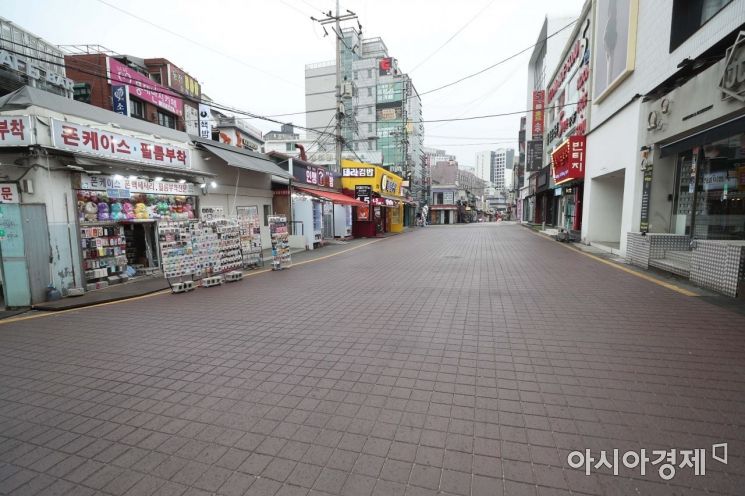 On the 10th, the streets of Hongdae in Mapo-gu, Seoul, are deserted. As of midnight on the same day, the Central Disaster and Safety Countermeasures Headquarters reported 682 new confirmed cases of COVID-19 in the country, bringing the total to 40,098. Photo by Moon Honam munonam@
[Asia Economy Reporter Han Seung-gon] "Since I'm working from home, I have no interaction with my colleagues," and "It's so hard. Business is really bad."
The novel coronavirus (COVID-19) infection that began in February this year continues to spread rapidly even today (the 10th), several months later. According to the quarantine authorities, 682 new confirmed cases were reported as of this date. The number of critically ill patients and deaths has also surged. On this day alone, the number of severe or critical patients whose condition worsened due to COVID-19 soared to 23, and there were 8 deaths recorded.
Across society, people are experiencing another illness caused by COVID-19: 'depression' and 'anger.' According to a survey conducted by the Seoul National University Graduate School of Public Health from August 25 to 28 targeting 2,000 people nationwide aged 18 and over, the proportion of respondents who answered "anger" to the question "What emotion do you feel most strongly from COVID-19 news?" increased more than twofold from 11.5% in the first week of August to 25.3%, and those who answered "fear" rose from 5.4% to 15.2%.
Kim, a company employee in his 30s, said, "I think I've developed a bit of impatience since COVID-19. I wash my hands more than others, which is good in terms of following quarantine rules, but I wonder if it's an obsession in a bad way." He added, "Because of this, when I see people not wearing masks, I feel a surge of anger inside," and lamented, "It seems like the leisure in daily life has disappeared."
Also, the number of adolescents expressing anxiety due to COVID-19 is increasing. According to a survey released by the Korea Youth Counseling & Welfare Institute in May, 59.8% of 92 youths aged 9 to 24 reported feeling anxiety, worry, or fear after the spread of COVID-19.
72% of respondents cited "not being able to meet friends" as a stress factor caused by COVID-19, followed by ▲online school openings (64.6%) ▲disruption of daily rhythm (64.6%) ▲the frustration of having to stay at home due to refraining from going out (62.2%).
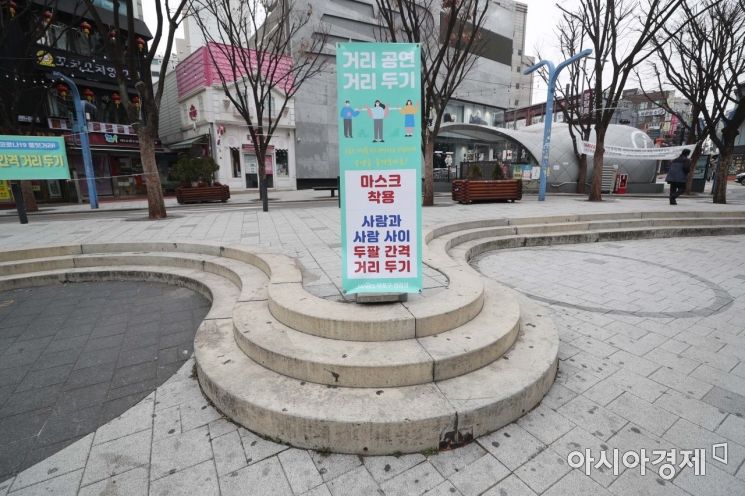 On the 10th, the busking stage in Hongdae, Mapo-gu, Seoul, was quiet. As of midnight on the same day, the Central Disease Control Headquarters announced that the number of new confirmed cases of COVID-19 in the country increased by 682, bringing the total to 40,098. Photo by Moon Honam munonam@
COVID-19 threatens not only health but also shakes the economy. The estimated annual economic loss in South Korea due to the COVID-19 shock amounts to 67.2 trillion KRW in gross domestic product (GDP) and 678,000 jobs.
According to the "Economic Impact and Implications of the COVID-19 Shock by Sector" report released by Hyundai Research Institute in August, assuming the economic shock from COVID-19 continues through the first and second quarters, if South Korea's economic growth rate records -0.5% this year, the economic damage is expected to be a nominal GDP loss of 67.2 trillion KRW and a decrease of 678,000 jobs compared to the normal growth path.
Additionally, according to the Bank of Korea, as the spread of COVID-19 intensified, the domestic demand sector began to slump first, and with a one-quarter lag, the export sector entered a recession phase. The domestic demand growth rate in the second quarter was only -0.6%, but the growth rate of goods and services exports plunged sharply to -13.6%.
Jobs were found to be most difficult for the youth. According to Statistics Korea as of July, the employment rate of the elderly (60 years and older) rose by 0.9 percentage points to 43.8% compared to the same period last year. During the same period, the employment rate of the middle-aged group (30-59 years) fell by 1.3 percentage points, and the youth group (15-29 years) also decreased by 1.4 percentage points.
The institute emphasized, "The essence of the COVID-19 economic shock is the psychological anxiety of economic agents about the epidemic," and stressed, "From an economic perspective, quarantine is even more important."
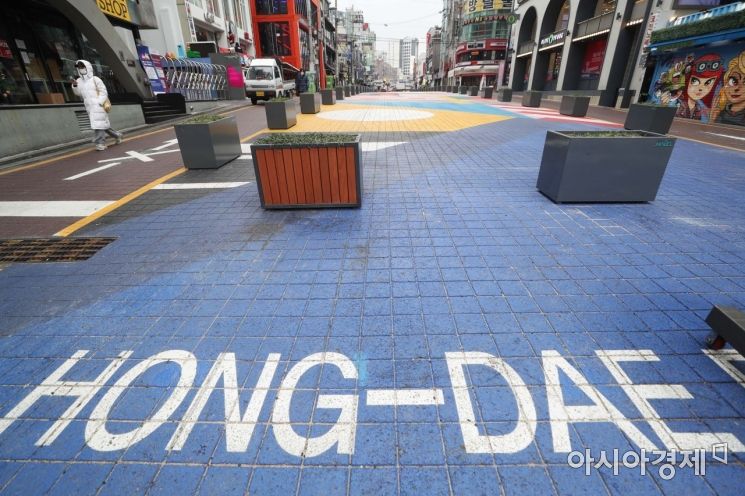 On the 10th, the streets of Hongdae in Mapo-gu, Seoul, were deserted. As of midnight on the same day, the Central Disaster and Safety Countermeasures Headquarters reported 682 new confirmed cases of COVID-19 in the country, bringing the total to 40,098. Photo by Moon Honam munonam@
Self-employed people unanimously pleaded for COVID-19 to end as soon as possible. Lee, a self-employed person in his 40s running a general store near Myeongdong, Jung-gu, Seoul, said, "It's a difficult time not only for people like us (self-employed) but for everyone," and lamented, "I just want to go back to before COVID-19. I hope this situation passes quickly, whether a vaccine or something else comes out." He added, "It will be tough, but I hope everyone stays strong."
Park, a restaurant owner in his 40s, said, "At the end of the year, even if I was tired, I was happy because of the income, but not now," and said, "I'm just waiting for customers to come." He lamented, "Revenue is decreasing, rent keeps going out, and it's hard to hold on."
Office workers also sighed. Lee, a company employee in his 40s working in sales, said, "Transactions with clients have decreased a lot. The company is maintaining itself with basic transactions, but I don't know when this (relationship with clients) will end."
Meanwhile, the average daily number of domestic (local) COVID-19 confirmed cases in South Korea over the past week was 601.7.
The Korea Disease Control and Prevention Agency announced on the 10th at midnight that the cumulative number of domestic COVID-19 confirmed cases was 40,098. Imported cases numbered 4,825. On this day, 646 new cases were domestic, and 36 were imported. The number of new confirmed cases from the 4th to the 10th was 600 → 559 → 599 → 580 → 566 → 662 → 646.
The government repeatedly urged individuals to comply with quarantine rules and emphasized once again the seriousness of the COVID-19 situation. Park Neung-hoo, the first deputy head of the Central Disaster and Safety Countermeasures Headquarters (and Minister of Health and Welfare), stated on the 10th regarding the spread of COVID-19 in South Korea, "It is a precarious situation where the capacity of quarantine and medical systems may soon reach their limits."
Park also said, "The risk of infection is very high in all aspects of daily life, and it is difficult to guarantee that there are no undisclosed confirmed cases or infection clusters around us," and urged, "Until vaccination begins, please practice mask-wearing as a daily habit, thorough social distancing, and getting tested."
© The Asia Business Daily(www.asiae.co.kr). All rights reserved.
![Clutching a Stolen Dior Bag, Saying "I Hate Being Poor but Real"... The Grotesque Con of a "Human Knockoff" [Slate]](https://cwcontent.asiae.co.kr/asiaresize/183/2026021902243444107_1771435474.jpg)













