'Direct Hit from COVID-19' Billiard Halls, Karaoke Rooms, and PC Rooms: Over 5,000 Closures in 7 Months
Industries Requiring Close Contact Close Faster... Popular Startup Sectors Also Shut Due to COVID-19
KB Financial Group Research Institute's 'COVID-19 and Self-Employment Prospects' Report
Closure Rate Expected to Accelerate in Second Half
Considering 2nd and 3rd Waves, Surge in Closures Unavoidable
[Asia Economy Reporter Park Sun-mi] "We assist with the closure and demolition of indoor golf practice ranges." "We will help expedite various paperwork and approvals so that small business owners can receive 2 million KRW in demolition support funds for closed stores." "We also provide one-stop solutions for used product and waste disposal." These are online advertisements from demolition specialists experiencing an unexpected boom amid a surge in self-employed business closures due to the third wave of the novel coronavirus infection (COVID-19). The ad copy targets indoor golf practice ranges, which are seeing a wave of closures. This highlights the stark contrast in fortunes among industries divided by the COVID-19 outbreak.
Due to the spread of COVID-19, closures are rapidly increasing in general consumer and leisure sectors where contact with customers is unavoidable. In particular, billiard halls, karaoke rooms, and PC bangs have seen over 5,000 closures from the start of this year through July. Since these figures were compiled before the second (August) and third (December) waves of COVID-19 and considering the strengthened social distancing measures, the pace of closures in the second half of the year is estimated to have accelerated further.
Conversely, hygiene and health-related sectors and consumer industries utilizing non-face-to-face methods have greatly benefited from COVID-19. Experts predict that as more industries are unable to operate until the end of the year due to the application of social distancing level 2.5 in the Seoul metropolitan area, the gap in fortunes between industries and business types will widen further.

PC Bang Closure Rate Exceeds 10%
Billiard Halls, Golf Practice Ranges, Karaoke Rooms Also See 3-4 Times More Closures Than Openings
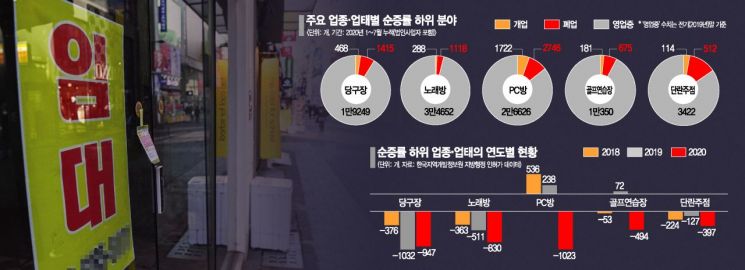
◆Decline in Self-Employment... "Greater Impact Expected During 2nd and 3rd Waves"=According to the 'COVID-19 and Self-Employment Prospects' report by KB Financial Management Research Institute on the 9th, from January to July this year, industries and business types where closures exceeded openings due to the impact of COVID-19 include PC bangs, billiard halls, golf practice ranges, karaoke rooms, barbershops, bathhouses, and entertainment bars. In particular, PC bangs had a closure rate exceeding 10%, and billiard halls, golf practice ranges, and karaoke rooms recorded 3 to 4 times more closures than openings, classifying them as industries heavily impacted by COVID-19.
During this period, PC bangs reported 1,722 new openings but 2,746 closures. Billiard halls closed 1,415 locations, three times the 468 openings, karaoke rooms closed 1,118, about four times the 288 openings, and entertainment bars recorded 512 closures, nearly five times the 114 openings.
Golf practice ranges, once considered a rising startup sector due to the increasing young golf population, also felt the impact of COVID-19. Over the past seven months, 675 locations closed, more than three times the 181 openings. Industries such as door-to-door sales, general game rooms, and domestic and international travel-related sectors, which had seen an increase in startups until last year, faced similar situations.
The issue is that these statistics reflect data before the second and third waves of COVID-19.
This raises concerns that closures in the second half of the year may surge compared to the first half. Kim Dong-woo, a research fellow at KB Financial Management Research Institute, stated, "With the third wave of COVID-19 emerging after November, the number of closures in industries already affected by COVID-19 is expected to increase further," adding, "The gap in fortunes between industries will become even more pronounced."

Emergence of Beneficiary Industries
Disinfection Industry Sees 1,711 Openings from January to July... Ten Times More Than Closures
Telecommunication Sales Also Booms Due to Expansion of Non-Face-to-Face Consumption
◆COVID-19 Boom... Disinfection and Health Supplement Sales Thrive=Despite the decline in self-employment, some industries are experiencing a boom. Telecommunication sales, medical device sales, leasing, waste disposal, disinfection, and health functional food sales are representative beneficiary industries of COVID-19.
In particular, disinfection and health functional food sales had stagnated or even declined in the number of business operators until last year but saw a significant increase in openings after the COVID-19 outbreak. The disinfection industry recorded 1,711 openings from January to July this year, which is ten times the 169 closures. This means that over the past seven months, more than a quarter of the total 6,752 operating businesses opened.
Industries such as environmental specialized construction, video production, waste disposal, campgrounds, and cultural arts planning also saw openings outnumber closures. Additionally, telecommunication sales, boosted by the expansion of non-face-to-face consumption, opened 107,823 businesses during the same period, far exceeding the 5,965 closures. With growing public interest in health, the health functional food sales sector also opened nearly 15,000 stores. Among health functional food sales, telecommunication sales business operators increased significantly after the COVID-19 outbreak, while door-to-door and multi-level marketing operators either declined or showed only slight increases.
Research fellow Kim explained, "Even within similar industries, the impact of COVID-19 shows clear differences depending on whether the business is non-face-to-face," adding, "For example, within the restaurant sector, the number of operators in delivery-focused chicken and pub businesses has greatly increased, whereas those in dine-in focused Japanese, meat, and sashimi restaurants have significantly decreased, which is evidence of this."
© The Asia Business Daily(www.asiae.co.kr). All rights reserved.



















