Tax Revenue 253.8 Trillion Won, Down 6.7 Trillion Won YoY
Fiscal Management Deficit Scale 90.6 Trillion Won
[Asia Economy Reporter Kwangho Lee] The national debt is swelling like a snowball. After surpassing 800 trillion won in September, it jumped to 813 trillion won in October. Due to the decrease in tax revenue caused by the novel coronavirus disease (COVID-19) and the 'super budget' combined, the national debt is expected to approach 1,000 trillion won by the end of next year. Experts are expressing concerns that the situation may become unbearable with our current capabilities. The fiscal situation is reaching what is called a 'tipping point.'
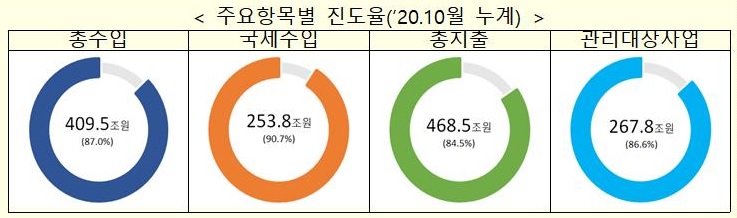
According to the 'Monthly Fiscal Trends December Issue' published by the Ministry of Economy and Finance on the 8th, the government's total revenue until October was 409.5 trillion won, an increase of 3.3 trillion won compared to the previous year. This was due to a 1.7 percentage point rise in the progress rate, with fund income increasing by 8.6 trillion won.
Tax revenue was 253.8 trillion won, down by 6.7 trillion won. Corporate tax decreased by 16.1 trillion won compared to the same period last year due to a decline in operating profits caused by the economic downturn from the COVID-19 crisis. Value-added tax and customs duties also decreased by 3.3 trillion won and 100 million won, respectively. On the other hand, income tax increased by 8.5 trillion won due to early completion of wage and child tax credit payments and increases in comprehensive income tax and earned income tax compared to the previous year.
Although government revenue decreased, expenditures increased significantly. Total expenditures until October were 468.5 trillion won, an increase of 50.9 trillion won compared to the same period last year. This was due to the execution of the 4th supplementary budget, including new hope funds for small business owners to overcome COVID-19, care and learning support funds, mobile communication fee support, job-seeking benefits, and employment retention subsidies.
Accordingly, the integrated fiscal balance recorded a deficit of 59 trillion won. During the same period, the management fiscal balance deficit, excluding various social insurances from the integrated fiscal balance, increased to 90.6 trillion won.
As a result, as of the end of October, the national debt stood at 812.9 trillion won, an increase of 12.6 trillion won from the previous month. This is an all-time high.
Among the 30.93 trillion won of early execution management target projects by central ministries and public institutions this year, 26.78 trillion won (86.6% of the annual plan) was executed by the end of October.
A Ministry of Economy and Finance official stated, "The fiscal balance and national debt are progressing according to the usual trend, and will be managed based on the 4th supplementary budget by the end of the year (management fiscal balance -118.6 trillion won, national debt 846.9 trillion won)."

© The Asia Business Daily(www.asiae.co.kr). All rights reserved.


















