Used Plastic Waste Requires Written Consent from Importing Country for Movement
Domestic Law Revised to Align with Basel Convention on Export-Import Permits and Reporting Items
"Related Industries Must Be Careful to Avoid International Conflicts"
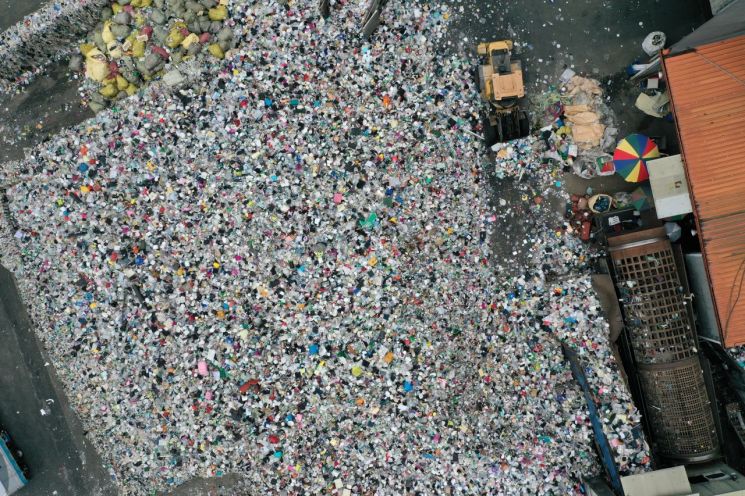
[Asia Economy Reporter Kim Bo-kyung] The Basel Convention amendment, which adds all plastic waste to the list of controlled waste for export and import, will take effect from January next year.
The Ministry of Environment announced on the 8th that the Basel Convention amendment adopted at the '14th Conference of the Parties to the Basel Convention' last May will come into force on January 1st next year.
The Basel Convention is an international agreement aimed at preventing illegal trade of hazardous waste and other wastes between countries. It came into effect in 1992 and has been ratified by 188 countries, including South Korea.
According to the amendment, plastic waste composed of a single material (a total of 17 types) or plastic waste mixed with only three types such as PET, polyethylene (PE), and polypropylene (PP) are excluded from the export-import control list.
All other plastic waste falls under controlled waste. Even if composed of a single material such as PET, if contaminated with hazardous substances or containing harmful materials like lead, arsenic, or mercury, it is included in the controlled waste category.
Under the Basel Convention, controlled waste can only be moved between countries with prior written consent from the importing country. Those who import or process the waste must notify the exporter and the exporting country of the receipt or processing results of the waste.
Domestically, controlled waste is managed as export-import permit items (regulated export-import waste) under the 'Act on the Transboundary Movement of Waste and Its Disposal.' Other waste is classified as export-import declaration items, so the domestic export-import permit and declaration items will also be revised in accordance with the amended Basel Convention.
For controlled waste departing from the exporting country after the effective date of the amended Basel Convention on January 1, 2021, it will be subject to export-import permit items under domestic law, and the corresponding export-import permits must be obtained.
Meanwhile, the Ministry of Environment banned the import of four items?PET, polyethylene (PE), polypropylene (PP), and polystyrene (PS)?in June to promote recycling of domestic waste. Regardless of the Basel Convention amendment, the import of these items remains prohibited domestically.
Hong Dong-gon, Director of the Resource Circulation Policy Division at the Ministry of Environment, said, "Related industries should be careful not to cause unnecessary conflicts with other countries during the initial implementation of the Basel Convention amendment," and added, "We will continue to strengthen domestic export-import management to ensure the purpose of the Basel Convention in preventing illegal plastic waste export and import is upheld."
© The Asia Business Daily(www.asiae.co.kr). All rights reserved.
![Clutching a Stolen Dior Bag, Saying "I Hate Being Poor but Real"... The Grotesque Con of a "Human Knockoff" [Slate]](https://cwcontent.asiae.co.kr/asiaresize/183/2026021902243444107_1771435474.jpg)
















