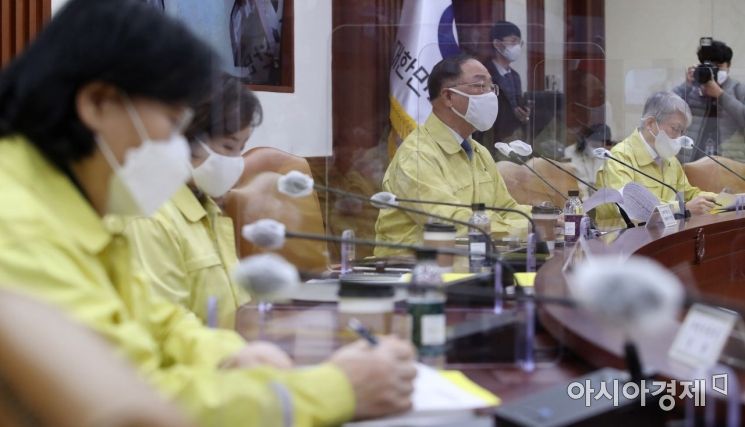
 Hong Nam-ki, Deputy Prime Minister and Minister of Economy and Finance, is delivering opening remarks at the "22nd Emergency Economic Central Countermeasures Headquarters Meeting" held on the 7th at the Government Seoul Office in Jongno-gu, Seoul. Photo by Kang Jin-hyung aymsdream@
[Sejong=Asia Economy Reporters Kim Hyun-jung and Joo Sang-don] The government plans to introduce a de facto 'carbon tax' to reduce greenhouse gas emissions and use the revenue to establish a 'Climate Response Fund (tentative name).' The fund will be used not only for carbon-neutral investments and expenditures but also to support industries, regions, and workers affected by a just transition. To review the carbon tax rate and other pricing mechanisms such as charges and emissions trading systems, the government intends to start related research projects next year.
On the morning of the 7th, the government announced the '2050 Carbon Neutrality Promotion Strategy' at the Seoul Government Complex, expressing its intention to actively rebuild the carbon pricing system through the introduction of a de facto carbon tax. The government unveiled the '3+1 strategy' for achieving carbon neutrality, which includes ▲decarbonizing the economic structure ▲creating a low-carbon industrial ecosystem ▲a just transition to a carbon-neutral society, and ▲strengthening the institutional foundation for carbon neutrality. Hong Nam-ki, Deputy Prime Minister and Minister of Economy and Finance, emphasized at a joint government briefing, "The transition to a sustainable economy through carbon neutrality is a global and timely trend," adding, "It is no longer a choice but a necessity for us, and bold proactive responses are preferable to mere situational adaptation for national interests and future generations."
The government decided to take a 'proactive response' by establishing new economic and social development strategies, as major advanced countries are expanding investments to seize new markets arising from climate change. The U.S. and Europe, which are accelerating carbon neutrality, have energy-intensive industries accounting for only 3.7% and 5.0%, respectively, whereas South Korea's share is significantly higher at 8.4%. In terms of energy source composition, South Korea's coal power generation accounts for 40.3%, which is higher than the U.S. at 24%, Japan at 32%, and Germany at 30%.
However, the government assessed that carbon neutrality implementation could impose a significant burden on companies and citizens, considering that South Korea has a relatively short period of 32 years from the peak of greenhouse gas emissions to carbon neutrality compared to other countries, and the industrial structure has a high proportion of manufacturing and carbon-intensive sectors.
To address this, the government will improve fiscal systems to operate mechanisms that suppress carbon emissions during revenue and expenditure processes. The core is the establishment of the Climate Response Fund, with related ministries first discussing the consolidation of existing special accounts and funds of similar nature, securing stable revenue sources for the fund, and preparing detailed operational plans.
Through research projects, the government will comprehensively review tax systems, charges, and emissions trading systems that can price carbon and reconstruct the carbon pricing system. In the mid-to-long term, it will also promote the introduction of fiscal systems that consider the environmental and economic value of carbon, such as the carbon-aware budgeting system, which evaluates the impact of government projects on carbon reduction and reflects the results in budget and settlement documents.
Additional secured resources will be increasingly allocated to investments in carbon neutrality and support for industries, regions, and workers affected during the carbon-neutral transition. From next year, budgets and tax support related to carbon neutrality will also be strengthened. This points to the likely introduction of a de facto 'carbon tax.' Earlier, during the National Assembly's budget review for next year, related project budgets such as energy transition support and carbon reduction technology development were increased by about 300 billion KRW. Furthermore, tax benefits will be provided to corporate activities contributing to carbon neutrality goals to encourage voluntary carbon emission reduction efforts by companies.
The government will also increase policy finance support to foster the green sector. It set a target to expand the share of green sector funding by policy financial institutions from the current 6.5% to about 13% by 2030, doubling the current level. Using a 20 trillion KRW policy-type New Deal Fund as seed money, it plans to strengthen the leading roles of key institutions to induce the expansion of green investments from market funds.
To support companies' transition to a low-carbon industrial structure, the government will continuously utilize support programs for green transition companies such as 'RE100' (Renewable Energy 100, a global campaign where companies commit to using 100% renewable energy for their electricity needs).
To prevent the insolvency of companies unable to adapt during the transition from spreading to the real economy, the government will support restructuring through the expansion of the Corporate Structural Innovation Fund.
To establish criteria for green finance judgments, the government will develop a green taxonomy and gradually strengthen disclosure obligations to ensure broad disclosure of companies' environmental information. It will also intensively support the development of core technologies for carbon neutrality, such as carbon capture, utilization, and storage (CCUS) technology and energy efficiency. For CCUS technology, a phased development roadmap will be established based on the possibility of industrial application by 2030, covering commercialized technologies and next-generation source technologies. The direction and outcomes of research and development (R&D) in core technology fields will be managed through the 'Carbon Neutrality R&D Special Committee' under the National Science and Technology Advisory Council.
Meanwhile, related policy tasks will be primarily discussed and gradually implemented by the '2050 Carbon Neutrality Committee,' established as a presidential advisory body.
© The Asia Business Daily(www.asiae.co.kr). All rights reserved.
![User Who Sold Erroneously Deposited Bitcoins to Repay Debt and Fund Entertainment... What Did the Supreme Court Decide in 2021? [Legal Issue Check]](https://cwcontent.asiae.co.kr/asiaresize/183/2026020910431234020_1770601391.png)
















