Redevelopment of 27,000㎡ Including Jjokbangchon and Railroad Site
1,400 Housing Units Including Public Rental Housing to Be Built
Support for Jjokbangchon Residents' Resettlement
Promotion of 'Prior Relocation, Good Circulation' Method
Urban Regeneration New Deal for Revitalizing Daejeon Station Old Downtown Area Also Promoted
Expected Synergy with Revitalization Projects Including Innovation City and Baseball Stadium Reconstruction
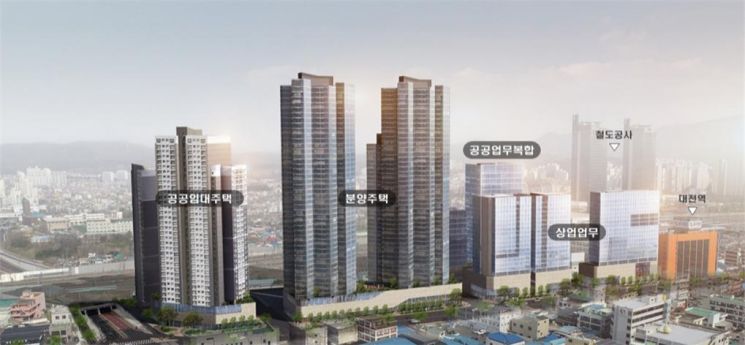 Public Housing Project Rendering of Daejeon Station Shantytown (Provided by Ministry of Land, Infrastructure and Transport)
[Asia Economy Reporter Lee Chun-hee] A public housing project to transform the aging downtown area around Daejeon Station into a residential, commercial, and welfare town is set to be actively promoted. On the site where the shantytown was completely demolished, 1,400 housing units including public rental housing and mixed-use office land will be developed, and the surrounding old downtown area will also see environmental improvements through an urban regeneration New Deal project.
The Ministry of Land, Infrastructure and Transport, Daejeon City, and Dong-gu District Office of Daejeon announced on the 6th that the Daejeon Station shantytown public housing project will be officially designated as a public housing district on the 7th following the completion of the Central Urban Planning Committee review. This project involves redeveloping approximately 27,000㎡ near Daejeon Station in Dong-gu, Daejeon, to supply 1,400 housing units including public housing.
According to the Ministry of Land, Infrastructure and Transport, about 170 residents currently live in 119 shanty rooms across 62 buildings in the Daejeon Station shantytown area, paying monthly rents in the 100,000 KRW range. Most residents belong to vulnerable groups such as basic livelihood security recipients (63 people, 37.5%), elderly living alone aged 65 or older (50 people, 29.8%), lower-income groups (17 people, 10.1%), and persons with disabilities (24 people, 14.3%), relying on welfare benefits for their livelihood. Moreover, the housing conditions fall below the minimum housing standards, with kitchens and bathrooms smaller than 6.6㎡ and inadequately equipped. Additionally, insulation and heating/cooling are insufficient, and residents are constantly exposed to risks such as fire and crime.
This project is a follow-up measure to the "Daejeon Station Shantytown Urban Regeneration Plan" jointly announced last April by the Ministry of Land, Infrastructure and Transport, Daejeon City, and Dong-gu District Office. After public viewing by residents, consultations with related agencies, and disaster impact assessments, the project passed the Central Urban Planning Committee review and is now on track.
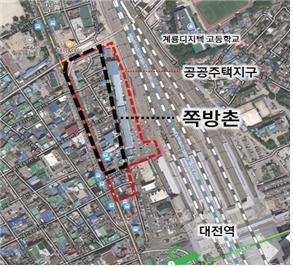 Location map of Daejeon Station slum area (Provided by Ministry of Land, Infrastructure and Transport)
This redevelopment project will cover not only the current 15,495㎡ shantytown area but also approximately 12,000㎡ of adjacent railway land, totaling about 27,000㎡. It is a public housing project jointly implemented by Dong-gu District Office, LH (Korea Land & Housing Corporation), and Daejeon Urban Corporation.
The plan envisions a complex including not only residential units but also commercial facilities and officetels. It will supply 700 public rental housing units, including 250 permanent rental homes for shantytown residents and 450 "Daejeon Dream Town" happy housing units for young adults, as well as 700 sale housing units for building owners and residents within the district, totaling 1,400 housing units.
The 250 permanent rental homes for shantytown residents will be about 16㎡ in size and offered at an affordable monthly rent of approximately 31,000 KRW. This capacity is sufficient to accommodate all current residents of the shantytown. Additionally, within the housing complex where shantytown residents will resettle, a living support center will operate to provide psychological counseling, vocational training, and self-sufficiency support to ensure successful resettlement. Care facilities such as "Bethel House," which has provided free meals and medical care to residents, will also be relocated to the complex.
Social welfare facilities and a public library, among other social overhead capital (SOC), will be established to improve the welfare of local residents. To prevent commercial displacement (gentrification) within the project area, LH will operate "Hope Shops," commercial buildings rented at below 80% of the local market rent to youth and small business owners living in LH rental housing. More than 40 such shops will be created in the Daejeon Station project.
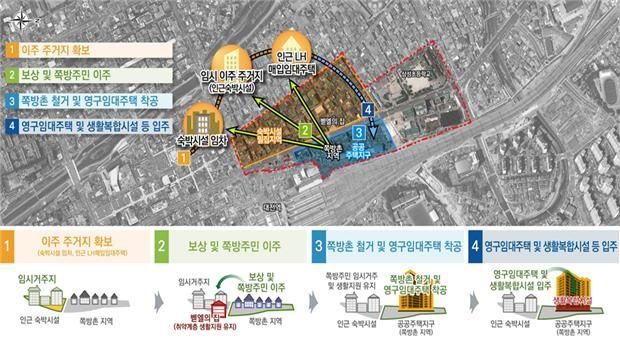 Conceptual Diagram of Early Relocation and Virtuous Cycle for Public Housing Project to Improve Residential Environment and Urban Maintenance in Daejeon Station Shantytown (Provided by Ministry of Land, Infrastructure and Transport)
The Ministry of Land, Infrastructure and Transport plans to proceed with the project using a "prior relocation, virtuous cycle" approach, sequentially providing housing supply. After securing relocation housing for existing residents by renting nearby accommodations, residents will move into permanent rental housing once construction is completed. Welfare services such as care and self-sufficiency support will continue until residents move into the public rental housing.
In addition to redeveloping the shantytown, an urban regeneration New Deal project will be promoted to revitalize the old downtown area around Daejeon Station. Since the opening of the Gyeongbu Line in 1905 and the establishment of Daejeon Station, the old downtown area has developed steadily. However, with the development of new downtown areas such as Dunsan and Wolpyeong-dong in Seo-gu and the construction of Doan New Town, commercial districts have declined, major public facilities have relocated, and the area has lost its central functions, becoming a densely populated area of aging low-rise residences.
Accordingly, Daejeon City and LH plan to promote this project as an urban regeneration initiative aimed at restoring the functions of the original downtown area around Daejeon Station, beyond mere shantytown redevelopment.
To boost economic vitality, anchor facilities such as startup spaces, community plazas, and regional cultural tourism hubs will be created, along with a traditional Korean medicine (Hanbang) specialized street. Specialized spaces for startup companies, including co-working spaces, shared offices, and pop-up stores, will be established. Together with the urban regeneration project field support center, cooperative commercial areas, community platforms, and cultural plazas will be developed to revitalize the local community.
The Hanbang specialized street, home to over 100 related businesses such as clinics, herbal medicine shops, and decoction centers, will feature a regional cultural tourism hub including VR (virtual reality) and AR (augmented reality) tourism experience centers, a Hanbang exhibition hall, and a Hanbang caf?.
Additionally, the project area will link the Daejeon Station tourism resource development project (Ministry of Culture, Sports and Tourism) and urban planning road construction (Daejeon City). A railway industry complex cluster (KORAIL) will be established by consolidating scattered core railway industry facilities, including railway-related companies, research institutes, and subsidiaries of Korea Railroad Corporation (KORAIL). Mixed-use residential-commercial-office land development (by LH) will also be carried out to actively attract private investment.
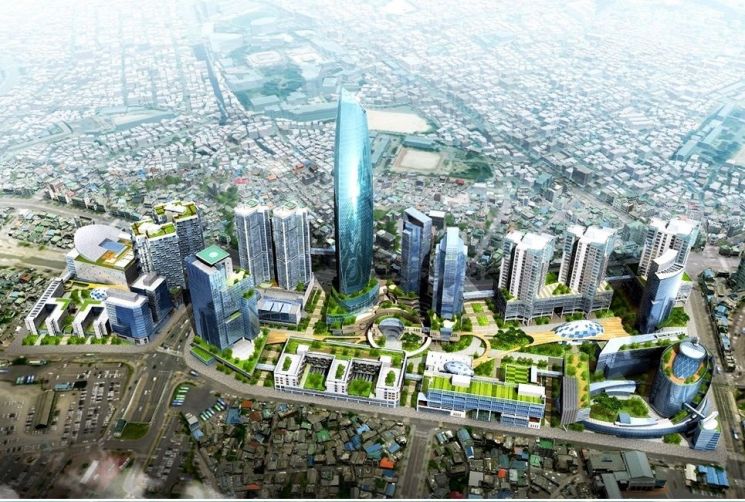
Daejeon City and LH are currently preparing an urban regeneration New Deal project activation plan incorporating these details and plan to finalize it within the year after review. If this project, along with the ongoing Daejeon Innovation City and Daejeon Baseball Dream Park projects, are completed, it is expected to revitalize the long-declining old downtown area of Daejeon.
The Ministry of Land, Infrastructure and Transport plans to hold a design competition and gather residents' opinions next year to establish the district plan, with construction scheduled to begin in 2022. Alongside the district plan, compensation procedures will be conducted through the project implementers to provide fair compensation to landowners, and self-employed business owners within the district will be offered commercial spaces within the public rental housing complex to continue their business activities.
Kim Cheol-gi, Director of the Public Land Development Division at the Ministry of Land, Infrastructure and Transport, said, "Through this project, shantytown residents will be able to live in wider and more comfortable spaces at more affordable rents than their current shantytown rooms, and the long-neglected urban environment will be transformed into a clean and pleasant area."
© The Asia Business Daily(www.asiae.co.kr). All rights reserved.
![Clutching a Stolen Dior Bag, Saying "I Hate Being Poor but Real"... The Grotesque Con of a "Human Knockoff" [Slate]](https://cwcontent.asiae.co.kr/asiaresize/183/2026021902243444107_1771435474.jpg)


















