Former Konkuk University Professor Song Cheolwon, Current Director of the Institute of Contemporary History Records, Publishes Park Jeonghee Series 1 'Introduction to the Park Jeonghee Coup'
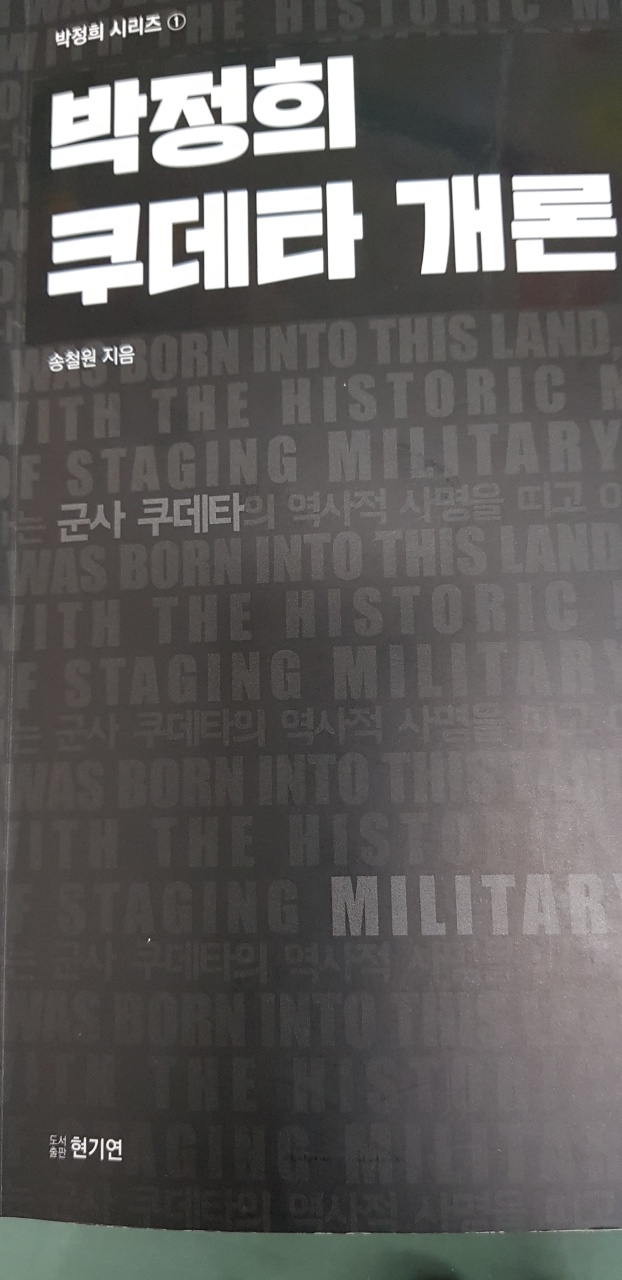
[Asia Economy Reporter Jong-il Park] Song Cheol-won, former professor at Konkuk University and director of the Institute of Modern History Records, has published the Park Chung-hee Series 1, "Introduction to the Park Chung-hee Coup."
Starting from April 30, 2009, when it was first posted on the internet 'Geulbang', after considerable data collection, this book was recently published.
In particular, the author stated that in order to secure objectivity in judgment, he collected and referenced as many materials as possible, and that all referenced materials were footnoted to clearly indicate their sources.
Since last year, he began organizing materials centered on Park Chung-hee and opened a "History Study Room" on August 9, where they regularly gathered to study deeply and review materials for over a year, culminating in the publication of this book.
Song introduced that the History Study Room participants included leader Kim Cheong-sik (Kim In-ho, Secretary General of the Seoul Metropolitan Council), Kim Yoon-gi, Kim Myung-ja, Kim Seung-pil, Kim Eun-jung, Park Sam-gyu, Park Chun-sik, On Hyun-jung, Lee Jeong-yeol, Lim Jin-hee, Jang Young-joo, and Choi Soo-dong.
The book explains that including figures up to Syngman Rhee and Chun Doo-hwan is because Park Chung-hee is at the center and pinnacle of coups in Korea.
Park Chung-hee first learned about coups by participating in an attempt to overthrow Syngman Rhee, and after several coup attempts based on what he learned, he finally succeeded. Chun Doo-hwan also learned from and succeeded Park Chung-hee’s coup, so it is impossible to discuss Korean coups without considering Park Chung-hee separately, the book adds.
In particular, the coup plan to overthrow Syngman Rhee attempted by Park Chung-hee on May 8, 1960, was aborted due to the earlier April 19 Revolution led by students. Another coup plan to incite riots on the first anniversary of the April 19 Revolution in 1961 was also foiled by the students’ calm "silent protest."
Park Chung-hee did not stop there; although the coup plan postponed to May 12, 1961, was halted due to a leak, he ultimately succeeded in the May 16 coup four days later.
Thus, the roots of Park Chung-hee’s coup trace back to Syngman Rhee, the book records.
What about Chun Doo-hwan?
Chun Doo-hwan’s coup was the result of 18 years of observation and learning from Park Chung-hee’s inner circle.
Chun Doo-hwan met Park Chung-hee the day after the May 16, 1961 coup, quickly assessed the situation with sharp thinking, and successfully organized the May 16 coup support protest by cadets at the Korea Military Academy on May 18, becoming a close aide to Park Chung-hee, the book states.
Therefore, the coups staged by Chun Doo-hwan’s new military regime on December 12, 1979, and May 17, 1980, were new Yushin coups that inherited Park Chung-hee’s Yushin coup, the author argues.
Director Song Cheol-won emphasized, “The early period of modern Korean history after liberation was stained by the coup games of Syngman Rhee, Park Chung-hee, and Chun Doo-hwan. The power they enjoyed was not obtained through legitimate means but was extended or born through illegal acts of coups, so they were essentially fake rulers.”
He also wrote, “Since the masters were fake, it was natural that fake subordinates appeared in various fields. A representative example is the fake pastor Choi Tae-min, who played around with Park Chung-hee’s daughter Park Geun-hye during Park’s era. Those who gathered around the power created by this person swarmed like moths and disturbed the world, and the aftermath led to Park Geun-hye’s impeachment.”
Director Song stated, “The original fakes in modern Korean history are pro-Japanese collaborators. They lived in luxury in exchange for selling out the country, and when Japan was defeated and the U.S. military landed, they suddenly changed their appearance, shouting anti-communism and disguising themselves as fake patriots, forming vested interest groups and manipulating our society. Tracing this back to its origin, Park Chung-hee appears again.”
Accordingly, the next book he is preparing is titled "Park Chung-hee and Japan," he explained.
The book is composed of three parts: Part 1 describes Park Chung-hee’s birth and his Japanization process through colonial education under Japanese rule, and the colonial historical perspective ingrained in him; Part 2 narrates the process of Park quitting elementary school teaching, going to Manchuria, transforming into a Japanese soldier, returning to Korea after Japan’s defeat, changing into a Korean soldier, becoming a secret member of the South Korean Workers' Party, and then defecting?four transformations in total.
The final Part 3 provides an overview of Korean coups, examining coups by Syngman Rhee, Park Chung-hee, and Chun Doo-hwan in that order, and especially reviews the downfall process of Park Chung-hee.
Director Song concluded the book introduction by saying, “I only hope that my work containing such content will help to ruthlessly drive out the fakes and create a world where the real ones can flourish.”
© The Asia Business Daily(www.asiae.co.kr). All rights reserved.

















