Passage of Partial Amendment to Customs Act
Patent Fee Reduction... 75 Billion Won This Year
Industry: "Double Taxation, Need to Revise Calculation Method"
Labor Union: "Chaebol Privileges... Prioritize Win-Win Promises"
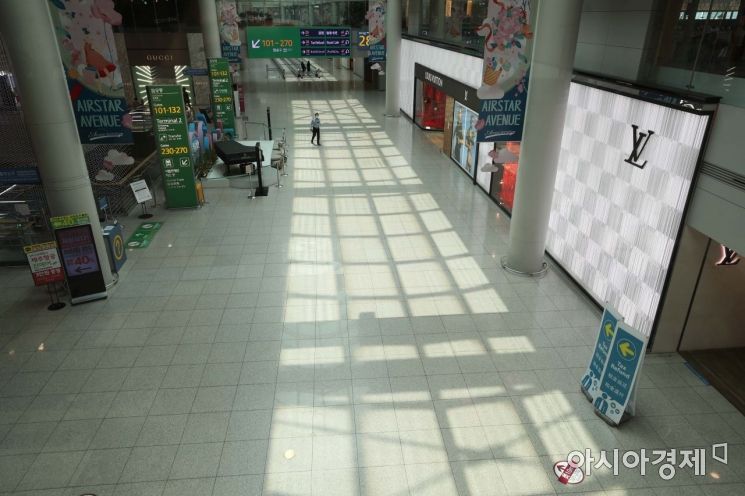 On the 18th, the duty-free shop at Terminal 1 of Incheon International Airport was quiet due to the impact of the novel coronavirus (COVID-19).
 Photo by Mun Ho-nam munonam@
[Asia Economy Reporter Seungjin Lee] The National Assembly passed the 'Partial Amendment to the Customs Act' as originally proposed, allowing the duty-free industry, which was hit hard by the COVID-19 pandemic, to receive partial reductions in patent fees amounting to hundreds of billions of won. However, the duty-free industry still expressed that the measures are "insufficient," drawing attention.
On the 4th, the duty-free industry welcomed the reduction in patent fees. However, since the industry is facing an existential crisis due to the COVID-19 situation, they urged for more proactive measures. They raised their voices for support to develop practical sales channels, such as extending the 'third-party return' system, which is set to end at the end of this month. On the other hand, the duty-free store labor union opposed the measure, stating it is merely a "special privilege for conglomerates without employment stability plans or promises of coexistence with partner companies."
Sighs Despite Patent Fee Reduction Approval
The amendment passed by the National Assembly on the 2nd included a clause allowing for a reduction in patent fees for a certain period if significant business losses occur due to a disaster. Patent fees are imposed by the government on duty-free operators in exchange for granting exclusive rights, for purposes such as administrative and management cost collection and social return of reduced taxes.
The patent fee rate was 0.05% of sales in 2016 but was raised to between 0.1% and 1.0% following the revision of the Customs Act Enforcement Rules in 2017. Last year, the duty-free industry paid patent fees amounting to 102.9 billion won. Although the government recently changed the basis for calculating patent fees from 'customs declaration sales' to 'corporate accounting sales,' reducing the payment scale, about 75 billion won still must be paid this year.
Since April, duty-free store sales had been gradually increasing but sharply declined again after October, heightening the sense of crisis. Sales in October decreased by about 100 billion won compared to the previous month. With the recent surge in COVID-19 cases and tightened regulations by the Chinese government, the number of daigou (informal shoppers) has decreased, and sales in November and December are expected to drop significantly.
Accordingly, the duty-free industry insists that a review of the calculation method is necessary rather than a temporary reduction in patent fees. They argue that paying patent fees to recover profits, while already paying corporate tax on duty-free store profits, constitutes "double taxation."
A duty-free industry official emphasized, "In countries like the United States and Japan, duty-free store patent fees are regarded as a kind of 'stamp tax,' replaced by a certain deposit. Given the industry's nature of competing globally rather than domestically, spending hundreds of billions of won annually in additional costs could lead to weakened industrial competitiveness."
"Government Support Lacks Substance"
Despite the government repeatedly proposing support plans for the duty-free industry, the sector is currently on the brink of collapse. Six duty-free store business rights at Incheon Airport Terminal 1 (T1) failed to attract bids in three rounds, and even recent private contracts fell through. The insistence on the existing fixed rent system, despite a 90% drop in arrivals and departures due to COVID-19, has been a stumbling block.
The duty-free industry argues that, given the uncertainty of when the COVID-19 situation will end, the entire contract period should switch from the existing fixed rent system to a sales-linked rent system, but the gap with the government remains unresolved.
The industry is gradually withering away. City Duty Free and SM Duty Free have given up their Incheon Airport duty-free stores. Lotte and Shilla Duty Free temporarily extended contracts until February next year, but the situation after February is uncertain. Recently, individual brand withdrawals have also continued. Following the exit of food and beverage companies, the overseas luxury brand Montblanc also left Incheon Airport on the 30th of last month.
The duty-free industry insists on the need for practical sales channel development, such as the indefinite extension of the third-party return system, which is temporarily allowed until the end of this year. The third-party return system allows overseas duty-free operators to send duty-free goods, which have completed customs declaration, to desired locations. A duty-free industry official said, "This year, third-party returns raised sales from 10 to 50 billion won, up from 100 billion won, but if this ends next year, we will inevitably be pushed to the brink again."
Patent Fee Reduction Is a Conglomerate Privilege... Coexistence Promises First
On the other hand, the Department Store Duty-Free Store Sales Service Labor Union of the Service Federation expressed regret regarding the patent fee reduction.
The union stated that while it is understandable to reduce patent fees for the duty-free industry hit by COVID-19, if large conglomerates receiving benefits worth hundreds of billions of won only take the benefits without fulfilling social responsibilities, it is merely a privilege for conglomerates.
According to the union, as of December last year, duty-free store workers consisted of about 5,000 workers directly employed by the duty-free stores and 30,000 workers employed by subcontracted partner companies. However, as of October, the number of workers directly employed by duty-free stores dropped to 3,900, and subcontracted partner company workers decreased to 17,895, nearly half the workforce.
The union said, "Conglomerate-owned duty-free stores, as the primary contractors, are neglecting employment stability, delaying applications for employment retention subsidies, and forcing workers into unpaid leave," and urged, "The government and National Assembly must compel large conglomerate duty-free stores to present responsible measures for coexistence with partner companies and employment stability for workers."
© The Asia Business Daily(www.asiae.co.kr). All rights reserved.
![Clutching a Stolen Dior Bag, Saying "I Hate Being Poor but Real"... The Grotesque Con of a "Human Knockoff" [Slate]](https://cwcontent.asiae.co.kr/asiaresize/183/2026021902243444107_1771435474.jpg)
















