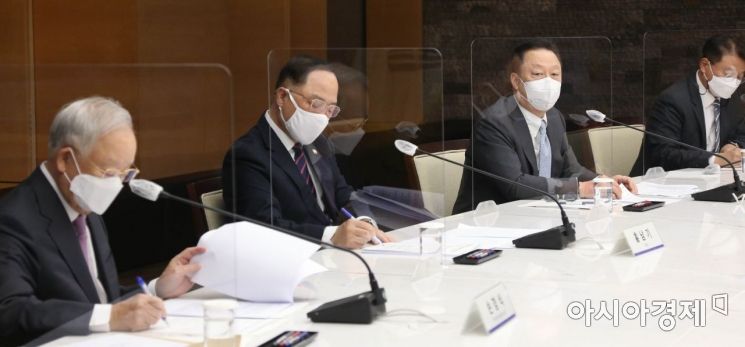
 Park Yong-man, Chairman of the Korea Chamber of Commerce and Industry, economic organization leaders, and the Deputy Prime Minister for Economy held a meeting on the 4th at the Korea Chamber of Commerce and Industry building on Sejong-daero to discuss the '2021 Economic Policy Direction Establishment.' From the left, Sohn Kyung-shik, Chairman of the Korea Employers Federation, Hong Nam-ki, Deputy Prime Minister for Economy, Park Yong-man, Chairman of the Korea Chamber of Commerce and Industry.
[Asia Economy Reporter Changhwan Lee] Park Yong-man, Chairman of the Korea Chamber of Commerce and Industry, recently expressed renewed concerns about several corporate regulatory bills being promoted by the government and ruling party.
At the '2021 Economic Policy Direction Establishment Meeting for Heads of Economic Organizations' held on the 4th at the KCCI Chamber Lounge in Namdaemun, Seoul, Chairman Park said, "It is hard to dispel the impression that various bills restricting corporate activities, such as class-action lawsuits and punitive damages, are being suddenly pushed forward."
He added, "There are actually many negative opinions even among experts about the comprehensive introduction of Anglo-American legal systems, which differ from our legal culture and system. Even when we in the business community raise issues, I am very worried that the authorities might unilaterally push through these bills with the logic that companies should just endure because they have some faults."
He continued, "Rather than concluding solely on the necessity of legislation, I hope that in-depth research and discussions on whether there are better alternatives will precede."
At this meeting chaired by Deputy Prime Minister and Minister of Economy and Finance Hong Nam-ki, Chairman Park also suggested that the effectiveness of financial support for companies should be enhanced.
He said, "Looking at the current situation, financially sound companies are managing without major problems, but for non-prime companies, while the demand for funds is high, there seem to have been hurdles in utilizing the prepared liquidity measures. If liquidity support institutions are extended in the future, it would be good if the system is improved to lower these hurdles and increase utilization by non-prime companies."
He also added, "While short-term liquidity is important now, it seems that companies' demand for funds for business restructuring or reorganization has increased significantly. If there are unused funds among the resources prepared for short-term shocks, I request that measures be taken to support business restructuring and the like."
He emphasized the need to create a future-oriented corporate ecosystem. Chairman Park said, "Looking at startup statistics, compared to major countries, we have a high proportion of livelihood startups, but the ratio of ‘opportunity startups’ based on R&D or technology is significantly lower. I believe that the most important task is to reform the outdated laws and systems created during the developmental era."
He added, "Although discussions on legislative tasks related to the Korean New Deal are underway, the young people I have met say that many business models are still not resolved by New Deal legislation, and in many cases, related bills have not even been proposed yet. Businesses approved under the regulatory sandbox will begin to have their temporary permits expire starting February next year, so it would be good if the government actively supports them through persuading vested interests, proposing bills, and proactive legal interpretations."
© The Asia Business Daily(www.asiae.co.kr). All rights reserved.

















