LH Announces Office-tels in Suwon Jangan-gu
Targeting Middle Class... Suitable for Families of 3-4
Supply Increase Effect Hard to Expect
Concerns Over Outlet for Malignant Unsold Units
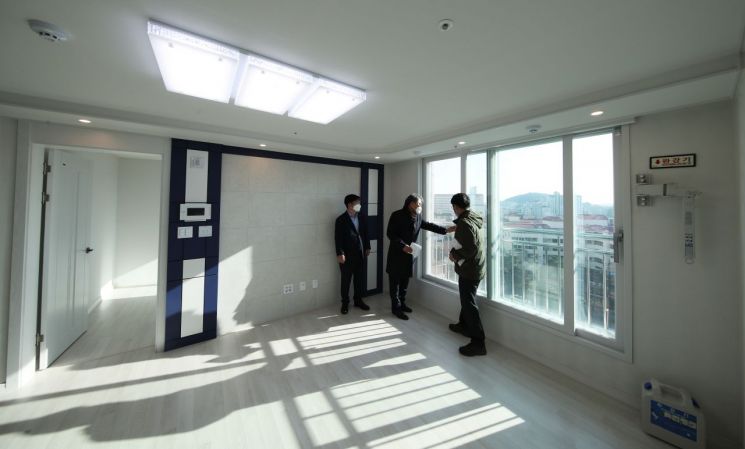 On the afternoon of the 3rd, at the LH public rental housing preview event held in Songjuk-dong, Jangan-gu, Suwon-si, Gyeonggi-do, Seo Chang-won, Head of Housing Welfare Division at Korea Land and Housing Corporation, along with other attendees, are inspecting the interior of the housing.
 [Image source=Yonhap News]
[Asia Economy Reporter Lee Chun-hee] A housing model that can give an idea of the 'public jeonse housing' the government announced it would supply through the November 19th jeonse policy has been revealed.
According to industry sources on the 4th, Korea Land and Housing Corporation (LH) unveiled a similar model of public jeonse housing yesterday in Suwon, Gyeonggi Province. Public jeonse housing is a mid-sized jeonse-type housing model that the government announced it would supply targeting the middle class in the November 19th policy.
The revealed housing is an officetel located near Suwon Sports Complex in Songjuk-dong, Jangan-gu, Suwon City. It is a 9-story building with 48 units, completed in December last year. LH purchased it from the developer in June this year and is currently recruiting prospective tenants. The area ranges from 75 to 81㎡ (exclusive area), similar to a 30-pyeong apartment in general standards. The layout also includes 3 rooms and 2 bathrooms, suitable for a household of 3 to 4 people. However, the rental condition is not jeonse but monthly rent with a deposit. LH plans to rent it to multi-child families with a deposit of 12 million KRW and a monthly rent of about 320,000 KRW.
An LH official explained, "When converted to a jeonse deposit, it would be priced at about 180 million KRW," adding, "This was introduced with the intention of supplying public jeonse housing of a similar scale." Compared to the 61㎡ apartment in 'Suwon Royal Palace' next to the housing, which was leased for 280 million KRW last month, the price is significantly cheaper.
The revealed housing was purchased at the new construction stage, so the interior finishes are clean enough not to require additional remodeling.
The government and LH plan to supply 18,000 units of public jeonse housing nationwide by 2022, similar in form to the Songjuk-dong officetel. This includes 13,000 units in the metropolitan area and 5,000 units in Seoul. In particular, they plan to raise the purchase price per unit of purchase-rental housing, currently up to 300 million KRW (average 120 million KRW), to a maximum of 800 million KRW (average around 600 million KRW) in Seoul, securing mid-sized housing with three or more rooms in high-demand urban areas.
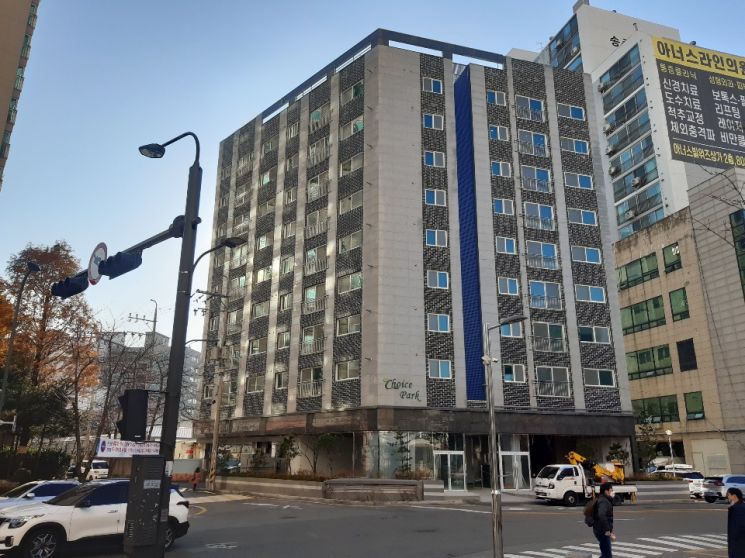 Public rental housing under purchase agreement in Jangan-gu, Suwon-si, Gyeonggi Province, disclosed by LH on the 3rd. The government plans for LH to supply 18,000 units of 'public jeonse housing' with apartment-level quality by 2022. (Provided by LH)
However, experts are skeptical about whether a sufficient supply of mid-sized jeonse housing of similar quality can realistically be provided in desirable locations. Even the Songjuk-dong officetel revealed this time is relatively poor in residential conditions within Suwon city. LH explained that with the extension of the Shinbundang Line in 2027, Suseongjung Intersection Station will be located 700 meters away on foot, but currently, there is no subway station within walking distance, and the surrounding area mostly consists of old residential neighborhoods. Since LH purchased an officetel that was already completed and unsold by a private construction company, it is not a purely new supply.
The government plans to actively increase the purchase agreement method through private construction companies to secure high-quality new housing. This system involves LH agreeing to purchase housing planned or under construction by private developers before completion and buying it at the appraised price after completion. To this end, they plan to provide incentives such as low-interest construction funds at an annual rate of around 1%, priority supply, and additional points when bidding for apartment sites. However, recent purchase agreement cases disclosed by the Ministry of Land, Infrastructure and Transport mostly involve small housing units for 1-2 residents, and except for Seocho-dong in Seocho-gu, Seoul, they are all built in outer areas like Incheon.
There is also concern that purchase-rental housing could become a channel for private construction companies to resolve their chronic unsold inventory. In fact, LH purchased the Songjuk-dong officetel for 13.25 billion KRW, about 276 million KRW per unit. This is similar to the original sale price of 268 million to 280 million KRW at the time of sale. Considering that officetels generally start sales at the construction start stage, industry observers believe this officetel likely remained as chronic unsold inventory until completion.
The representative of A Real Estate Agency (licensed) in Songjuk-dong said, "It was a property that did not receive much response during sales," adding, "I understand that even the single unit that was sold eventually fell through because the jeonse lease did not go through." A nearby B real estate agent also said, "Honestly, the building was not considered well-built by local businesses," adding, "Many potential tenants avoided it due to it being an officetel with mechanical parking and a high sale price."
Lee Eun-hyung, senior researcher at the Korea Construction Policy Research Institute, pointed out, "If the government buys unsold housing and rents it out cheaply as jeonse, there will be a positive response in terms of price, but since these are already supplied properties, there is no net increase in supply volume." He added, "There are criticisms that the remodeled hotel housing in Anam-dong was purchased at a higher price than officetel jeonse rents in Gangnam and Yeouido due to repair costs," and said, "If there is no significant difference between private purchase agreements and direct LH implementation, it might be better for LH to take direct action rather than risk controversies over private sector favoritism in purchase agreements."
© The Asia Business Daily(www.asiae.co.kr). All rights reserved.


















