Proposed Amendment Raises Penalties
Up to 3 Administrative Actions Leading to License Revocation
Financial Services Act Enforcement Adds to Challenges
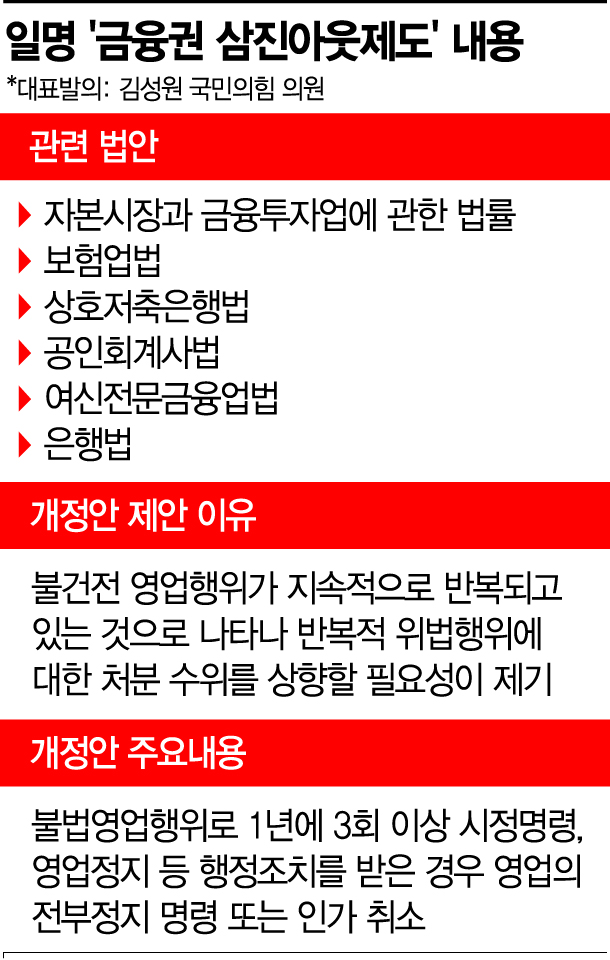
[Asia Economy Reporter Jo Gang-wook] A bill has been proposed that allows for the complete suspension of business operations or even cancellation of approval if administrative actions are taken three times within a year across the entire financial sector, including banks, securities, insurance, and credit card companies. This is the so-called 'Financial Sector Three-Strikes-Out System.' Within the financial sector, complaints are pouring in that despite concerns about soundness amid the prolonged COVID-19 pandemic, the political sphere is focusing solely on populist bills that tighten regulations on financial companies under the pretext of protecting financial consumers.
Bill Proposed to Raise Penalties with 'Three-Strikes-Out System' in Finance: Approval Cancellation after 3 Administrative Actions
According to financial and political sources on the 4th, Kim Seong-won, a member of the National Assembly’s Environment and Labor Committee from the People Power Party, officially proposed a bill on the 1st that significantly raises the level of penalties across financial-related laws such as the Banking Act, Insurance Business Act, and Specialized Credit Finance Business Act. The main point of the amendment is that if a financial company receives administrative sanctions such as corrective orders or business suspensions three or more times within a year due to unsound business practices, it will be subject to a complete suspension of business or cancellation of approval. The bills applying the financial sector three-strikes-out system include the Capital Markets Act, Insurance Business Act, Mutual Savings Banks Act, Certified Public Accountants Act, Specialized Credit Finance Business Act, and Banking Act.
This is not the first time Kim has proposed such a bill. Two years ago, in the 20th National Assembly in 2018, when he was a member of the Liberty Korea Party, he served on the Political Affairs Committee and submitted a bill with the same content. Kim pointed out, "Improvement in the light punishments by financial authorities is urgently needed."
Financial Services Commission Abolished It in 2015... 'Three-Strikes-Out System' to Return After 5 Years if Amendment Passes
The financial sector three-strikes-out system was initially introduced in 2010. If a financial company employee caused consumer disputes three or more times due to incomplete sales of financial products such as insurance or funds, they were expelled, and if a financial company received three institutional warnings, their overseas expansion or entry into new businesses was restricted. However, in 2015, then Financial Services Commission Chairman Lim Jong-ryong abolished the system, stating, "As financial companies are increasingly expanding overseas and cross-selling is active, such regulations hinder the development of our financial companies and are self-defeating."
If this amendment passes, the financial sector three-strikes-out system will be revived after about five years. Moreover, it will cover the entire financial sector with even stronger penalties. The financial sector is opposing this as a regulation that goes against the times, especially in an already difficult situation due to COVID-19. This is seen as adding insult to injury, especially with the enhanced Financial Consumer Protection Act set to take effect in March next year. The Financial Consumer Protection Act centers on a 'punitive surcharge' system that imposes fines up to 50% of the revenue from the related product in cases of incomplete sales. It also includes a 'right of withdrawal' allowing consumers to cancel subscriptions within a certain period without any reason. Responsibility can also be held against executives such as CEOs.
Financial Consumer Protection Act to Take Effect in March Next Year... Industry Pushes Back Against Excessive Financial Company Restrictions
A financial company official said, "Ahead of the Financial Consumer Protection Act enforcement in March next year, we are sharing joint response measures and focusing on eliminating incomplete sales elements internally," adding, "There are already related regulations, so strengthening penalties through another bill will not improve effectiveness."
Another financial company official also said, "Recently, there are even moves in the political sphere to interfere with the terms and personnel of financial company executives," pointing out, "With concerns about a COVID-19-induced 'bad debt tsunami,' the enforcement of the Financial Consumer Protection Act, and the lowering of the maximum interest rate, the management environment is tough, and excessive regulations disconnected from reality could shake the entire Korean financial sector."
© The Asia Business Daily(www.asiae.co.kr). All rights reserved.

















