Conflict Between Eumjeohyeop and Domestic Operators
Ministry of Culture, Sports and Tourism to Finalize This Month
[Asia Economy Reporter Kim Heung-soon] The conflict among stakeholders over the music copyright royalty rates imposed on online video service (OTT) content such as Netflix and Wavve is expected to be resolved this month at about 'twice the current rate.' This comes as the government appears to be aiming to settle the dispute at an intermediate level that considers the positions of the Korea Music Copyright Association (KMCA), the trust management organization that collects music copyright royalties, and domestic OTT operators. Although this rate is lower than the 'fourfold' increase demanded by KMCA, concerns persist that the cost will ultimately be passed on to consumers. Domestic OTT operators are demanding a reasonable rate setting, arguing that they find it difficult to accept the sharp increase based on the global OTT 'giant' Netflix.
Domestic Operators like Wavve, Watcha, Tving
Point Out "Double Charging and Reverse Discrimination"
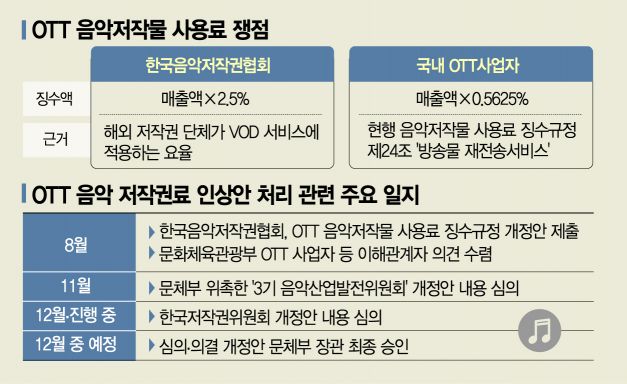
According to the industry on the 4th, the Ministry of Culture, Sports and Tourism, the main government body responsible for copyright royalties, plans to finalize the OTT music copyright royalty imposition standards within this month. The Korea Copyright Commission is currently reviewing the matter. If Minister Park Yang-woo of the Ministry of Culture, Sports and Tourism approves the final plan, the increase rate will be confirmed. A source said, "Internally, the weight is leaning toward an increase of about twice the current rate, considering both sides' positions."
Representatives of domestic OTTs such as Wavve, Watcha, and Tving met with Minister Park the day before and presented research results including overseas music copyright royalty imposition standards, requesting a reasonable decision from the ministry. Minister Park reportedly said, "I will carefully review the research results."
Domestic OTT operators have two main concerns. First, KMCA demands the same music usage royalty rate for domestic OTTs based on contracts with Netflix. Second, there is a risk of 'double charging' because royalties are being settled uniformly even for content that has already completed copyright contracts during the production stage.
A domestic OTT official pointed out, "In Netflix's case, the proportion of original (self-produced) content is high, and even if the music copyright royalty is set high, most of the amount can be recovered as a copyright holder," adding, "If the Netflix rate is used as a basis, only domestic OTT operators will face reverse discrimination by paying much higher amounts in copyright royalties."

KMCA's Demand for a Fourfold Increase: Basis?
International Practices and Netflix-Based Increase Proposal
According to the current Copyright Act, when popular songs or instrumental music are used as background music in performances, broadcasts, or transmissions, the relevant business operator must pay a certain percentage of copyright royalties to KMCA. However, the recently emerging OTT sector does not fit neatly into existing collection regulations.
Accordingly, KMCA submitted a revision proposal for the music copyright usage fee collection regulations to the Ministry of Culture, Sports and Tourism in August, which includes standards for imposing music copyright royalties on OTT operators. The revision stipulates that when 'video transmission services' like OTT provide videos that use music works incidentally, they must pay KMCA the greater amount between 2.5% of sales revenue multiplied by the music usage rate or 175 KRW per subscriber for each OTT. For example, if annual sales are 1 million KRW, KMCA intends to collect 25,000 KRW as a music usage fee.
KMCA explained, "This is based on a report published by the International Confederation of Societies of Authors and Composers (CISAC) and the collection rates applied by overseas copyright organizations to video-on-demand (VOD) services."
On the other hand, domestic OTT operators argue that the 'broadcast retransmission service' regulation, which was applied to broadcasters' streaming services under existing collection rules, should be applied. They claim that internet catch-up viewing provided in streaming form and OTT services are not significantly different. Applying this standard, the music copyright royalty domestic OTT operators would pay is about 0.6% of sales revenue, which amounts to about 6,000 KRW per 1 million KRW in sales. This is more than four times less than the amount KMCA demands.
A copyright expert said, "If music copyright royalties are calculated based on Netflix, the dominant player in the global market, domestic OTT operators will have significant dissatisfaction and burdens, and these costs may be passed on to users," adding, "The government should make a careful decision to establish an appropriate standard."
© The Asia Business Daily(www.asiae.co.kr). All rights reserved.


















