Fund Management Scale Reaches 724.8 Trillion Won This Year
Selective Payments Using Fund and Unused Budget
Disaster Relief Fund Could Expand to Trillions if COVID-19 Resurges
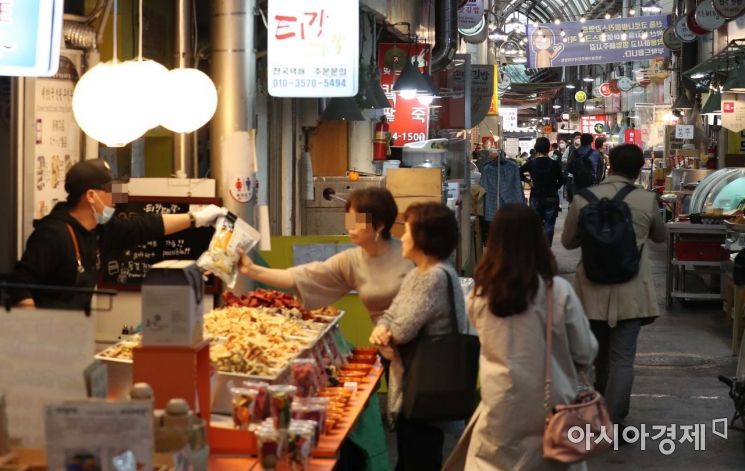 Among the 10 households eligible for the government emergency disaster relief fund due to the novel coronavirus infection (COVID-19) crisis, 9 households applied for and received the support fund. The Ministry of the Interior and Safety announced on the 22nd that the total amount of emergency disaster relief funds paid from the 4th to the 21st was 12.1068 trillion won, and the number of households that received the funds was 19.21 million. On this day, citizens are shopping at Tongin Market in Jongno-gu, Seoul.
 Photo by Moon Honam munonam@
[Asia Economy Reporter Jang Sehee] As the resurgence of the novel coronavirus infection (COVID-19) continues, the scale of the 3rd emergency disaster relief fund, which was reflected as 3 trillion won in next year's budget, is expected to increase to the trillion-won level. The government is expected to secure funding by utilizing various funds and unused budgets, including contingency funds.
On the 4th, a senior government official said, "The 3rd disaster relief fund will not be composed solely of the 3 trillion won contingency fund secured by the National Assembly, but will be prepared as a single measure by drawing on transferable portions of funds and unused budgets," adding, "A rough outline will be revealed when the economic policy direction for next year is announced."
Since the execution of next year's budget will begin in January, the government plans to decide the specific scale of funding after reviewing the extent of COVID-19 damage in the future. If the COVID-19 situation worsens compared to the current state and social distancing continues or is raised to a higher level, the scale of support targets may increase beyond expectations.
On this day, the number of new COVID-19 cases was 629, which is higher than the nationwide weekly average daily cases of 400-500 under social distancing level 2.5, making it impossible to rule out the possibility of raising social distancing to level 3. If the nationwide weekly average daily cases reach 800-1000 or more, gatherings, meetings, and events of 10 or more people will be banned nationwide, and all multi-use facilities except essential facilities will be suspended.
The government plans to add disaster relief funds beyond the 3 trillion won reflected in the budget by carrying over some of the various funds and unused budgets that could not be spent this year due to COVID-19. If the number of self-employed people affected by social distancing increases, the plus alpha (+α) scale could grow to the trillion-won level.
In this regard, the government is also considering using the Small and Medium Business Promotion and Industrial Infrastructure Fund and the Small Business Market Promotion Fund as sources for the disaster relief fund. According to 'e-Nara Indicators' operated by Statistics Korea, the scale of fund operation this year is 724.8 trillion won. According to the National Finance Act, financial funds can change their expenditure plans without submitting a fund operation plan change proposal to the National Assembly within 30% of expenditure, and non-financial funds within 20%.
However, even if the total funding scale is increased, since the payments will be selectively made to industries affected by the government's gathering ban and restriction measures, concerns are emerging that controversies will reoccur during the process of selecting targets and amounts. In fact, during the 4th supplementary budget, 2 million won of the Small Business New Hope Fund was paid to entertainment bars and colatecs, which were excluded from the government's original supplementary budget among the 12 gathering-ban industries. Also, 1 million won was supported not only to individual taxi drivers but also to corporate taxi drivers. If the damage caused by COVID-19 increases, there may be demands to raise the amount compared to the 2nd round.
This 3rd disaster relief fund is likely to have a structure similar to the small business damage support budget (3.9 trillion won) prepared in the 4th supplementary budget. At that time, gathering-ban industries such as karaoke rooms and PC rooms were supported with 2 million won, gathering-restricted industries such as coffee shops with 1.5 million won, and general industries with 1 million won each.
Meanwhile, the government announced that it will continue to support small and medium-sized enterprises and small business owners to overcome the COVID-19 crisis. Kim Yongbeom, 1st Vice Minister of Strategy and Finance, said on the day, "As the crisis prolongs, concerns about economic polarization by sector and class are being raised," adding, "Support for small business owners and small and medium-sized enterprises is necessary to continue as part of strengthening the social safety net." The government plans to start paying the 3rd disaster relief fund before the Lunar New Year holiday next year once the payment targets and amounts are finalized.
© The Asia Business Daily(www.asiae.co.kr). All rights reserved.

















