Bank of Korea 'October Balance of Payments (Provisional)'
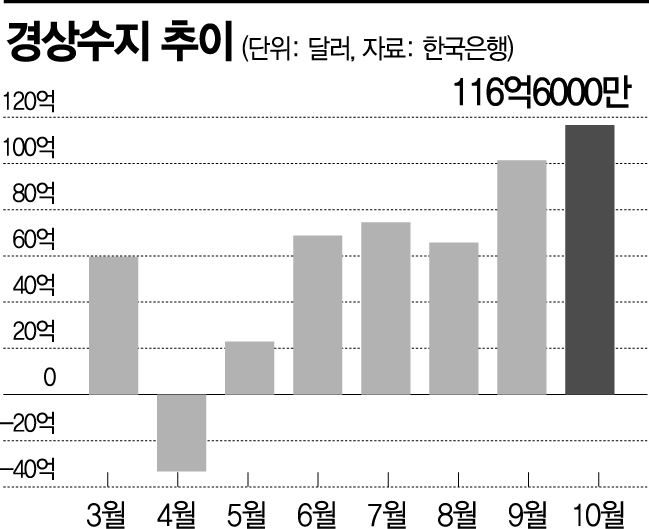
[Asia Economy Reporter Eunbyeol Kim] The current account surplus in October exceeded $10 billion for the second consecutive month, marking the third-largest surplus on record. The improvement in exports, coupled with a decline in oil prices that reduced import costs, contributed to the expansion of the goods trade surplus. The Bank of Korea expects the annual current account surplus forecast of $65 billion to be comfortably exceeded this year.
According to the 'October Balance of Payments (preliminary)' statistics released by the Bank of Korea on the 4th, the current account surplus recorded $11.66 billion (approximately 12.8 trillion KRW). It surpassed $10 billion for two consecutive months, maintaining a surplus trend for six months. The surplus amount is the largest since September 2017 ($12.34 billion), ranking third all-time. The current account sums all economic transactions between countries, including goods and services exports and imports. The cumulative current account surplus from January to October was $54.97 billion, indicating that the Bank of Korea's annual surplus forecast of $65 billion is likely to be achieved.
Lee Seong-ho, head of the Financial Statistics Department at the Bank of Korea's Economic Statistics Bureau, said, "The customs-based trade balance for October was $5.8 billion, but the current account surplus compiled by the Bank of Korea was $11.6 billion. Considering that the trade balance for November was $5.9 billion, it is expected that the annual current account forecast will be met by November." The goods balance within the current account announced by the Bank of Korea includes exports and imports through overseas production in addition to customs-based trade, generally making it larger than the trade balance. The current account is determined by adding the services balance and primary and secondary income balances.
While exports showed improvement, the decline in oil prices reduced import costs, expanding the goods trade surplus, which underpinned the current account surplus. October exports amounted to $46.99 billion, turning to a year-on-year decrease (-4.3%), but the average daily export was $2.24 billion, marking a year-on-year increase (4.8%) for the first time in 23 months. Imports recorded $36.84 billion, down 10.3% year-on-year due to weak energy prices. As a result, the goods trade surplus, the sum of exports and imports, was $10.15 billion, an increase of $2.12 billion (26.4%) compared to the same month last year.
Park Dong-jun, head of the Bank of Korea's Balance of Payments team, said, "Combining September and October, which include the Chuseok holiday, exports increased by 1.5%, turning positive. Exports, which had been sluggish since the fourth quarter of 2018, seemed to rebound early this year but were hit by the COVID-19 pandemic. However, recent current account figures suggest that exports have recovered to pre-COVID-19 levels."
Regarding concerns that the surplus is a 'recession-type surplus' caused by a sharp decline in imports compared to exports, the Bank of Korea draws a line. Park explained, "When combining September and October, exports turned positive, and most of the import decrease was due to the drop in crude oil prices. Capital goods imports actually increased, indicating that investment is proceeding well. Therefore, it is difficult to describe the surplus as a recession-type surplus since June."
The deficit in the services balance (-$660 million) also significantly decreased. The reduction in the travel deficit (-$470 million) by $350 million year-on-year due to the COVID-19 pandemic had a major impact. The number of outbound travelers in October decreased by about 96% compared to the same period last year. With a significant reduction in shipping and air transport supply, income from maritime and air cargo transport increased, while payments, mainly for air passenger transport, decreased, resulting in a $440 million surplus in the transport balance. Park said, "The transport balance surplus is more due to a significant reduction in payments rather than an increase in income. With reduced traffic volume, expenses such as maintenance and refueling at overseas ports and airports decreased, lowering outgoing payments."
The primary income balance, related to wages, dividends, and interest flows, recorded a surplus of $2.45 billion, an increase of $620 million compared to the same month last year. This was due to increased dividend and interest income from securities investments, mainly by institutional investors, while dividend payments on direct investments decreased.
Regarding the financial account, overseas securities investments by Korean nationals have increased for seven consecutive months since April. In particular, overseas stock investments increased by $2.97 billion, marking 56 consecutive months of growth since March 2016. Foreigners' domestic securities investments have also increased for five consecutive months since June, with stock investments rising by $1.54 billion, turning positive after three months.
© The Asia Business Daily(www.asiae.co.kr). All rights reserved.
![Clutching a Stolen Dior Bag, Saying "I Hate Being Poor but Real"... The Grotesque Con of a "Human Knockoff" [Slate]](https://cwcontent.asiae.co.kr/asiaresize/183/2026021902243444107_1771435474.jpg)











