Mathematics Type A "Difficult to manage time due to high-level problem solving"
Mathematics Type B "Relatively easier due to similarity with June and September mock exams"
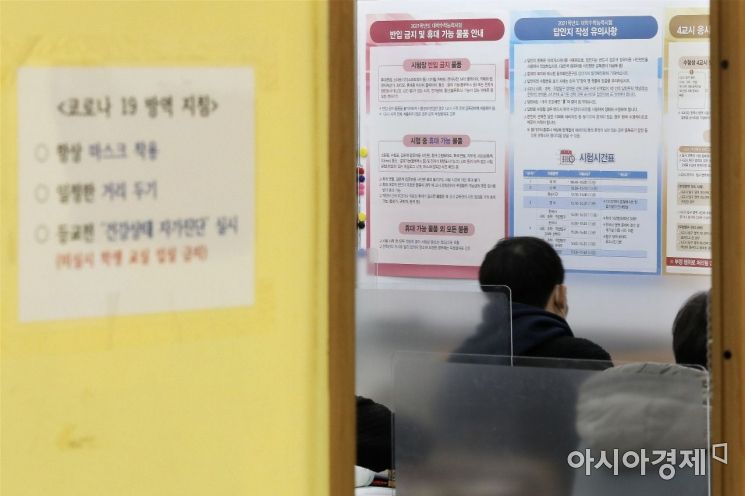 On the morning of the 3rd, the test site at Gyeongbok High School in Jongno-gu, Seoul, where the 2021 College Scholastic Ability Test was held, displayed exam instructions during the test.
Due to the impact of the novel coronavirus disease (COVID-19), this year's CSAT was postponed by two weeks and was simultaneously conducted at 1,383 test centers across 86 test districts nationwide, with a record low of 493,433 test takers. Photo by Joint Press Corps
[Asia Economy Reporter Hyunju Lee, Trainee Reporter Seungseop Song] In the 2021 College Scholastic Ability Test held on the 3rd, the mathematics section was evaluated as slightly more difficult for Type Ga compared to the September mock exam, while Type Na had a similar level of difficulty.
Kim Jeonghwan, a college entrance counseling teacher from Daegu Hyehwa Girls' High School and a member of the Korea Council for University Education (KCUE), who analyzed the Type Ga mathematics, explained, "Compared to last year's CSAT and the September mock exam, the number of high-difficulty questions increased, so students likely found it challenging. For mid-level students, the lengthy solving process for difficult questions probably made time management difficult, and there were tricky problems in calculus."
He identified objective questions 20 and 21, and short-answer questions 28, 29, and 30 as high-difficulty items. Kim said, "Question 16 was not about a single concept but a blank inference problem involving the graph of a real function and the concept of root multiplicity, so it seemed difficult. Question 21 required inferring the inductive definition of a sequence, and question 29 involved calculating the number of cases using combinations with repetition." He added, "Although similar problems appeared in the September mock exam, so students could have solved them, questions 28, 29, and 30 were inference problems, which likely made them feel difficult for examinees."
Regarding Type Na mathematics, the difficulty level was assessed to be similar to last year's CSAT and this year's September mock exam. Jo Mangi, a teacher at Gyeonggi Pangok High School, explained, "The last two objective and subjective questions, totaling four questions, which distinguish top-tier students, were again high-difficulty questions this time. Questions 20 and 30 were new types of problems, so students probably found them challenging." Jo added, "Nevertheless, it is expected that students felt less overall burden because fractal and blank inference problems, which were difficult for students in previous years, were not included this time. Although trigonometry questions newly included in the scope appeared, they were at a level prepared for through this year's mock exam."
© The Asia Business Daily(www.asiae.co.kr). All rights reserved.

















