Establishing Electric Vehicle Battery Material Business Value Chain
Increasing Lithium Reserves, Advancing Nickel Smelting Business, Investing in Graphite Mine Shares
Also Developing Solid-State Battery Materials
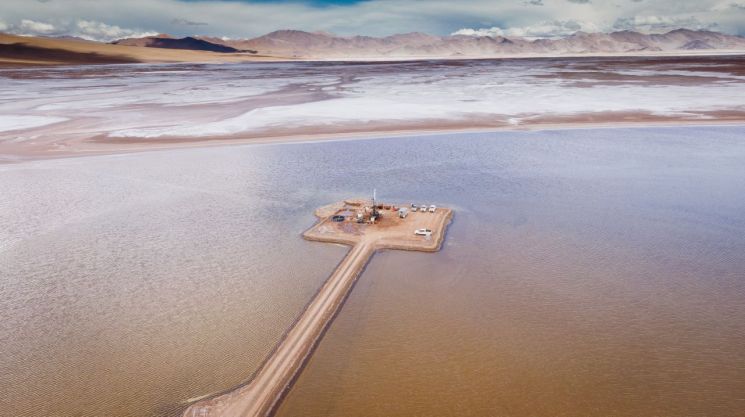
[Asia Economy Reporter Hwang Yoon-joo] POSCO Group is accelerating the completion of the value chain for secondary battery (electric vehicle battery) materials business.
On the 3rd, POSCO Group announced that it will build a value chain for the secondary battery materials business by linking ▲increased estimated reserves of lithium brine in Argentina ▲promotion of eco-friendly nickel refining business ▲investment in graphite mine shares. Through this, the group plans to expand its core raw material business for secondary batteries such as lithium, nickel, and graphite.
Choi Jeong-woo, Chairman of POSCO, emphasized, "We are the only company in the world that has an integrated supply system for secondary battery materials, from raw materials such as lithium, nickel, and graphite to cathode and anode materials," adding, "Let us focus all our capabilities on nurturing the secondary battery materials business into a world-class enterprise based on differentiated competitive advantages."
The value chain of the secondary battery industry can be classified into companies that produce batteries used in electric vehicles, secondary battery materials companies that produce cathode materials, anode materials, and precursors required for batteries, and raw material suppliers that process and supply raw materials such as lithium, nickel, and graphite needed for these materials.
Lithium, a key material for cathode materials of secondary batteries, plays a role in generating and charging electricity, while nickel plays an important role in extending the driving range of secondary batteries. Additionally, graphite is an excellent material for storing and releasing lithium ions discharged from cathode materials to generate electricity and is stable, making it suitable as a raw material for anode materials.
On the 30th of last month, POSCO confirmed that the final estimated reserves of lithium at the 'Hombre Muerto' brine lake in Argentina, which it owns, increased sixfold from the initially estimated 2.2 million tons at the time of acquisition to 13.5 million tons. This amount is sufficient to produce approximately 370 million electric vehicles.
The lithium concentration was also confirmed to be high, averaging 921 mg/L, making it the highest level in the world in terms of both lithium reserves and concentration among brine lakes globally. The higher the lithium concentration, the more lithium can be extracted from less brine.
Furthermore, POSCO plans to promote the production of high-purity nickel, an essential raw material for high-capacity battery cathode materials. Based on its expertise in molten iron production and impurity removal technology used in steel production processes, the company will expand investment to develop an eco-friendly high-purity nickel refining process. It also plans to enter the recycling business to extract nickel, lithium, cobalt, and other materials from used batteries, leading eco-friendly battery resource circulation.
Alongside this, POSCO will secure graphite mines in Africa and Australia to diversify the supply of graphite, a raw material for anode materials currently fully dependent on China. The group aims to reduce dependence on Chinese raw materials to below 50% in the mid to long term.
It also plans to develop materials for all-solid-state batteries, which are spotlighted as the next-generation secondary batteries.
In particular, POSCO Chemical, responsible for POSCO Group's secondary battery materials business, carried out a paid-in capital increase of 1 trillion KRW last month, the largest ever in the group’s history. POSCO Group, uniquely capable of supplying cathode materials, anode materials, and their core raw materials lithium, nickel, and graphite worldwide, plans to complete the materials value chain and supply 220,000 tons of lithium and 100,000 tons of nickel independently by 2030. By 2030, it aims to establish a production system of 400,000 tons of cathode materials and 260,000 tons of anode materials, achieving a 20% global market share and annual sales of 23 trillion KRW in the secondary battery materials sector.
© The Asia Business Daily(www.asiae.co.kr). All rights reserved.
![Clutching a Stolen Dior Bag, Saying "I Hate Being Poor but Real"... The Grotesque Con of a "Human Knockoff" [Slate]](https://cwcontent.asiae.co.kr/asiaresize/183/2026021902243444107_1771435474.jpg)
















