Daewoeyeon, Presentation on "China's 14th Five-Year Plan (2021-25) Economic Policy Directions and Implications"
"Must Prepare for Competition with China in ASEAN... Exploring Cooperation for Joint Entry of Third Countries in Quarantine and Health"
China Strengthens 'Economic Security' Against the US... "Chinese Companies Must Monitor 'Export Ban and Restricted Technology Lists'"
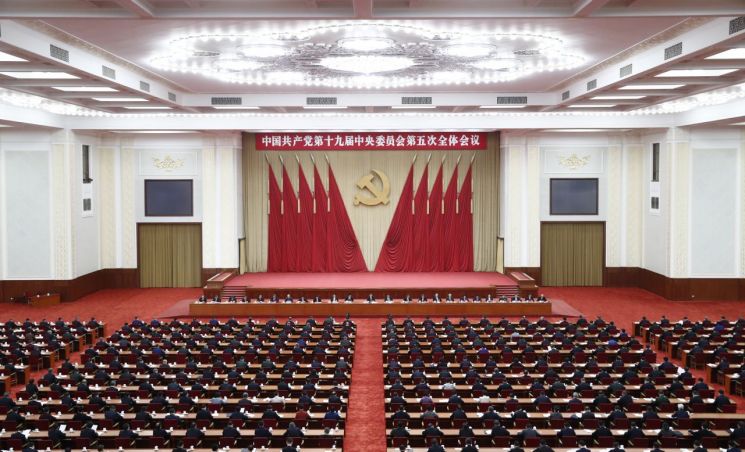 On October 29th, the 5th Plenary Session of the 19th Central Committee of the Communist Party (19th 5th Plenum) was held in Beijing, China, with the attendance of the Party leadership. At this meeting, the Chinese leadership adopted the dual circulation development strategy to strengthen the domestic market for the 14th Five-Year Economic Plan (2021?2025). (Image source= Xinhua News Agency)
[Asia Economy Reporter Moon Chaeseok] The Korea Institute for International Economic Policy (KIEP), a government-funded research institute, advised on the 2nd that "if China advances its industries and seeks import substitution markets, reducing imports of intermediate goods made by Korea, sectors such as electronics, petrochemicals, and automobile parts could suffer significant damage."
KIEP made this statement through its report titled 'Economic Policy Directions and Implications of China's 14th Five-Year Plan (2021?25)'.
According to KIEP, China released its '14.5 Plan' on the 3rd of last month, which aims to improve the qualitative level of its economy and industry over the next five years.
China declared to the world that it will maintain close connections with the global economy (international circulation) while maximizing the development of its domestic economy (domestic circulation) through the 'dual circulation strategy'.
KIEP emphasized the need to establish a comprehensive and mid-to-long-term strategy to improve the structure of the Korean economy and industry in response to China's industrial upgrading policy.
It judged that urgent measures include scientific and technological development, expanding investment in core components, enhancing competitiveness of key industries, promoting the development of materials, parts, and equipment, and creating new growth engines through the Digital New Deal and Green New Deal.
KIEP forecasted that as the dual circulation strategy raises the income levels of Chinese people, exports of Korean products such as cosmetics, food and beverages, agricultural products, tourism, medical services, education, and cultural contents could increase, and service sector entry could expand.
However, in the mid-to-long term, it anticipated that the comparative advantage between Korea and China could shrink due to China's independent innovation in science and technology, core component development, establishment of its own supply chain, industrial structure upgrading, and new industry cultivation.
KIEP stated, "If China's industrial upgrading and import substitution reduce Korea's exports of intermediate goods to China, sectors with a high proportion of intermediate goods exports to China, such as electronics, petrochemicals, and automobile parts, are expected to suffer significant damage."
It added, "With China's industrial structure upgrading, the level of intermediate goods it imports is expected to gradually increase. Therefore, it is necessary to enhance the competitiveness of Korean intermediate goods, develop fundamental technologies through basic research investment, and pursue localization strategies."
However, it seems that it will take some time before the gap with China narrows in areas such as semiconductors, next-generation displays, secondary batteries, and Internet of Things (IoT) home appliances.
KIEP said, "Rather than excessive concern about the rise of Chinese companies, it is necessary to find strategic countermeasures to maintain the technological gap."
China's digital economic transition is expected to open opportunities in digital healthcare, cultural contents, e-commerce, mobile games, smart logistics and payments, online education, and digital marketing. It is necessary to establish channels for public-private consultative bodies.
As China commits to green growth transition, Korea can seek to strengthen environmental cooperation and expand exports of eco-friendly products. On the other hand, companies operating in China must respond swiftly to Chinese regulations on carbon emissions and water resource usage.
With prolonged conflicts with the United States, China aims to form a regional value chain (RVC) by expanding economic cooperation with countries along the Belt and Road Initiative.
KIEP advised, "In this case, preparations should be made for intensified competition with China in the Association of Southeast Asian Nations (ASEAN) market, where many Korean companies have entered."
It also suggested, "However, it is necessary to identify cooperation demands between companies of both countries in ASEAN and explore the possibility of joint third-country ventures in new fields such as quarantine and healthcare."
KIEP noted that the Chinese government has recently emphasized 'economic security' in response to conflicts with the United States and is legislating laws related to foreign trade and investment, which requires caution.
Chinese President Xi Jinping emphasized five major relationships for the establishment of the 14.5 Plan: the relationship between inheritance and innovation, government and market, openness and autonomy, development and security, and strategy and tactics.
Regarding 'development and security,' KIEP interpreted, "It appears to emphasize properly managing the relationship between economic development and economic security."
Recently, the Chinese government has responded to U.S. corporate sanctions through legislation such as the 'Export Control List of Prohibited and Restricted Technologies,' 'Regulations on Unreliable Foreign Entities List,' and the 'Export Control Law.'
KIEP stated, "Korean companies operating in China should closely monitor the related laws and systems being established by the Chinese government."
© The Asia Business Daily(www.asiae.co.kr). All rights reserved.

















