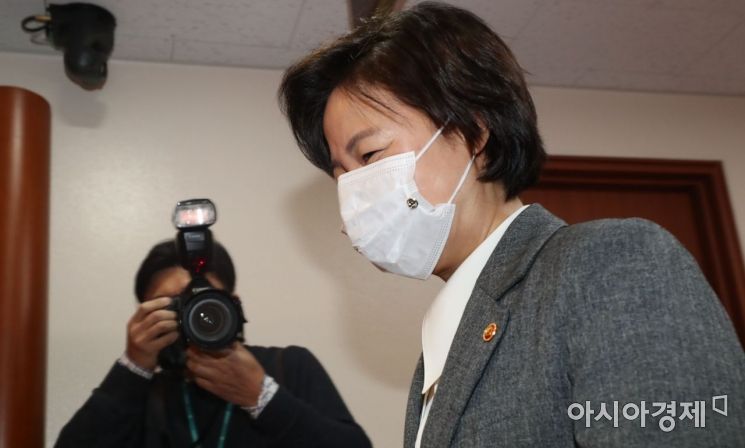
 Minister of Justice Choo Mi-ae is attending the Cabinet meeting held at the Government Seoul Office in Jongno-gu, Seoul on the 1st. Photo by Kim Hyun-min kimhyun81@
[Asia Economy Reporter Seongpil Cho] "Both President Roh Moo-hyun and President Park Geun-hye had their duties suspended for several months following the National Assembly's impeachment resolutions."
Attorney Okhyung Lee, legal representative for Justice Minister Choo Mi-ae, issued a rebuttal to the court's ruling that accepted Prosecutor General Yoon Seok-yeol's request for suspension of duty. Attorney Lee criticized the court's logic that suspension of duty is effectively equivalent to dismissal, arguing that under such reasoning, it would be impossible to order suspension of duty for any organizational leader under any circumstances.
Why Can Presidents Be Suspended but Not the Prosecutor General?
In a six-page statement on June 2, Attorney Lee pointed out, "Even if the Prosecutor General is absent, the Deputy Prosecutor General is legally designated to act on their behalf," adding, "There have been countless precedents where prosecutorial affairs were maintained without any issues under an acting system, even when the Prosecutor General position was vacant."
This was a rebuttal to the Seoul Administrative Court Administrative Division 4 (Presiding Judge Mi-yeon Jo) partially accepting Yoon's suspension request the previous day, which explained that "if the suspension of duty occurs, there is a risk of disruption and confusion in the overall operation of prosecutorial affairs and the work performance of prosecutorial officials, which affects public welfare." Attorney Lee stated, "This is a mistaken judgment that could lead to the misunderstanding that most prosecutorial officials, who quietly fulfill their duties as prescribed by law, are influenced by the status of the Prosecutor General."
Attorney Lee identified the court's key reasoning as follows: ▲ Whether there is cause for disciplinary action is not subject to judgment ▲ The applicant suffers irreparable harm (term guarantee, de facto dismissal) ▲ Suspension of the Prosecutor General's duty contradicts public welfare in terms of organizational stability. He added, "This logic is a problem that always arises when ordering suspension of the Prosecutor General's duty," and "The conclusion of this logic is that suspension of duty can never be ordered for the Prosecutor General or any organizational leader in a similar position."
Attorney Lee also cited cases of former presidents' suspension of duty. He said, "It can be seen from the fact that even the President's duty is suspended when the National Assembly passes an impeachment resolution, which is a kind of disciplinary procedure, until the Constitutional Court's decision," pointing out, "Both President Roh Moo-hyun and President Park Geun-hye had their duties suspended for several months following the National Assembly's impeachment resolutions."
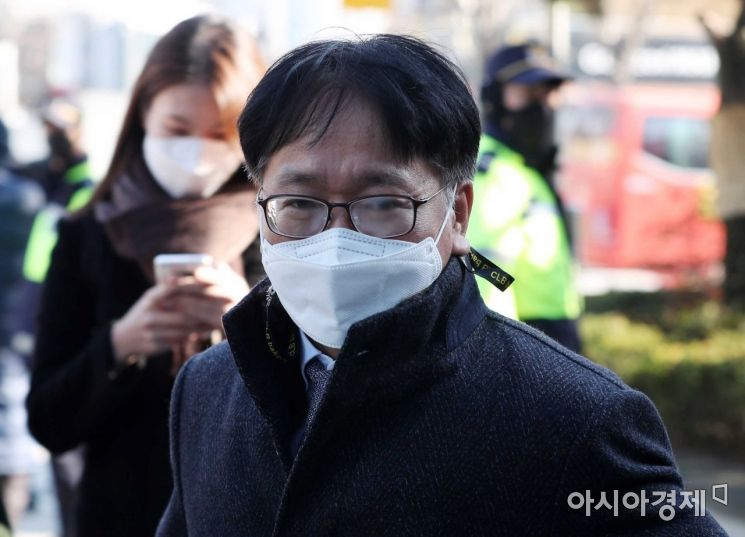 The hearing on the suspension of the enforcement of the suspension order against Prosecutor General Yoon Seok-yeol was held on the 30th at the Seoul Administrative Court. On this day, lawyer Lee Ok-hyung, the legal representative of Minister of Justice Chu Mi-ae, is entering the court. / Photo by Moon Ho-nam munonam@
Court Interprets Justice Minister’s Discretion Narrowly Under Prosecutor Disciplinary Act
Minister Choo’s suspension order against Prosecutor General Yoon on May 24 is based on Article 8, Paragraph 2 of the Prosecutor Disciplinary Act. This provision states that "the Minister of Justice may order suspension of duty if necessary for prosecutors, including the Prosecutor General."
Attorney Lee said, based on this provision, "It inevitably raises the question of 'in what cases the Minister of Justice can order suspension of duty that do not fall under the cases specified by the court.'" This means the court interpreted the discretion granted to the Minister of Justice under the Prosecutor Disciplinary Act too narrowly. He said, "The court’s reasoning is that the Minister of Justice has the authority but should not exercise it," adding, "This is an interpretation clearly contrary to the provisions of the Prosecutor Disciplinary Act."
At the end of his statement, Attorney Lee again criticized the court’s reasoning by comparing it to a late-career public official. He said, "If a public official nearing retirement is subjected to disciplinary action and placed on standby, it is practically equivalent to dismissal," and "According to the court’s logic, in such cases, suspension of execution should always be granted."
He also expressed his intention to consider an appeal. Attorney Lee said, "We did not expect the ruling to be in favor the previous day," adding, "Just as there can be errors in the legal representative’s expectations, the court also makes mistakes." He continued, "We all have to bear the confusion and inconvenience caused by judicial errors as long as we seek to resolve disputes through the judicial system," and "Regarding whether to appeal, I will carefully review and provide my opinion to the Minister of Justice."
© The Asia Business Daily(www.asiae.co.kr). All rights reserved.