"On-site inspection until March... Will thoroughly review all fields"
"Overseas merger notifications by mid-January... No cases of disapproval"
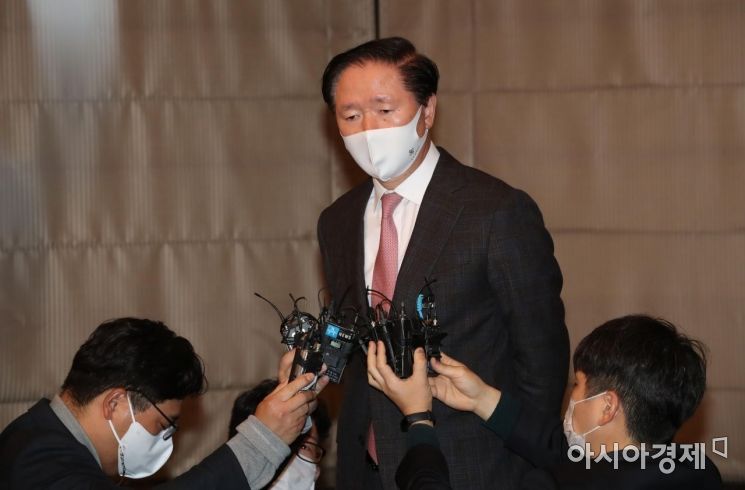 Woo Ki-hong, President of Korean Air, is answering questions from the press after the 22nd Tourism Industry Committee held on the 20th at Lotte Hotel in Jung-gu, Seoul. Photo by Kim Hyun-min kimhyun81@
[Asia Economy Reporter Yu Je-hoon] Woo Ki-hong, CEO of Korean Air, said on the 2nd regarding concerns about redundant workforce restructuring after the integration of Korean Air and Asiana Airlines, "Even if the integration takes place, we do not plan to reduce supply, so the demand for direct workforce will remain the same," adding, "There will be no artificial restructuring."
Through an online briefing held that afternoon, CEO Woo stated, "The absence of artificial restructuring is also guaranteed in the contract, and since it is a promise made by KDB Industrial Bank Chairman Lee Dong-geol and Hanjin Group Chairman Cho Won-tae, I believe the labor union will trust the sincerity of this commitment."
CEO Woo first mentioned that among the 28,000 workers of both companies, the redundant indirect workforce (such as headquarters) is about 2,000, saying, "More than 95% are direct workers, and we do not plan to reduce (aircraft) supply." He emphasized, "The annual natural reduction, including retirement and resignation, is about 1,000 people, and any other redundant workforce can be sufficiently absorbed by transferring them to departments with higher manpower needs if necessary."
Regarding the labor union's opposition, he said, "We are in constant dialogue with the labor union," adding, "However, since the Asiana Airlines labor union has not yet been incorporated into the Hanjin Group subsidiaries, if necessary, we will discuss with Asiana Airlines management and KDB Industrial Bank how best to communicate."
Regarding the future acquisition schedule, CEO Woo said they plan to prepare an integration plan by March 17, stating, "Korean Air will form working groups in each field, and under the participation of accounting and law firms, we will review all areas such as finance, materials, and legal affairs." He added, "Due diligence will also be conducted simultaneously on Asiana Airlines group companies (subsidiaries)."
On concerns that the corporate merger procedures in each country may not be easy, he explained, "We plan to apply to competition authorities in each country by January 14 next year. Overseas, there are not many routes with high market share like in Korea, so it is not expected to be a big issue." He added, "In past cases, airline mergers and acquisitions (M&A) have been carried out countless times, and there have been almost no cases where approval was not granted."
Regarding the synergy from the merger of the two companies, he said, "The synergy effect estimated by the accounting firm from the integration is 300 billion KRW annually. By having a more diverse schedule, it is possible to expand transit demand attraction and strengthen sales in overseas markets. Also, improving the load factor (L/F - passenger load factor or cargo load factor) is expected to increase profits."
He also emphasized, "In the case of Asiana Airlines, due to difficult circumstances, lease fees are high because of credit ratings, and the proportion of leased aircraft among owned models is also high." He added, "If the integrated airline changes the structure related to aircraft (finance) based on improved credit ratings, significant cost reductions are expected, and annual financial interest expenses of several hundred billion KRW will also be substantially improved."
Furthermore, CEO Woo said regarding the brand of the integrated airline, "Considering the time and investment costs, launching a third new brand is not appropriate," adding, "I think we should go with one existing brand. There is still time to consider how to utilize other unused brands." This is interpreted as leaving room for the utilization of the 'Asiana Airlines' brand, which is mentioned as the name for the integrated low-cost carrier (LCC).
Regarding the establishment of the integrated LCC's base in Busan, he said, "When the three companies are integrated, it should not be just one place, but both the current Busan and Incheon should be developed simultaneously." He added, "There is still a lot of time before integration, and the issue of moving the headquarters to Busan will be resolved through good consultation among local residents, related organizations, employees, and the new management."
© The Asia Business Daily(www.asiae.co.kr). All rights reserved.

















