18 Years of Resident Autonomy in Suncheon City, Growing Together with Citizens
The Beginning of Resident Autonomy Committees, Creating a New Model of Resident Autonomy
Community Representative Organizations, Challenges for the Growth of Resident Aut
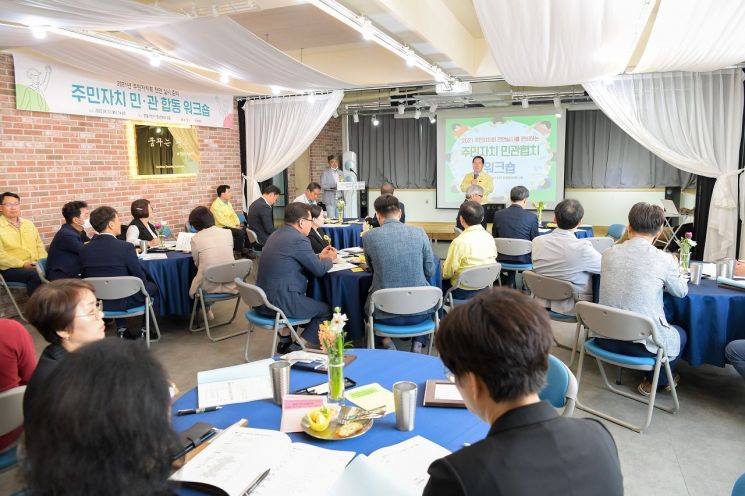
[Asia Economy Honam Reporting Headquarters Reporter Lee Hyung-kwon] Suncheon City (Mayor Heo Seok) will lead a new wave of resident autonomy by fully implementing resident autonomy committees in all 24 eup, myeon, and dong districts starting next year.
By strengthening the activities of resident autonomy committees, which are representative organizations of local communities, the plan is to create a grassroots village autonomy system where residents take the lead in discovering, discussing, and solving various local issues on their own.
Starting with the establishment of resident autonomy centers in 2003 and leading up to the full implementation of resident autonomy committees in 2021, we look back on the 18-year history of resident autonomy in Suncheon City and anticipate its future direction.
▶ 18 Years of Resident Autonomy in Suncheon City, Growing Together with Citizens
Suncheon City began by installing resident autonomy centers and forming resident autonomy committees in dong areas in 2003, completing the installation of resident autonomy centers and committee formation in all 24 eup, myeon, and dong districts by 2008.
This is an advanced administrative move compared to neighboring local governments that completed the formation of resident autonomy committees only 2 to 3 years ago.
It reflects Suncheon City’s determination to activate the existing eup, myeon, and dong offices, which were mainly focused on administrative tasks, as places for communication among residents.
The growth of resident autonomy has led to the growth of Suncheon City.
The village-making project led by resident autonomy committees in 2005 was selected as an excellent case by the Ministry of the Interior and Safety and spread nationwide.
Cheongsugol, which grew through the creative village cultivation in 2013, was linked to an urban regeneration project and has been spotlighted as a benchmarking site for local governments nationwide to this day.
The activation of village communities that began with resident autonomy created the achievement of "Suncheon, the No. 1 place for resident-led urban regeneration."
However, challenges remain. There were doubts about whether the visible and short-term resident autonomy activities, mainly focused on village beautification projects, truly represented resident autonomy activities.
In 2013, reflecting on this, a pilot project to create a new model of resident autonomy began.
▶ The Start of Resident Autonomy Committees, Creating a New Model of Resident Autonomy
In 2013, Jungang-dong was selected for the Ministry of the Interior and Safety’s pilot project for resident autonomy committees.
Based on six years of experience, the decision was made in 2018 to expand the implementation of resident autonomy committees.
Last year, full-fledged resident autonomy committee activities began in a total of eight areas, including seven regions selected through Suncheon City’s own public contest and Jungang-dong.
The two-year pilot activities of resident autonomy committees produced many achievements.
Various groups such as students, housewives, and local institution officials participated in the village planning process, creating an opportunity for diverse citizens to engage in resident autonomy activities, which had previously been perceived as activities centered on local representatives.
In particular, linking village plans with resident participatory budgets to enhance the execution power of village plans received nationwide recognition and was selected as the best case at last year’s National Resident Autonomy Expo.
It also contributed to strengthening the democratic decision-making system of villages.
At the residents’ general meetings led by resident autonomy committees, eup, myeon, and dong projects were decided by direct voting of residents.
This created an opportunity for the majority of residents to share and directly decide on village projects, which had previously been selected mainly by eup, myeon, and dong administrations and some resident representatives.
This year, amid difficulties in resident meetings due to COVID-19, new attempts by resident autonomy committees shone.
Various methods of residents’ general meetings were tried to hear as many opinions as possible, including online residents’ general meetings using smartphones and PCs, and visiting village meetings by region.
As a result, this year, an average of 7% of residents participated in village project decisions, higher than last year’s average participation rate of 4.6%.
▶ Representative Organizations of Communities, Challenges for the Growth of Resident Autonomy Committees
Starting next year, resident autonomy committees will be fully implemented in all 24 eup, myeon, and dong districts of Suncheon City. This reflects Suncheon City’s active will to empower citizens and strengthen their right to self-determination.
Based on the achievements of the two-year pilot activities of resident autonomy committees, the institutional foundation for full implementation in all 24 eup, myeon, and dong districts has also been established.
The achievements of the pilot resident autonomy committees’ activities were analyzed. While there were many successes, challenges remain.
First, there is a question about the representativeness of resident autonomy committees.
To form open resident autonomy committees that anyone can participate in, the existing method of selecting committee members based on evaluations by selection committees was abolished and changed to a democratic method of selecting members through public lotteries.
However, it is realistically difficult for various citizens such as youth and office workers to participate in resident autonomy committee activities, which require a lot of time and communication.
Efforts are needed to strengthen the representativeness of resident autonomy committee activities by involving diverse people in village affairs.
Second, how to integrate and harmonize the opinions of various organizations in the village.
Within one village, there are various organizations that care for the village in their own ways.
While respecting the activities of each organization, the question is how to effectively integrate their opinions into the resident autonomy committee.
Lastly, there is concern about the sustainability of resident autonomy committees.
Currently, the activities of resident autonomy committees are practically supported by eup, myeon, and dong administrations.
Challenges remain for the sustainability of resident autonomy committees, including fostering professional personnel within the committees, securing independent resources, and building trust within the village.
▶ The Value of Community Amid the COVID-19 Crisis, Dreaming of 24-Color Villages Drawn by Residents
Suncheon City is preparing various measures in line with the full implementation of resident autonomy committees in all 24 eup, myeon, and dong districts in 2021.
The plan is to create connections one by one to solve the challenges raised earlier.
First, to encourage participation from diverse groups in resident autonomy committees, support will be provided to form subcommittees reflecting regional characteristics.
Resident autonomy committee subcommittees can be joined by any resident interested in village activities, in addition to committee members.
This is to guarantee the activity of residents who had difficulty integrating with existing resident autonomy committees, such as office workers, university students, and childcare groups, and to expand participation by integrating the subcommittee plans they establish with the overall village plan.
Additionally, plans are in place to create mechanisms for various organizations within villages to understand and participate in resident autonomy committee activities.
The resident autonomy public-private consultative body, operated on a pilot basis this year, will be expanded to create channels through which opinions of activists in various fields can be reflected in resident autonomy policies.
Within eup, myeon, and dong districts, village-harmony type residents’ general meetings will be operated to attempt growth of resident autonomy committees as connecting links among various actors within villages.
Efforts for the sustainability of resident autonomy committees will continue.
Plans include strengthening the obligation of information disclosure to build trust within villages and securing sustainability through enhancing expertise.
In October, the resident autonomy committee ordinance was revised to increase the number of auditors from one to two and to strengthen the obligation of public disclosure and reporting on the execution of decisions made by resident autonomy committees.
Also, through education and activity support for resident autonomy committee secretaries introduced in 2020, the expertise of resident autonomy committees will be strengthened, and a foundation for independence will be established.
Along with this, efforts to publicize the achievements of resident autonomy in Suncheon City will be intensified.
Next year, the 1st Suncheon Autonomy Expo will be held to showcase excellent resident autonomy activities in the 24 eup, myeon, and dong districts and to provide a festival venue where citizens can recognize and empathize with the necessity of resident autonomy activities.
A Suncheon City official said, “Villages have various colors, and the colors of village members are even more diverse.
Each village will find its unique color, and Suncheon City’s new attempts to establish a village autonomy system will continue.” He added, “In the difficult situation caused by COVID-19, the implementation of resident autonomy committees in all eup, myeon, and dong districts will be a meaningful attempt by Suncheon City to trust the power of residents and return authority to them to truly activate village autonomy.”
© The Asia Business Daily(www.asiae.co.kr). All rights reserved.

















