Ministry of Foreign Affairs Holds Discussion on 'Prospects for International Relations After the US Presidential Election' During Overseas Diplomatic Chiefs Meeting
Vice Minister Choi Jong-geon: "South Korea, a Leading Nation in Non-traditional and Health Security, to Take the Lead in International Cooperation"
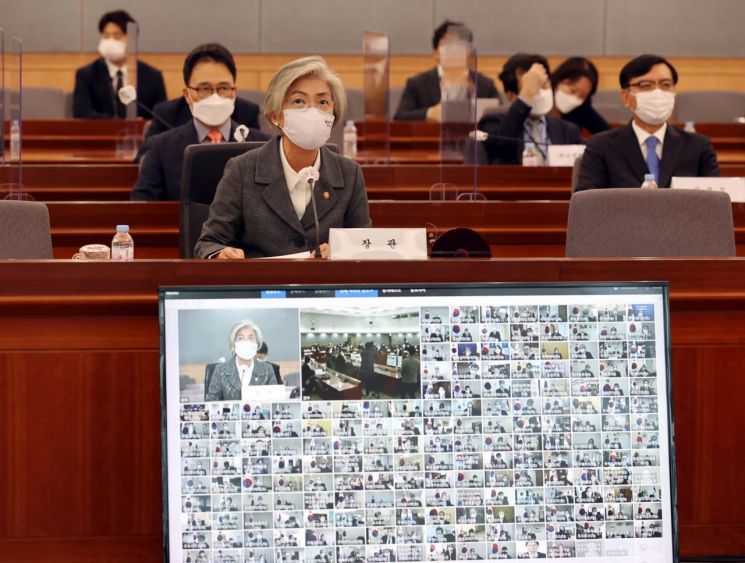
[Asia Economy Reporter Lim Cheol-young] At the meeting of heads of overseas diplomatic missions held by the Ministry of Foreign Affairs, ambassadors of major countries to Korea anticipated that with the inauguration of the Joe Biden administration in the United States, priority would be given to strengthening alliances, making a smooth Korea-US relationship possible. However, they also forecast that the US-China conflict would continue to have a considerable impact on Korean diplomacy.
On the 2nd, the Ministry of Foreign Affairs held a discussion titled "Prospects for International Relations after the US Presidential Election," with ambassadors of major countries attending via video conference during the heads of overseas missions meeting. They shared the situation in their host countries and future plans. Lee Soo-hyuk, the ambassador to the US, explained, "The Biden administration is expected to prioritize restoring America's global leadership in response to various global challenges," adding, "The most important aspect of restoring US leadership is cooperation with allied countries."
Accordingly, the Korea-US alliance is expected to advance into a more mutually beneficial and respectful relationship. Ambassador Lee said, "We expect the Korea-US alliance to encounter a new opportunity to develop into a more mutually beneficial and respectful relationship than in the past," and added, "The Biden administration is also expected to continue organic efforts for the complete denuclearization of the Korean Peninsula and the establishment of lasting peace."
He also gave a positive evaluation of Tony Blinken, the nominee for Secretary of State, and Jake Sullivan, the National Security Advisor. Ambassador Lee stated, "They appointed former officials different from those in the Trump administration," and explained, "The environment for consulting and discussing various issues diplomatically has improved."
Although the conflict between the US and China continues, there was a forecast that it would take a different form from the Cold War era. Jang Ha-sung, ambassador to China, said, "Unlike in the past, the world is economically integrated," and added, "There are issues that the world must jointly respond to, such as the COVID-19 pandemic and the joint response to global climate change that the US and China both voice." He further noted, "Within China, the consensus is that the US-China conflict will continue," but added, "The Biden administration will have a different approach and method in the process of this conflict's development and resolution."
Ambassadors attending the discussion unanimously expressed their intention to continue diplomacy for progress in the peace process on the Korean Peninsula even after the inauguration of the new US administration. Nam Kwan-pyo, ambassador to Japan, emphasized, "The Biden administration is expected to emphasize and highlight Korea-US-Japan cooperation," and stressed, "We will create conditions and an environment where the historical issues that seem to block cooperation between Korea and Japan can be properly resolved."
He added, "Although next year will be difficult due to COVID-19, if the Tokyo Olympics are held, we expect significant progress in resolving the Korean Peninsula issue ahead of the Beijing Winter Olympics, following the Pyeongchang Olympics, and we will work towards resolving bilateral issues."
Lee Seok-bae, ambassador to Russia, emphasized that the Korean Peninsula issue is one on which Russia and the US have cooperated so far, and that Russia's constructive contribution must be continuously encouraged. He explained, "The Korean Peninsula issue is one of the few matters on which Russia and the US have closely cooperated despite conflicts," and added, "In advancing the denuclearization process of the Korean Peninsula, we must firmly maintain our autonomous stance, strengthen the Korea-US alliance, and encourage Russia's constructive contribution."
Earlier, Choi Jong-geon, the first vice minister of the Ministry of Foreign Affairs, stated in his opening remarks that the foundation of the Korea-US alliance is solid and very strong. Vice Minister Choi said, "Contrary to the so-called crisis theory of the Korea-US alliance mentioned by some, the institutional and cultural foundations of the alliance are very solid," and added, "The fact that both countries share democratic values alone means that the Korea-US alliance is very strong."
He continued, "Effectively responding to issues such as COVID-19 and climate change is impossible with the leadership of any single country alone," and added, "As a leading country in non-traditional and health security, the Republic of Korea will take the lead in promoting international cooperation to prepare for the post-COVID era together with the United States and the international community."
© The Asia Business Daily(www.asiae.co.kr). All rights reserved.

















