[Asia Economy Reporters Hyewon Kim and Dongwoo Lee] Samsung Electronics has revealed its determination to maintain its global No.1 position through a 'super-gap' strategy by surprisingly appointing young presidents in their early 50s in the semiconductor sector this year, following last year's move in the smartphone division.
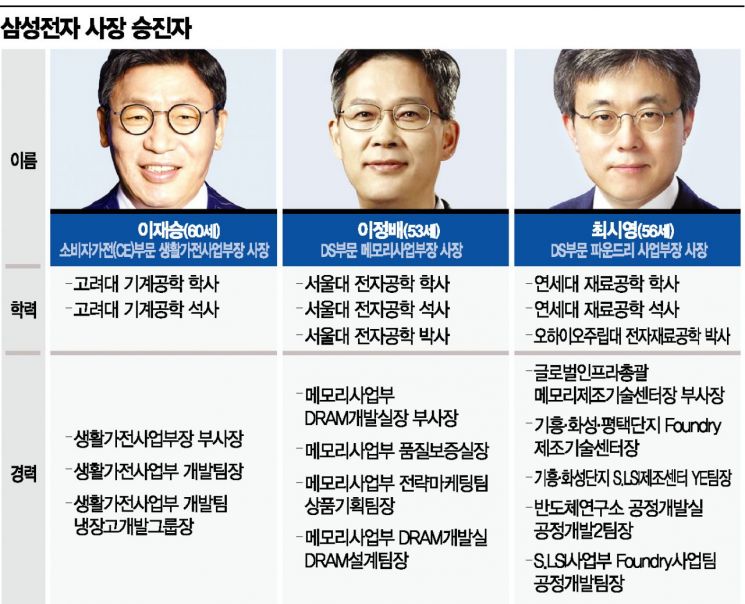
Among the notable promotions in Samsung Electronics' 2021 regular executive reshuffle announced on the 2nd are Presidents Lee Jeong-bae and Choi Si-young. Executive Vice President Lee Jeong-bae, head of the DRAM Development Office, replaced President Jin Gyo-young as the new head of the Memory Business Division. Born in 1967, he is 53 years old this year. Having joined Samsung Electronics in 1992, he is a DRAM expert with extensive experience solely in the memory business division. Leading Samsung Electronics' rise to the world's No.1 in DRAM, Lee has been tasked with expanding the super-gap against competitors across all memory products including DRAM, NAND flash, and solutions as the new head of the Memory Business Division following his promotion.
Samsung Electronics maintains the No.1 global market share in NAND flash as well as DRAM, but to fend off competitors' pursuit, it continues to tighten the reins on large-scale investments. According to market research firm TrendForce, Samsung Electronics held a 33.1% share of the global NAND flash market in the third quarter of this year, ranking first. Japan's Kioxia (21.4%), US-based Western Digital (14.3%), and SK Hynix (11.3%) follow behind.
Samsung Electronics expects the global DRAM market to grow about 15-20% and NAND flash by 30% next year, anticipating a semiconductor market recovery. The company plans to lead the market with cutting-edge technologies such as extreme ultraviolet (EUV) lithography equipment and double-stack NAND. At the 'Samsung Electronics Investor Forum 2020' held on the 30th of last month for domestic and international institutional investors, Samsung introduced the 'double-stack' technology, which, although complex due to the increased number of processes, can double the number of layers. This technology theoretically allows stacking up to 256 layers. Samsung plans to widen the technological super-gap further by launching the 7th generation V-NAND next year.
In this personnel reshuffle, Samsung Electronics also appointed President Choi Si-young as the right person to achieve Vice Chairman Lee Jae-yong's goal of becoming the world's No.1 system semiconductor (non-memory) company by 2030, a future growth engine. President Choi, who is also relatively young at 56 years old this year, joined Samsung Electronics' Memory Headquarters Semiconductor Research Institute in 1995. He is recognized as a process and manufacturing expert who has led process development and manufacturing across all semiconductor products while gaining key positions in the semiconductor business.
President Choi is especially expected to lay the foundation for achieving the world's No.1 foundry position as head of the Foundry Business Division, which has immense growth potential as a major pillar of Samsung Electronics' semiconductor business in the future. He brings process development expertise and manufacturing experience across all semiconductor products to this role.
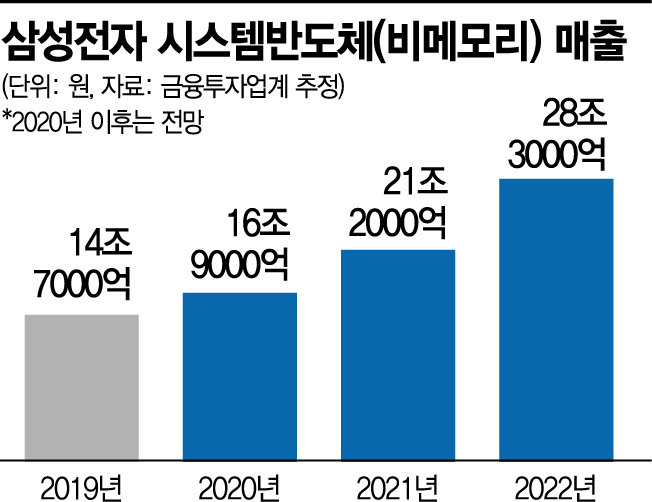
Inside and outside the industry, Samsung Electronics' system semiconductor sales, which have hovered around 14 trillion won for several years, are expected to surpass 20 trillion won for the first time next year, showing a steep growth trajectory. Compared to the memory semiconductor market, which Samsung currently focuses on, the system semiconductor market is more than twice as large, with Taiwan's TSMC occupying over half of the market. Samsung, as a latecomer with about 17% market share, is fiercely chasing TSMC. At the recent investor forum, Samsung introduced ultra-fine process and packaging technologies it is preparing to narrow the gap with TSMC, forecasting that the foundry market will rapidly grow to exceed $130 billion (approximately 144 trillion won) by 2025.
© The Asia Business Daily(www.asiae.co.kr). All rights reserved.
![Clutching a Stolen Dior Bag, Saying "I Hate Being Poor but Real"... The Grotesque Con of a "Human Knockoff" [Slate]](https://cwcontent.asiae.co.kr/asiaresize/183/2026021902243444107_1771435474.jpg)

















