Bank for International Settlements, Q2 Real House Price Index Growth Rate
South Korea House Price Growth 2.5%...Global Average 1.9%
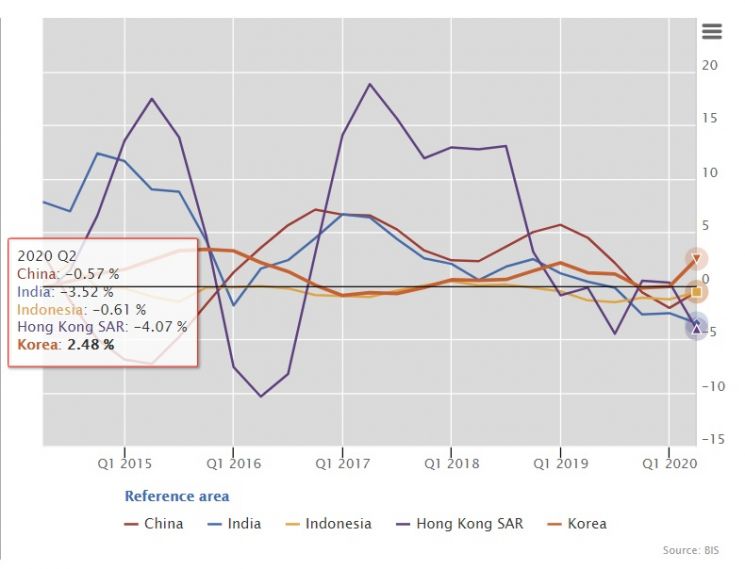 Trends in the Real Housing (Residential Real Estate) Price Index Growth Rates of Major Asian Countries
*Bank for International Settlements (BIS)
[Asia Economy Reporter Kim Eun-byeol] South Korea's real housing price growth rate in the second quarter jumped 2.5% compared to last year, far surpassing the global average increase of 1.9%. Among major Asian countries, it recorded the highest growth rate. While asset prices rose worldwide as countries injected money to respond to the COVID-19 pandemic, South Korea's housing price growth rate was notably higher.
According to the Bank for International Settlements (BIS) on the 2nd, South Korea's real housing (residential real estate) price index stood at 108.3, up 2.5% from 105.6 in the second quarter of last year. South Korea showed a particularly high increase in housing prices among major Asian countries. BIS data indicates that South Korea's real housing price growth rate in the second quarter was the highest among major Asian countries and was the only one to show a positive increase. China recorded a housing price growth rate of -0.57% in the second quarter, Japan -0.6%, and Indonesia -0.61%. India saw a significant decline at -3.52%, and Hong Kong at -4.07%. In the second quarter of last year alone, China's housing price growth rate was 4.47%, dominating the Asian region, while South Korea's growth rate was around 1.19%. This means the growth rate more than doubled in one year. However, BIS excluded countries like Thailand and the Philippines from the Asian country comparison.
Since the 2008 financial crisis, housing prices in countries like China and India have risen sharply, supported by low interest rates and rapid growth. However, recently, due to the COVID-19 crisis, real estate transactions have not been active, causing prices to fall. In contrast, South Korea showed a high housing price growth rate due to abundant liquidity combined with government real estate policies.
However, compared to the group of advanced countries, South Korea's housing price growth rate is relatively low. The average housing price growth rate in advanced countries in the second quarter was 3.7%. Australia recorded the highest at 6.60%, followed by Canada (5.90%), the Eurozone (4.88%), and the United States (4.19%). BIS explained, "Following the COVID-19 pandemic, fiscal and monetary policies have led to an increase in housing prices."
Not only residential housing but also investment funds flowing into commercial real estate in South Korea are outstanding. According to Real Capital Analytics (RCA), a U.S.-based real estate analysis firm, investment funds flowing into South Korea's commercial real estate market in the third quarter increased by 22% year-on-year. Unlike Japan (-62%) and China (-36%), which have larger market sizes than South Korea, transaction amounts increased significantly and uniquely. RCA estimates that the size of the commercial real estate investment market in Asia in the third quarter was $2.6 billion, down an average of 38% year-on-year. Although commercial real estate yields are expected to decline as the COVID-19 pandemic prolongs, it is analyzed that asset owners turned their attention to commercial real estate due to apartment investment regulations, resulting in this outcome.
© The Asia Business Daily(www.asiae.co.kr). All rights reserved.
![Clutching a Stolen Dior Bag, Saying "I Hate Being Poor but Real"... The Grotesque Con of a "Human Knockoff" [Slate]](https://cwcontent.asiae.co.kr/asiaresize/183/2026021902243444107_1771435474.jpg)











