[Asia Economy Reporter Oh Ju-yeon] Following the regular MSCI (Morgan Stanley Capital International) index changes on the 30th of last month, foreign investors, who had unleashed a selling spree worth 2.4 trillion KRW in the KOSPI market, have started to gradually buy again since December. As the KOSPI surged more than 300 points throughout November, some analysts suggested that the overheated market might enter a phase of stabilization, but the December stock market has continued its upward trend for two consecutive days.
In particular, there is analysis that the foreign investors' selling pressure may not be a one-time event caused solely by the MSCI index changes, making their supply and demand direction even more noteworthy. Although they have shown net buying for two consecutive days, the buying strength is not strong compared to the massive selling scale of 2.4 trillion KRW.
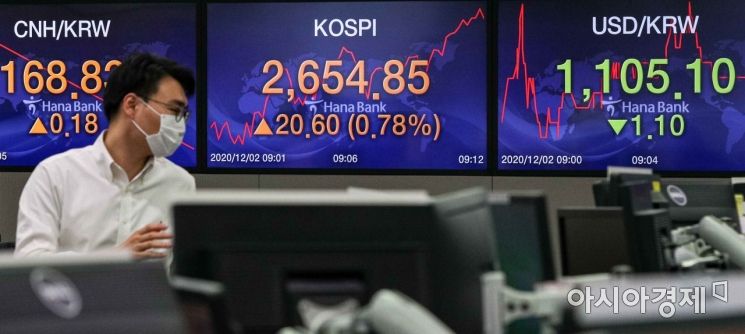 On the 2nd, the KOSPI index opened at 2645.88, up 11.63 points (0.44%) from the previous trading day, as employees were working in the dealing room of Hana Bank in Jung-gu, Seoul. On the same day, the won-dollar exchange rate started trading at 1105.2 won, down 1.0 won from the previous trading day. Photo by Kang Jin-hyung aymsdream@
On the 2nd, the KOSPI broke through the 2,670 mark during trading hours, setting a new all-time high. The KOSDAQ index also surpassed 890 points, approaching the 900-point threshold.
As of 10:55 AM that day, the KOSPI recorded 2,664.10, up 1.13% from the previous trading day. The KOSPI started the day with a 0.41% increase compared to the previous day but then expanded its gains, soaring to 2,675.28, up about 1.5% intraday, breaking the historical record. Although foreign investors had unleashed a record-breaking selling spree due to the MSCI index changes on the 30th of last month, they have since been gradually buying again.
On the 1st, foreign investors net bought stocks worth 74.8 billion KRW in the KOSPI market, along with institutions (267.5 billion KRW), lifting the index from the 2,500 level back above 2,600. On the same day, foreign investors continued to lead the index rise by purchasing stocks worth 314.6 billion KRW as of 10:57 AM.
Individuals and institutions sold stocks worth 118.1 billion KRW and 167.7 billion KRW, respectively.
The stock most heavily purchased by foreign investors was SK Hynix. On the 1st, they poured 88.8 billion KRW into SK Hynix. They also bought 9.4 billion KRW worth on the same day, supporting the stock price. SK Hynix surged to 109,000 KRW intraday, setting a 52-week high.
Following that, NAVER (68.3 billion KRW), LG Chem (45.8 billion KRW), NCSoft (36.0 billion KRW), Alteogen (31.9 billion KRW), and Seegene (30.1 billion KRW) were sequentially net bought.
According to Kiwoom Securities, in November, foreign investors bought mainly around the KOSPI 200 due to passive fund inflows worth about 4 trillion KRW, but they also actively net bought semiconductor and secondary battery sectors with an estimated 3 trillion KRW of active funds. It is explained that in the December stock market, attention should be paid more to the inflow of such active foreign funds rather than passive funds.
Active funds tend to react sensitively to short-term momentum or changes in risk indicators, so they responded to expectations of semiconductor industry improvement, export increases, and electric vehicle sales growth, leading to concentrated net buying of related stocks. However, due to the nature of funds focused on short-term trading, it is necessary to observe further whether the continuous net buying trend will persist in December.
Seosangyoung, a researcher at Kiwoom Securities, said, "For active foreign investors' aggressive net buying to continue, export-import statistics that significantly exceed expectations and global electric vehicle sales trends announced at the beginning of the month must be released," adding, "If such trends do not emerge, the scale of active foreign investors' net buying will weaken compared to November."
He also added, "Regarding passive funds, since the stock allocation in global asset distribution has significantly increased, there is a high possibility of stock selling volume emerging for portfolio adjustments," and "Considering this, foreign investors' supply and demand in December can be viewed as neutral or below."
Researcher Seo said, "Meanwhile, the market's focus in December is on the European Central Bank (ECB) monetary policy and the Federal Open Market Committee (FOMC)," adding, "The market expects stimulus measures to be announced at the FOMC on the 16th, which could positively impact foreign investors' supply and demand, so it is worth paying attention to."
© The Asia Business Daily(www.asiae.co.kr). All rights reserved.

















