Incheon Free Economic Zone Authority Holds Final Report Meeting on 'Development Strategy for Revitalizing Yongyu-Muui Free Economic Zone'
Six Sites Proposed Including Wangsanhyeosu Beach Area as Candidates for Free Economic Zone Designation
[Asia Economy Reporter Park Hyesook] The Incheon Free Economic Zone Authority has devised a promotion strategy to develop the Yeongjong International City Yongyu and Muui areas into a world-class marine, tourism, and leisure hub.
On the 2nd, the Incheon Free Economic Zone Authority held the final report meeting for the "Yongyu and Muui Free Economic Zone Revitalization Development Strategy Establishment Project" at Songdo G Tower.
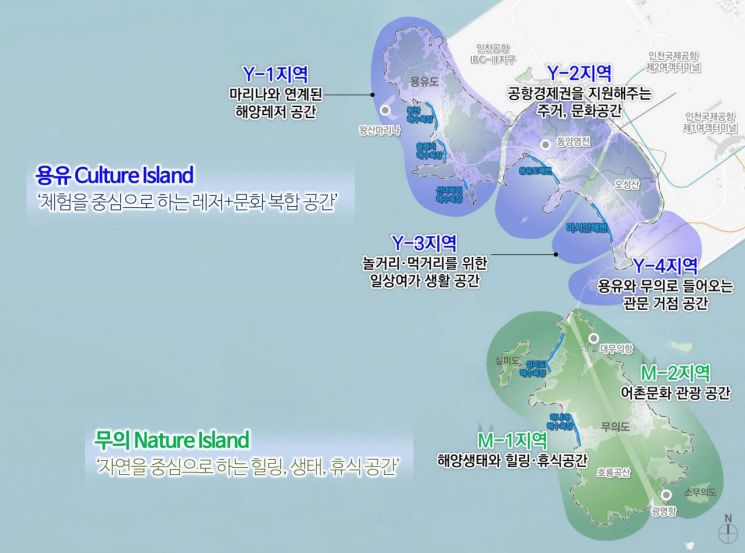
The research project focused on transforming the Yongyu area of Yeongjong Island into an experience-centered leisure and complex space, and the Muui area into a nature-centered ecological, healing, and relaxation space.
Specifically, in the Yongyu area, Wangsang Marina was designated as a marine leisure space linked with the marina, the area around Dongyang Salt Farm as a residential and cultural space supporting the airport economic zone, the Osungsan area as a daily leisure living space, and the area around Yongyu Station as a gateway hub space.
In the Muui area, Silmido, Hanagae Beach, and Horyonggoksan were proposed as marine ecological healing and relaxation spaces, while the areas around Daemuui Port, Somuui, and Gwangmyeong Port were planned as fishing village cultural tourism spaces.
Along with this, through analysis of surrounding area conditions and available development sites, six candidate sites for re-designation as free economic zones were selected, including the Wangsang Beach area, and development directions and land use plans (drafts) for each district were presented. Additionally, economic ripple effects on regional economic revitalization were reviewed through project cost estimation by district.
The spatial scope of this research project covers 25㎢ of the Yongyu and Muui areas, with a target year of 2030.
Since Yongyu and Muui areas were first designated as free economic zones in 2003, several changes in development plans and partial cancellations have resulted in insufficient planned and systematic management. In particular, to develop these areas into free economic zones with competitiveness centered on marine culture and tourism leisure in line with the Ministry of Trade, Industry and Energy’s "2nd Free Economic Zone Basic Plan (2018?2027)" announced in November 2018, it was necessary to establish a development strategy.
The research materials also included estimates of tourism demand for the 2030 target year, expansion of insufficient infrastructure in areas removed from the free economic zone, review of candidate sites for re-designation, and phased promotion strategies.
Based on the opinions presented at the report meeting, the Incheon Free Economic Zone Authority plans to additionally supplement the basic concept for tourism and leisure hubs, free economic zone re-designation plans, and other regulatory and institutional improvements, and include a comprehensive and macro development strategy in the final report by the end of this year.
Lee Wonjae, head of the Incheon Free Economic Zone Authority, stated, "The Yongyu and Muui areas have excellent natural scenery and are accessible within one hour from the metropolitan area. Considering the users and transfer passengers of the adjacent Incheon International Airport, these areas have sufficient competitiveness to develop the tourism and leisure industry. Based on the project results, we will cooperate with related organizations such as the Ministry of Trade, Industry and Energy to develop the Yongyu and Muui areas."
© The Asia Business Daily(www.asiae.co.kr). All rights reserved.
![Clutching a Stolen Dior Bag, Saying "I Hate Being Poor but Real"... The Grotesque Con of a "Human Knockoff" [Slate]](https://cwcontent.asiae.co.kr/asiaresize/183/2026021902243444107_1771435474.jpg)
















