'1 Company 2 Altteulpon' Excess Restriction Bill Proposed
KT and LGU+, Aggressively Expanding Businesses, Face Difficulties
Altteulpon Industry, Concerned About Mobile Carrier Monopoly, Welcomes Move
[Asia Economy Reporters Koo Chae-eun and Han Jin-joo] As KT and LG Uplus establish a 'one company, two MVNOs' structure in the budget phone market, a bill has been proposed to limit the number of budget phone subsidiaries per telecom company. This is to prevent the budget phone market from becoming an extension of competition among the three major telecom operators. While the budget phone industry welcomes the move, the differing interests of each telecom company in the budget phone market make the calculations regarding the stricter regulations more complex.
Bill Proposed to Limit 'One Company, Multiple MVNOs'
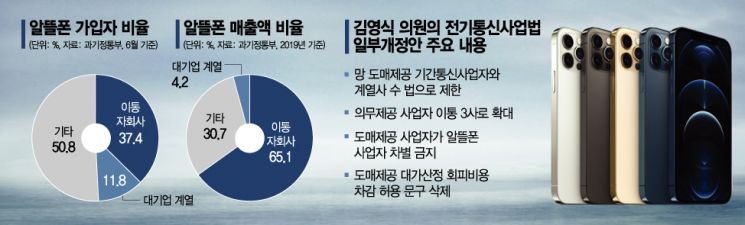
According to industry sources on the 2nd, Kim Young-sik, a member of the National Assembly’s Science, Technology, Information and Communications Committee from the People Power Party, has proposed an amendment to the Telecommunications Business Act that would set the number of MVNO subsidiaries a telecom company can have by presidential decree. The bill aims to curb telecom companies from expanding their budget phone businesses beyond the 'one company, two MVNOs' system, such as KT affiliates (Skylife and M Mobile) and LG Uplus (LG Hello and MediaLog).
The core of the bill is to set an upper limit on the number of subsidiaries operating budget phone businesses. This is to prevent the dominance of telecom companies from extending into the budget phone market and to protect and nurture small and medium-sized operators as mainstream players. Currently, there are no regulations limiting the expansion of budget phone businesses. The Ministry of Science and ICT only requires that when telecom subsidiaries apply to operate budget phone services, the combined market share of the three major telecom companies must not exceed 50%. As of June, telecom subsidiaries accounted for 37% of subscribers and 65% of revenue in the overall budget phone market.
Kim Young-sik explained, "Telecom companies operating budget phone businesses through subsidiaries are hindering fair competition in the market. The bill was proposed with the intention of promoting fair competition in the budget phone sector."
The bill also includes provisions to expand the mandatory wholesale service providers beyond SK Telecom to include LG Uplus and KT. The current law limits the wholesale provision period to three years, and the Ministry of Science and ICT has extended this period by revising the law at each sunset clause. Additionally, the bill proposes removing the allowance for deducting avoidable costs (costs that telecom companies can avoid when they do not provide services directly to users) from wholesale price calculations and prohibits discrimination in wholesale provision. Currently, wholesale price negotiations are delegated to the Ministry of Science and ICT, and KT and LG Uplus negotiate wholesale prices comparable to SK Telecom with individual operators.
Complex Calculations for the Three Major Telecom Companies
With upcoming changes in market dominance regulations, the calculations for the three major telecom companies are expected to become more complicated. The market share of budget phone networks among telecom companies is roughly 5 (LG Uplus) to 3 (KT) to 2 (SK Telecom). Especially after acquiring LG HelloVision (formerly CJ HelloVision), LG Uplus has aggressively expanded its budget phone business, leveraging wholesale price reductions. Both LG Uplus and KT, which are active in the budget phone business, are naturally sensitive to the proposed limit on the number of subsidiaries. Moreover, this differs from the government’s policy direction to promote budget phones. An industry insider said, "It is regrettable to overlook the contributions of telecom subsidiaries in expanding the budget phone market."
On the other hand, the budget phone industry welcomes the bill. This is due to concerns over the monopolization by telecom subsidiaries and the need to ensure the stability of the budget phone system. At the opening ceremony of Budget Phone Square, Kim Hyung-jin, chairman of the Korea Budget Telecommunications Operators Association, made a pointed statement that "the market share of telecom subsidiaries in the budget phone market should be reduced and they should withdraw from the business within three years." This is closely related to the current bill. A budget phone industry representative said, "We agree that an upper limit on the number of telecom subsidiaries is necessary as their numbers keep increasing," adding, "It is also necessary to abolish the sunset clause on mandatory wholesale provision and the avoidable cost clause to create diverse products and operate the budget phone business stably."
A Ministry of Science and ICT official stated, "The fundamental purpose of introducing budget phones is to provide users with affordable service and to activate competition," but also noted, "This is an issue that must be considered from a comprehensive perspective."
© The Asia Business Daily(www.asiae.co.kr). All rights reserved.
![Clutching a Stolen Dior Bag, Saying "I Hate Being Poor but Real"... The Grotesque Con of a "Human Knockoff" [Slate]](https://cwcontent.asiae.co.kr/asiaresize/183/2026021902243444107_1771435474.jpg)











