COVID-19, Borrowings, Route and Workforce Optimization... Numerous Challenges Ahead
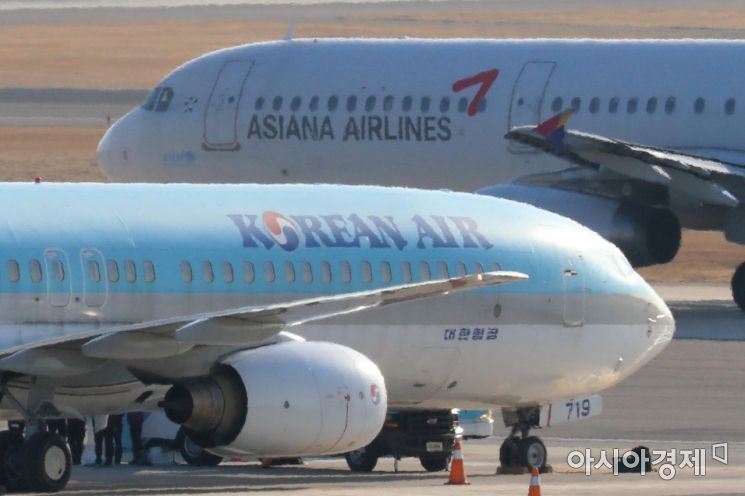 As the court's decision on Korean Air's acquisition of Asiana Airlines approaches, on the 30th, Korean Air and Asiana Airlines passenger planes were moving toward the runway at Gimpo Airport apron in Gangseo-gu, Seoul. The Seoul Central District Court is expected to deliver a ruling today or tomorrow on the injunction request filed by the activist private equity fund KCGI against Hanjin KAL to prohibit the issuance of new shares. If the court dismisses the injunction request, the acquisition process will accelerate, but if the injunction is granted, the acquisition is likely to be canceled. Photo by Kim Hyun-min kimhyun81@
[Asia Economy Reporter Yu Je-hoon] The court dismissed the provisional injunction filed by the private equity fund (PEF) KCGI against Hanjin KAL to prohibit the issuance of new shares, accelerating Korean Air's acquisition of Asiana Airlines. However, the prolonged contraction in air travel demand due to the COVID-19 pandemic and the tens of trillions of won in loans that must be repaid next year indicate a challenging road ahead before the full integration of the two companies.
◆ KDB Industrial Bank to inject 500 billion won today... Acquisition process speeds up = According to the aviation industry on the 2nd, KDB Industrial Bank and the Hanjin Group began procedures for Korean Air's acquisition of Asiana Airlines from this day. KDB Industrial Bank paid 500 billion won for a third-party allotment capital increase, securing a 10.66% stake in Hanjin KAL, and on the 3rd, it will acquire exchangeable bonds (EB) issued by Hanjin KAL, completing a total capital injection of 800 billion won.
Korean Air will use this 800 billion won to pay a deposit of 300 billion won to Asiana Airlines and begin a full-scale due diligence. By the end of the year, it will also acquire 300 billion won worth of perpetual convertible bonds (CB). Subsequently, Korean Air plans to secure funds through a shareholder allotment capital increase in March and participate in a third-party allotment capital increase of Asiana Airlines in June next year to acquire a 63.9% stake, completing the first phase of the merger and acquisition (M&A).
◆ Challenges of demand contraction, loan repayment, and restructuring = Although legal risks have been settled for now, many hurdles remain. First, the COVID-19 impact, which fundamentally restricts the aviation market, is prolonged. According to the 2021 demand forecast recently released by the Korea Transport Institute (KOTI), the domestic aviation market is expected to recover passenger demand to January 2021 levels by April 2022 at the earliest, or by June 2023 at the latest. This means that even after integration begins in earnest, the current austerity management measures such as paid and unpaid leave may continue for at least one to two years.
Massive short-term loan repayments are also anticipated. Korean Air's loans (short-term borrowings, current portion of long-term debt, current portion of lease liabilities) that must be repaid or refinanced next year amount to 5.2 trillion won, and Asiana Airlines also faces loans in the 3 trillion won range. It is difficult to rely solely on additional support from financial authorities and refinancing. Therefore, Korean Air is expected to focus on implementing self-help measures such as asset sales next year as well.
This year, Korean Air has pursued asset sales including its in-flight meal and in-flight sales division (about 1 trillion won), capital increase (about 1 trillion won), Wangsang Leisure Development (about 130 billion won), small-scale assets such as company housing in Jeju (about 40 billion won), and KAL Limousine (undecided). Among the remaining large assets, only the land in Songhyeon-dong, Jongno-gu, Seoul (36,642㎡), estimated to be worth 400 to 500 billion won, remains.
Industry insiders believe that since KDB Industrial Bank and others have consistently mentioned the need to sell non-core assets, remaining assets such as the Wilshire Grand Center in Los Angeles (LA), USA, may also be subject to sale. A company official said, "In addition, small-scale land and other trimming of excess will continue steadily."
Route and workforce optimization to be discussed during the M&A process also pose difficulties. KDB Industrial Bank and Hanjin Group estimate that about 1,000 indirect overlapping employees exist between the two companies, but industry insiders speculate that since both were large airlines, the actual number could reach several thousand in operations, cabin crew, and maintenance. With most employees currently on paid or unpaid leave due to COVID-19, how KDB Industrial Bank's imposed obligation of 'employment maintenance' will be upheld is a key issue.
Currently, the four labor unions of both companies are demanding a re-examination of the M&A from scratch, citing employment issues. An industry insider said, "Since employment maintenance was the rationale for integration, the principle will be upheld," adding, "In addition to natural attrition such as retirement, they will likely minimize workforce reduction needs through fixed-term workers."
Other remaining tasks include the chemical integration of employees who have competed for 30 years, and the optimization of long-haul routes that overlap not only in destinations but also in days and times.
© The Asia Business Daily(www.asiae.co.kr). All rights reserved.

















