[Asia Economy Reporter Kangwook Cho] The year 2021 marks the inaugural year of 'RESTART,' a new beginning where the pre-COVID-19 era and irreversible changes combine to create a new normal. Economic activities, which had stagnated, are expected to normalize with the development of COVID-19 vaccines, and the era of digital popularization will begin, based on the digital capabilities acquired in a short period and the essential technology for realizing a hyper-connected society, the 5G network.
Additionally, 2021 is the first year when all members of the MZ generation (Millennials and Generation Z) turn 20 years old or older, leading to a reorganization of the consumer market centered on the MZ generation with expanded purchasing power. Furthermore, with the election of U.S. President Biden, major countries are expected to refocus on eco-friendly policies.
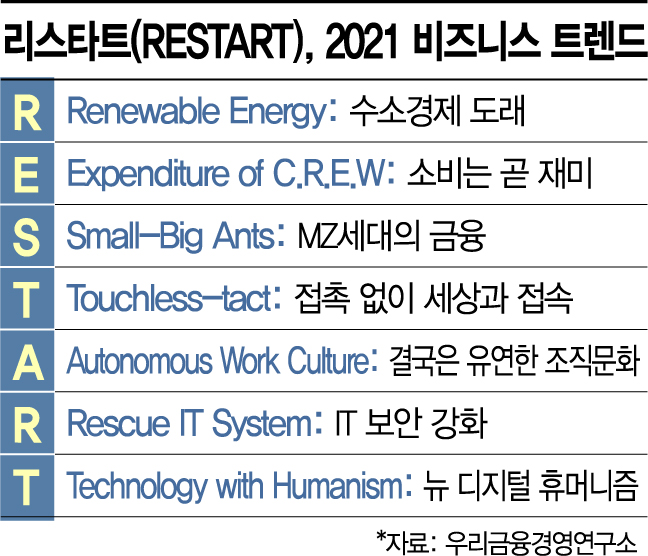
Woori Financial Management Research Institute summarized the changes emerging from the COVID-19 shock and announced on the 1st that it selected the seven major trends that will dominate the business ecosystem in 2021 under the acronym 'R.E.S.T.A.R.T.'
The seven major trends presented by the institute are ▲Renewable Energy (the advent of the hydrogen economy) ▲Expenditure of C.R.E.W (consumption equals fun) ▲Small-Big Ants (MZ generation finance) ▲Touchless-tact (connecting to the world without contact) ▲Autonomous Work Culture (ultimately flexible organizational culture) ▲Rescue IT System (strengthening IT security) ▲Technology with Humanism (new digital humanism).
Examining the seven business trends by their characteristics, they can be categorized into four groups: ▲Changes in interaction methods ('connecting to the world without contact,' 'ultimately flexible organizational culture'), ▲Expansion of MZ generation cultural influence ('consumption equals fun,' 'MZ generation finance'), ▲Technologies complementing digital transformation ('strengthening IT security,' 'new digital humanism'), and ▲Response to the climate crisis ('the advent of the hydrogen economy').
The institute expects that as the COVID-19 shock eases with vaccine development, digital transformation will accelerate technologically, the influence of the hyper-digital MZ generation will expand socially, and efforts to reduce carbon emissions will strengthen ecologically and politically in response to the climate crisis.
Accordingly, social interests are expected to shift from 'wise home-staying life' to 'safe outdoor activities,' with the MZ generation leading trends in the digital society. Especially, as the digital transformation moves beyond acceleration into digital popularization, attention is expected to focus more on the utilization aspect where users can safely and conveniently use technology rather than on supply factors such as new technology development. Additionally, to address issues like the sharp increase in electricity consumption due to digital transformation, the use of non-fossil energy sources is expected to expand. All seven business trends are based on mobile environments and characterized by digital technological innovations that can be applied anywhere regardless of location.
In particular, the MZ generation's approach to asset management, while fundamentally based on saving and investing like previous generations, is expected to differ in that they absorb information through YouTube, internet cafes, etc., and use digital platforms as their primary channels for financial activities. Investment targets include financial products incorporating 'gamification' that add fun, easy small-amount investments such as P2P, and high-risk, high-return investments (futures, options, cryptocurrencies). Consequently, the financial market is likely to be reorganized around platforms suitable for the MZ generation, who are emerging from potential customers to main customers, and financial services tailored to their areas of interest.
Kim Sujin, head of the Industrial Research Team at the Future Research Office and author of the report, advised, "Along with Korea's advanced IT technology and infrastructure, the culture of actively embracing new technologies is evaluated as a strength that will lead business trends during the digital transformation period. Financial companies need not only to actively promote digital innovation internally but also to focus on the new main customer base emerging from trend changes, discover appropriate financial services and customer touchpoints, and seek business opportunities in newly emerging industries."
© The Asia Business Daily(www.asiae.co.kr). All rights reserved.

















