Increased Dividend Size Raises Possibility of Institutional Inflow into Stock Market
Annual Dividends Up 3% Year-on-Year Despite No Special Dividends
[Asia Economy Reporter Minji Lee] With the possibility of a special dividend from Samsung Electronics, the year-end dividend scale of the KOSPI 200 is expected to increase, leading to forecasts that the index could rise further due to the inflow of financial investors into the stock market.
According to Shinhan Investment Corp. on the 29th, the annual dividends of domestic companies this year, based on KOSPI 200 companies, are expected to reach around 33.06 trillion KRW, a 25% increase compared to last year. Despite a decrease in quarterly and interim dividends from March to September due to poor performance caused by the novel coronavirus disease (COVID-19), the reason for the significant increase in annual dividend scale is the possibility of a special year-end dividend from Samsung Electronics.
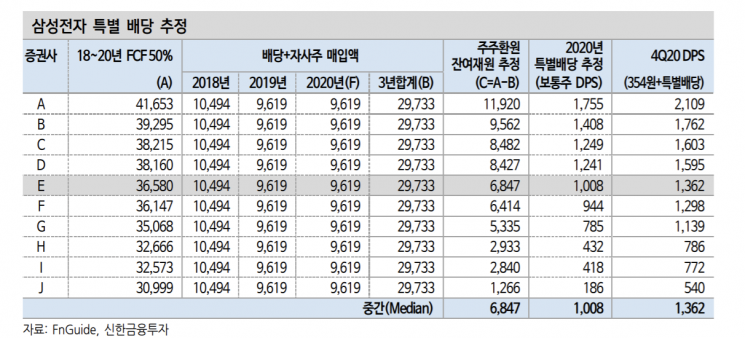
Samsung Electronics will finalize and announce the decision on the special dividend, its amount, and shareholder return policy from next year onward by the end of January next year. At the end of 2017, Samsung Electronics disclosed a shareholder return plan for three years from 2018 to this year, stating that it would use 50% of Free Cash Flow (FCF) over three years for shareholder returns.
Kang Songcheol, a researcher at Shinhan Investment Corp., said, “Although the expected FCF amounts vary among securities firms this year, excluding extreme values and taking the median, there will be about 6.8 trillion KRW of shareholder return funds remaining even after paying dividends at the usual level,” adding, “This amount allows for a special dividend of around 1,000 KRW per share at year-end.”
Besides Samsung Electronics, several large companies such as LG Chem and KT&G have announced plans to increase shareholder returns and dividends this year. Even assuming no special dividend from Samsung Electronics at year-end, the annual dividends of KOSPI 200 companies this year are expected to increase by about 3% compared to last year, reaching around 27 trillion KRW. Although dividends slightly decreased compared to the previous year, the trend has been continuously increasing since 2015.
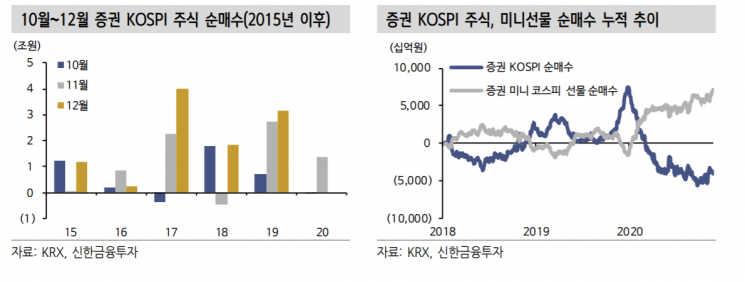
Accordingly, it is expected that movements by financial investors aiming for dividends will become more active toward the end of the year. Researcher Kang explained, “Every year from October to December, there is a significant inflow of program buying targeting dividends,” and added, “Since the exemption of transaction tax for mini-futures liquidity providers (LP) securities firms, the year-end stock buying by domestic institutions in securities has become most prominent.”
With the possibility of increased year-end dividends due to Samsung Electronics’ special dividend and financial investors currently having the largest capacity to buy stocks compared to the past, there is significant room to purchase stocks. From 2017 to 2019, financial investment firms recorded net purchases of over 5 trillion KRW in KOSPI stocks from October to December on average, but this year, from October to recently, net purchases have been 1.5 trillion KRW, indicating an additional buying capacity of about 3 trillion KRW compared to the past.
© The Asia Business Daily(www.asiae.co.kr). All rights reserved.
![Clutching a Stolen Dior Bag, Saying "I Hate Being Poor but Real"... The Grotesque Con of a "Human Knockoff" [Slate]](https://cwcontent.asiae.co.kr/asiaresize/183/2026021902243444107_1771435474.jpg)

















