[Asia Economy Reporter Suyeon Woo] Businesspeople from both Korea and Japan came together to improve the strained Korea-Japan relations and discuss economic cooperation in the 'post-COVID-19 era.'
On the 27th, Korean and Japanese businesspeople held the 52nd Korea-Japan Economic Conference by connecting the Okura Hotel in Tokyo and the JW Marriott Hotel in Seoul via video conference. Since 1969, the conference has been held alternately in Korea and Japan every year, but this year the meeting was postponed once due to the COVID-19 pandemic.
On this day, the businesspeople from both countries conducted the meeting via video conference and agreed to continue private sector exchanges aiming to achieve the Sustainable Development Goals (SDGs) despite the impact of COVID-19. They also declared the launch of a new era for sustainable development goals and issued a joint statement to strengthen Korea-Japan relations after COVID-19.
The joint statement included ▲continuation and expansion of economic, talent, and cultural exchanges between the two countries ▲welcoming the agreement on RCEP (Regional Comprehensive Economic Partnership) and promoting Korea-Japan collaboration in third countries ▲achievement of SDGs ▲addressing common challenges such as low birthrate, aging population, the Fourth Industrial Revolution, decarbonized society, and global value chains ▲activation of youth and regional exchanges ▲mutual cooperation for the successful hosting of the Tokyo Olympics and Paralympics.
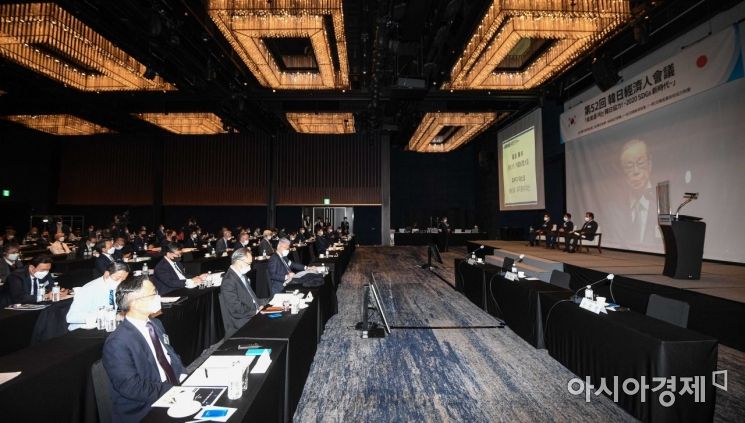 Yasuo Fukuda, the 91st Prime Minister, is giving a greeting at the '52nd Korea-Japan Economic Meeting' held on the 27th at JW Marriott Hotel in Seocho-gu, Seoul. Photo by Jinhyung Kang aymsdream@
Additionally, both sides urged the implementation of necessary measures to resume smooth business exchanges between the two countries. Kim Yoon, Chairman of the Korea-Japan Economic Association, stated, "We hope for additional essential measures for economic cooperation between the two countries, such as freer and simpler entry, quarantine exemptions, and the resumption of Gimpo-Haneda international flights."
He added, "We greatly welcome the recent efforts to resolve conflicts between Korea and Japan, including the dialogue and communication between the two governments. The two countries must cooperate to solve common challenges such as low birthrate, aging population, regional revitalization, and the Fourth Industrial Revolution."
On the Japanese side, Mikio Sasaki, Chairman of the Japan-Korea Economic Association, responded, "The global situation is being affected more than ever by COVID-19. As globalization connects the world as one, risks also impact the world in various forms. It is important that the world works together for recovery."
Meanwhile, Nam Gwan-pyo, the Korean Ambassador to Japan who attended the meeting, emphasized that the Korean government is making efforts to resolve the deteriorated Korea-Japan relations caused by lawsuits related to forced labor. Ambassador Nam said, "Since the second half of last year, Korea-Japan economic relations have been in a difficult situation and have not easily recovered. The Korean government is doing its best to overcome the current situation that causes difficulties and damages to the people and companies of both countries."
In response, Yasuo Fukuda, former Prime Minister of Japan and a guest at the meeting, said, "The two countries are the most important neighbors and have deepened relations in broad fields such as politics, diplomacy, economy, and culture, especially as important trade partners economically," emphasizing the need to maintain amicable relations. Fukushiro Nukaga, Chairman of the Japan-Korea Parliamentary League and member of the Liberal Democratic Party’s House of Representatives, pointed out that a 'Fourth Korean Wave boom' is occurring among young Japanese generations with the popularity of Korean dramas and K-pop, but "the political field feels the most delayed in Korea-Japan relations."
The meeting was attended by 98 people from the Korean side, including Kim Yoon, Chairman of the Korea-Japan Economic Association as the head, Park Ki-young, Deputy Minister of the Ministry of Trade, Industry and Energy, Nam Gwan-pyo, Ambassador to Japan, Hong Seok-hyun, Chairman of the Korea-Japan Vision Forum, Ryu Doo-hyung, President of Hanwha Solutions, Ryu Jin, Chairman of Poongsan Group, Son Bong-rak, Chairman of TCC Steel, Shin Dong-bin, Chairman of Lotte Group, Lee In-yong, President of Samsung Electronics, and Korean companies in Japan.
On the Japanese side, 109 people attended, led by Mikio Sasaki, Chairman of the Japan-Korea Economic Association, including former Prime Minister Yasuo Fukuda, Fukushiro Nukaga, Chairman of the Japan-Korea Parliamentary League, Masakazu Tokura, Vice Chairman of the Advisory Committee (Chairman of Sumitomo Chemical), Yutaka Aso, Vice Chairman (Chairman of Aso Cement), Haruhiro Imizu, Vice Chairman (President of Nikkan Kogyo Shimbun), Nobuhiko Murakami, Vice Chairman of the Advisory Committee (Head of Toyota Motor Corporation), and Japanese companies in Korea.
© The Asia Business Daily(www.asiae.co.kr). All rights reserved.