Continued Shift to Buying in Mid-Low Price and Job-Residence Proximity Areas Due to Jeonse Shortage
Gimpo, Goyang, and Namyangju See Increased Price Gains Following Non-Local Purchases
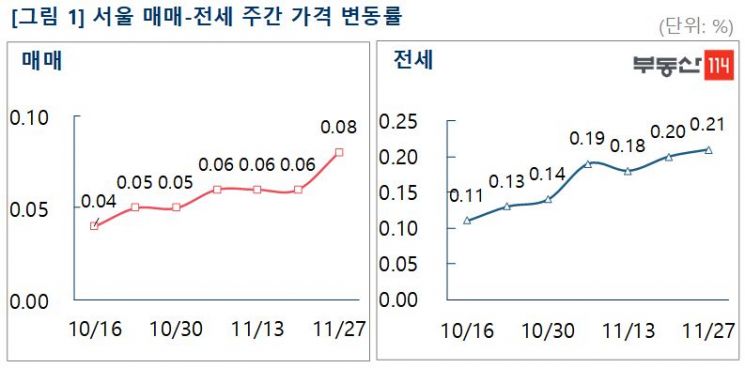
[Asia Economy Reporter Yuri Kim] The rate of increase in apartment sale prices in Seoul expanded in the last week of November compared to the previous week. Among the 25 districts in Seoul, 13 districts saw a larger rise in apartment prices, with notable increases in mid-to-low-priced apartment clusters such as Geumcheon, Guro, and Dobong. In the metropolitan area, prices rose mainly in Gimpo (649 transactions), Goyang (326 transactions), and Namyangju (286 transactions), where the highest number of apartment purchases by Seoul residents occurred in October. Meanwhile, the jeonse (long-term lease) market saw a wider price increase than the previous week as the shortage of available properties expanded throughout the metropolitan area.
According to Real Estate 114 on the 27th, the rate of change in Seoul apartment sale prices recorded an expanded increase of 0.08% compared to the previous week. Reconstruction and general apartments rose by 0.06% and 0.08%, respectively. Additionally, Gyeonggi and Incheon rose by 0.10%, and new towns increased by 0.16%.
In Seoul, there is a trend of switching to buying, centered on mid-to-low-priced apartments in areas with good proximity to workplaces and school districts. By region, prices rose in the following order: Songpa (0.17%), Yongsan (0.15%), Nowon (0.12%), Yangcheon (0.12%), Gangseo (0.11%), Gangdong (0.08%), Guro (0.08%), Geumcheon (0.08%), and Dongdaemun (0.08%). In Songpa, large-sized units in Olympic Athlete Village in Bangi-dong, Heliocity in Garak-dong, and Jamsil Jugong Complex 5 in Jamsil-dong increased by 15 to 30 million KRW. In Yongsan, Daewoo and Kolon in Ichon-dong rose by 10 to 50 million KRW. In Nowon, Sangye Jugong Complex 7 and Jugong Complex 2 in Sangye-dong increased by 2.5 to 15 million KRW. In Yangcheon, with the approval of the Mokdong Line and Gangbuk Transversal Line construction plans, Mokdong Shinsigaji Complex 7 in Mokdong, Sinwol Shiyeong in Sinwol-dong, and Mokdong Woosung Complex 2 in Sinjeong-dong rose by 10 to 30 million KRW.
New towns showed strength mainly in the southern metropolitan area, with a balloon effect on nearby Ilsan following Gimpo's designation as a regulated area. By region, prices rose in the following order: Pangyo (0.30%), Ilsan (0.29%), Pyeongchon (0.19%), Gwanggyo (0.19%), Wirye (0.16%), and Bundang (0.15%). In Pangyo, Botdeul Village Complex 4 in Sampyeong-dong, Baekhyeon Village Complex 6 in Baekhyeon-dong, and Pangyo Won Village Complex 1 in Pangyo-dong increased by 10 to 20 million KRW. In Ilsan, Gangchon Complex 7 Seonkyung Kolon in Madu-dong, Moonchon Complex 3 Woosung in Juyop-dong, and Jangseong Complex 4 Daemyung in Daehwa-dong rose by 5 to 10 million KRW. In Pyeongchon, Hangaram Sekyung in Gwanyang-dong and Chowon Booyoung in Pyeongchon-dong increased by 5 to 10 million KRW. In Gwanggyo, Gwanggyo Ode County in Iui-dong and Hillstate Gwanggyo in Hadong rose by 10 million KRW.
Gyeonggi and Incheon rose in the following order: Gimpo (0.29%), Goyang (0.23%), Namyangju (0.19%), Paju (0.19%), Uiwang (0.17%), Hwaseong (0.15%), and Yongin (0.14%). In Gimpo, Cheongsong Hyundai Hometown Complex 2 in Janggi-dong and Shindonga in Pungmu-dong increased by 5 to 22.5 million KRW. In Goyang, large complexes such as Wiscity Blooming Complex 3 in Siksa-dong, Raemian Hurest in Seongsa-dong, and Goyang Wonheungdong Ilsuite Complex 7 in Donae-dong rose by 5 to 10 million KRW. In Namyangju, Mirinae Village Hanwha Dream Green in Byeollae-dong, Doosan We’ve and Dongbu Centreville in Wabu-eup increased by about 10 million KRW. Paju, which remains a non-regulated area, saw continued transaction inquiries, with Hugok Village Ttaranchae Complex 4 in Geumchon-dong and Paju Prugio in Jori-eup rising by 5 to 12.5 million KRW.
The metropolitan jeonse market continued to see a shortage of available properties, with Seoul rising by 0.21%. Gyeonggi, Incheon, and new towns rose by 0.13% and 0.17%, respectively.
In Seoul's jeonse market, demand is flowing mainly to areas near subway stations and large complexes. By region, prices rose in the following order: Songpa (0.36%), Gwanak (0.30%), Nowon (0.27%), Gangnam (0.25%), Gangseo (0.25%), Gangbuk (0.23%), and Geumcheon (0.23%). In Songpa, Olympic Athlete Village in Bangi-dong and Heliocity in Garak-dong increased by 10 to 30 million KRW. In Gwanak, Samsung Mountain Jugong Complex 3 in Sillim-dong, Gwanak Prugio in Bongcheon-dong, and Seonghyeon Dong-A increased by 5 to 25 million KRW. In Nowon, Dream Forest SK View in Wolgye-dong and Hanshin Dongseong in Hagye-dong rose by 10 to 25 million KRW. In Gangnam, Hanbo Mido Mansion Complex 1 and 2 and Seonkyung Complex 1 and 2 in Daechi-dong, and Dogok Hanshin in Dogok-dong increased by 10 to 25 million KRW. In Gangseo, Hangang Dong-A Complex 2 in Yeomchang-dong and Gangseo Hangang Xi in Gayang-dong rose by 15 to 25 million KRW. In Gangbuk, Buksan Live Park in Mia-dong increased by 10 million KRW.
New towns rose in the following order: Dongtan (0.27%), Bundang (0.24%), Ilsan (0.19%), Paju Unjeong (0.19%), and Sanbon (0.18%). In Dongtan, large complexes such as Sibendaeun World Meridian Bando Yubora in Bansong-dong, Dongtan 2 New Town Central Prugio in Cheonggye-dong, and e-Pyeonhansesang Dongtan in Mokdong rose by 10 to 20 million KRW, driving the upward trend. In Bundang, Sangnok Woosung in Jeongja-dong, Jangmi Hyundai in Yatap-dong, Kkachi Lotte and Seonkyung in Gumi-dong increased by 10 to 20 million KRW. In Ilsan, Gangchon Complex 1 Dong-A in Madu-dong, Seongjeo Complex 1 Dongik in Daehwa-dong, and Moonchon Complex 3 Woosung in Juyop-dong rose by 5 to 10 million KRW, mainly in large-sized units. In Paju Unjeong, Hanbit Village Complex 1 Hanla Vivaldi Central Park in Yadang-dong and Garam Village Complex 4 Hanyang Sujain in Wadong-dong increased by 5 to 10 million KRW.
Gyeonggi and Incheon rose in the following order: Goyang (0.24%), Gimpo (0.21%), Namyangju (0.21%), Seongnam (0.19%), Paju (0.19%), Hwaseong (0.19%), and Yongin (0.17%).
Although the government announced on the 19th in the jeonse measures that it would increase short-term jeonse-type rental housing, most of the supply is expected to be multi-family houses or officetels rather than apartments. Due to the resulting disappointment and the exhaustion of tenants from the shortage of available properties, the trend of switching to buying continues. Demand is flowing into new towns with good residential environments, including Gyeonggi Gimpo, Goyang, and Namyangju, which have good accessibility to Seoul and relatively low housing prices, leading to an expanded rise in sale prices in Bundang, Ilsan, and Gwanggyo compared to the previous week. Kyunghee Yeo, senior researcher at Real Estate 114, said, "If the jeonse crisis is not quickly resolved, the possibility of a continued increase in the rate of price rises due to switching to buying cannot be excluded."
© The Asia Business Daily(www.asiae.co.kr). All rights reserved.

















