In the Past, Conflicts Mainly Between Teachers with Different Tendencies
Recently, Emotional Clashes Between Job Types Intensify
No Clear Work Guidelines Within Schools
Clashes Over Water Dispenser Management Occur
As Schools Partially Handle Educational Tasks
Calls for Specialized Training for Public Service Workers Raised
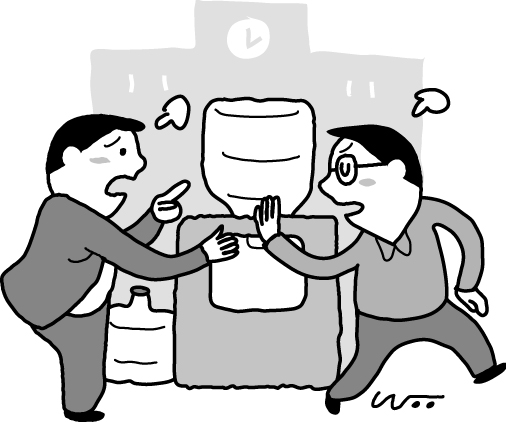
[Asia Economy Reporter Hyunju Lee] A dispute broke out at a certain school over the issue of the 'water purifier.' Staff members from different job categories argued with each other, saying "It's not my responsibility," and as a result, no one ended up managing the water purifier. Students were unable to drink water for a while. Administrative officials and educational public employees said, "Since the water purifier is inside the classroom, the teacher should manage it," while teachers insisted, "Environmental management unrelated to teaching should be handled by administrative or public employees." Because various job categories work together in schools, conflicts over job scope like this occur, and emotional disputes such as "passing the buck" or "not working but still getting paid" frequently arise. Only the innocent students suffer.
In the past, labor conflicts in schools mainly occurred among teachers with different educational directions or ideological tendencies. However, now they occur in various and complex forms among teachers, administrative officials, and educational public employees. Educational public employees, numbering about 50 different job categories, stand in the middle. Educational public employees are not civil servants but organize general labor unions to negotiate. When they take actions such as strikes, learning rights are immediately infringed upon, so the local education offices have resolved conflicts mostly by accepting their demands. Recently, there have been criticisms that the successive improvements in treatment have been somewhat unreasonable. A professor of education said, "Educational public employees are more of a labor policy issue than an educational policy target," adding, "Except that their wages come from the education office budget, they are practically unrelated to education."
Educational public employees are selected and hired by the superintendent of education. Therefore, the negotiation counterparts are the 17 metropolitan and provincial education offices. Negotiations are conducted regionally, but in reality, the regions influence each other in a 'federated' manner. When one education office improves treatment, demands arise and are realized in other regions as well. As these negotiations continue annually, education offices have struggled to respond independently and have even requested help from the Ministry of Education. However, the Ministry of Education has avoided responsibility, citing that personnel authority lies with the education offices and that it is part of educational autonomy. Through this process, the treatment of educational public employees has steadily improved. An education official said, "The number of public employees increased by 20% over the past three years, but wages increased by 300%."
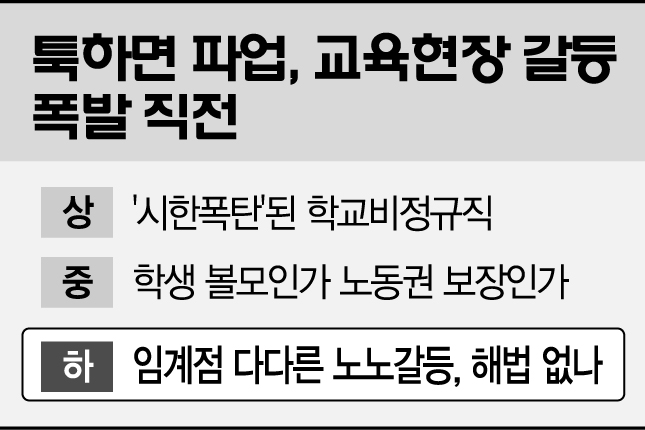
While frequent disturbances such as strikes during the process of improving treatment for educational public employees are problematic, ambiguous job scopes are also an area that needs resolution. Conflicts between teachers and care workers are particularly acute. In a small rural school, a care classroom was operated in a staff residence away from the school due to insufficient space. The care worker proposed moving the care classroom inside the school citing safety concerns, but it took two years to secure space. Even then, the space was provided in a corner of the health room, not a formal classroom. Among teachers, care is not regarded as "part of education," and there is widespread indifference with attitudes like "It's not my job, so I don't care." A teacher at an elementary school in Gyeongbuk criticized care workers, saying, "They only want to leave the school when there is a strike because they always get benefits," and "Sometimes they just read books during work hours, and even come in during times when no children are present to write overtime sheets."
Conflicts with administrative officials are also severe. In one school, an administrative official from the 'facility management category' and an educational public employee called 'facility manager' work together. Naturally, disputes over facility management responsibilities are inevitable. Adjusting job scopes is the principal's authority, but it is difficult because taking sides with either party can lead to collective dissatisfaction. Therefore, principals unanimously call for the education authorities to create 'guidelines' for determining job scopes between occupational categories.
Since educational public employees have contact with students in some form, there are calls for education that guarantees their professionalism. Also, it is necessary to decide what happens when educational public employees, who entered the school qualified for specific tasks, face the disappearance of those tasks in the future. Most of them are indefinite-term contract workers, so they may not leave even if the job disappears. An education official said, "Education offices should help educational public employees feel a sense of mission and contribute to their working environment and tasks, and the Ministry of Education should make efforts to establish these job categories by creating overall work guidelines."
© The Asia Business Daily(www.asiae.co.kr). All rights reserved.


















