Essential Power Born to Prepare for North Korea's Artillery Enhancement
Arms, Propellant, and Shell Developed from Scratch to Increase Range
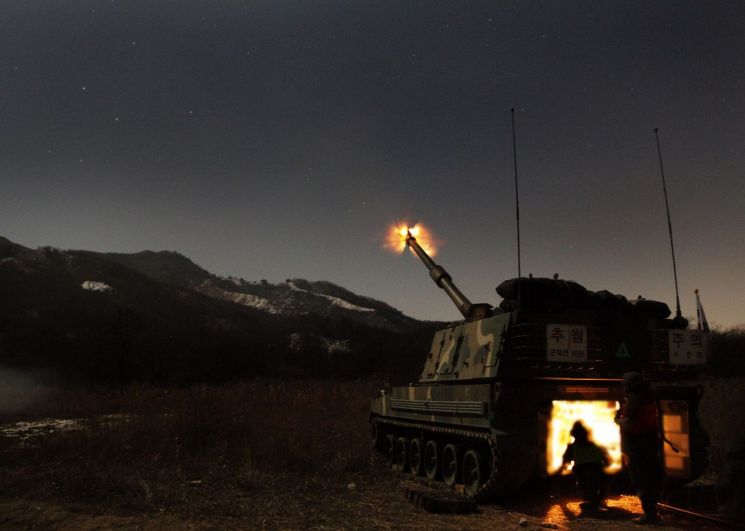
[Agency for Defense Development]The K9 self-propelled howitzer is a domestically unique model of self-propelled artillery whose development was completed in 1998 after ten years of research starting in 1989. In the early 1980s, the Army raised the need for a modern self-propelled howitzer with superior mobility, operability, and survivability compared to towed howitzers to compensate for the firepower disadvantage alongside the deployment of the KH179 towed howitzer.
Subsequently, it was decided to domestically produce under license the M109A2 self-propelled howitzer, which was the most widely operated worldwide at the time, and a memorandum of understanding was signed with the United States in December 1983, leading to its deployment from 1985.
However, as North Korea continuously increased its artillery deployments, South Korea remained at a disadvantage. North Korea had 5,000 more artillery pieces than South Korea, with 50% of them being self-propelled or vehicle-mounted, facilitating mobility. In particular, there was a need to establish countermeasures against the 170mm long-range artillery. Tactically, the Army required artillery with deep strike capability suitable for the Korean operational environment in the 2000s, leading to the decision to develop the K9, a new automated self-propelled howitzer with a range of about 40 km.
▲ Challenges to Securing Maximum Range= During research and development, securing the maximum range of the K9 self-propelled howitzer required the development of new armaments, propellants, and projectiles. It was necessary to design a barrel, breech block, and mount capable of withstanding the high pressure inside the barrel and firing shock more than twice that of the K55. Particularly important was the trade-off involving weight reduction, recoil minimization, and safety, which were directly related to the safety of the armament.
Through simulations, prototype structures were tested by firing, followed by redesign and retesting in repeated cycles. For the propellant, achieving a 40 km range required generating more energy while keeping chamber pressure below the barrel’s design limit and minimizing pressure differences inside the barrel.
With a lack of domestic independent propellant design technology, extensive experiments and analyses were necessary to optimize the propellant design. Although this was a highly risky task directly related to safety, and despite difficulties in technology transfer, the team challenged domestic development and experienced numerous dangerous moments during the process.
The projectile was designed to be as streamlined as possible to minimize drag during flight, while having small fins (nubs) to ensure stable movement inside the barrel. However, issues during loading required redesign during practical development. The technology to reduce drag behind the projectile was developed independently through the team’s persistent efforts despite having no prior related experience. As a result, long-range ammunition was exported to Turkey, and technology including ammunition production facilities was exported to Egypt.
 Challenges such as weight reduction and recoil minimization were necessary to secure range
Started without proprietary technology and repeated numerous experiments and analyses to optimize propellant design
After technology development, long-range ammunition was exported to Turkey, and ammunition production facilities were exported to Egypt
▲ Completion of Vehicle Sector through New Technology Development= Due to a lack of independent development technology and experience in the vehicle sector, a mobility test vehicle was produced by mounting a foreign power unit on a domestically developed structure and tested. Due to insufficient engine performance, mobility requirements were not met, leading to replacement with a German MTU engine for development.
This experience significantly enhanced vehicle system development capabilities. Additionally, unlike existing self-propelled howitzers with aluminum structures, new technology was needed to design and manufacture armored hull and turret protection structures using domestic armor plates. This was because it was difficult to theoretically estimate the durability of armored turret structures that must withstand firing shocks several times greater than existing self-propelled howitzers.
The research team tested the turret structure by applying loads from 15 tons up to 130 tons using a hydraulically operated hammer, identifying and improving many vulnerable areas. At that time, domestic engines, transmissions, position sensors, and muzzle velocity measurement radars had to be imported due to technological shortcomings and insufficient production infrastructure. The hydro-pneumatic suspension system was developed by adopting imported technology to suit the K9 self-propelled howitzer. This developed hydro-pneumatic suspension system was later re-exported to the United Kingdom.
▲ Birth of South Korea’s Strongest Firepower= The completed system had to prove its performance through testing. Although domestic testing facilities were inadequate at the time, creative ideas were necessary to perform the prescribed test items. The self-propelled howitzer system had to be stored under extreme cold conditions of minus 32°C before performance verification, but since a low-temperature chamber was unavailable, nitrogen gas was injected into a sealed building to lower the temperature, and operators wore oxygen masks to conduct the tests.
During the development period, a test site was constructed, allowing successful completion of related electromagnetic compatibility tests, durability driving tests, and mobility performance tests. The domestic independent development process of the K9 self-propelled howitzer involved many risks but successfully completed on schedule by integrating domestic ground weapon system development technology and experience and maintaining organic and active cooperation among the research institute, military, and defense industry companies.
© The Asia Business Daily(www.asiae.co.kr). All rights reserved.
![Clutching a Stolen Dior Bag, Saying "I Hate Being Poor but Real"... The Grotesque Con of a "Human Knockoff" [Slate]](https://cwcontent.asiae.co.kr/asiaresize/183/2026021902243444107_1771435474.jpg)
















