Responsible Role of Major Shareholders, Pain Sharing by Stakeholders, and Establishment of Sustainable Normalization Measures
Securing Long-term Competitiveness and Growth Foundation through Proactive Aviation Industry Restructuring
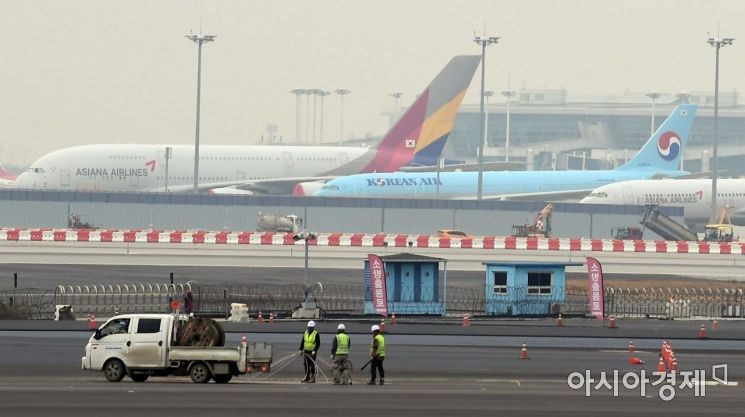 As Korean Air moves forward with the acquisition of Asiana Airlines, on the 17th, Korean Air and Asiana Airlines passenger planes are parked behind the construction site of the 4th runway at Incheon International Airport. Photo by Mun Ho-nam munonam@
[Asia Economy Reporter Jo Gang-wook] The Korea Development Bank (KDB) announced on the 26th that the plan to integrate the two major national airlines is being promoted in accordance with the three major principles of restructuring: responsible roles of major shareholders, pain-sharing among stakeholders, and preparation of sustainable normalization measures, in relation to the recent restructuring plan of the aviation industry.
According to KDB on the day, Chairman Cho Won-tae, an affiliated shareholder, has provided all of his shares in Hanjin KAL as collateral for breach of investment agreement and agreed to step down from the front line of management if the integration promotion and management performance prove inadequate. The market value of Chairman Cho’s shares amounts to a total of 273 billion KRW, and considering the previously provided collateral debt amount, the actual collateral value this time is about 170 billion KRW (applying 70,000 KRW per share).
Additionally, through the Ethics Management Committee, KDB emphasized that a system has been established to oversee the ethical management of Hanjin KAL, its major affiliates, and affiliated shareholders, recommend necessary investigations and actions, and impose penalties for breach of agreement and demand resignation if recommended measures are not followed.
KDB explained, "The mergers and acquisitions between companies are carried out by the acquiring company, not the major shareholder, by raising funds. It is difficult to unilaterally force the major shareholder of Hanjin KAL, a normal company rather than a restructuring company, to make personal contributions. Through management evaluations, measures such as disposal of collateral shares and resignation can be taken if the affiliated shareholder’s management performance is inadequate. KDB will faithfully fulfill its role of checks and monitoring."
Furthermore, KDB argued that although Korean Air requires urgent liquidity due to the COVID-19 crisis, considering it is a normal company, it is inappropriate to apply the same normalization measures (such as free capital reduction, creditor group equity conversion, and implementation of self-help plans) that are generally applied to restructuring companies.
Korean Air has already fulfilled its responsibilities as a normal company by borrowing 1.2 trillion KRW in emergency funds from creditor groups (KDB and Korea Eximbank) this year and faithfully executing self-help plans under special agreements, such as selling the Songhyeon-dong site and the in-flight meal and in-flight sales businesses.
Also, the management of Hanjin KAL and Korean Air have been reducing wages since April this year as part of pain-sharing. Affiliated shareholders have cut wages by half. Employees of the two major national airlines are also sharing the pain by enduring extensive paid and unpaid leave and furloughs to overcome the unprecedented COVID-19 crisis. Korean Air has about 9,800 employees on paid leave monthly, Asiana Airlines has about 2,600 employees on paid leave and about 5,600 employees on unpaid leave monthly.
As of the end of the third quarter this year, the debt ratios of Korean Air and Asiana Airlines reached 737% and 2,432%, respectively, and the combined funding shortfall for next year is expected to be 4.8 trillion KRW. Amid this, Korean Air has secured a funding base of about 2.5 trillion KRW from the capital market through a paid-in capital increase based on integration synergy from acquiring Asiana Airlines. This early capital increase is possible due to the capital market’s expectations of future corporate value growth from the integration synergy of the two companies. KDB explained that it is difficult for Korean Air alone to raise large-scale funds from the capital market while the current COVID-19 situation continues.
KDB stated, "The integrated airline can realize external growth and economies of scale by expanding its slot share at Incheon Airport, strengthening joint ventures with global airlines, and attracting overseas transfer demand. It is also expected to improve profitability through various synergies from integration, such as rationalizing route operations, joint purchasing of maintenance materials, internalizing Asiana Airlines’ outsourced maintenance costs, and reducing handling costs by sharing ground handling company tasks. We judge that the integration of the two companies will create a significant win-win effect."
Moreover, KDB emphasized, "Therefore, this aviation industry restructuring plan can be evaluated as a sustainable normalization measure in that it has established a long-term growth foundation by strengthening the fundamental competitiveness of the integrated national airline and the domestic aviation industry to overcome the COVID-19 crisis and prepare for the post-COVID era."
© The Asia Business Daily(www.asiae.co.kr). All rights reserved.
![Clutching a Stolen Dior Bag, Saying "I Hate Being Poor but Real"... The Grotesque Con of a "Human Knockoff" [Slate]](https://cwcontent.asiae.co.kr/asiaresize/183/2026021902243444107_1771435474.jpg)
















