Korea Real Estate Board Weekly Apartment Prices for 4th Week of November
Price Increase Rates Narrow in Gimpo and Busan Designated as Adjustment Areas
Seoul Jeonse Prices Rise 0.15%... Increase Continues
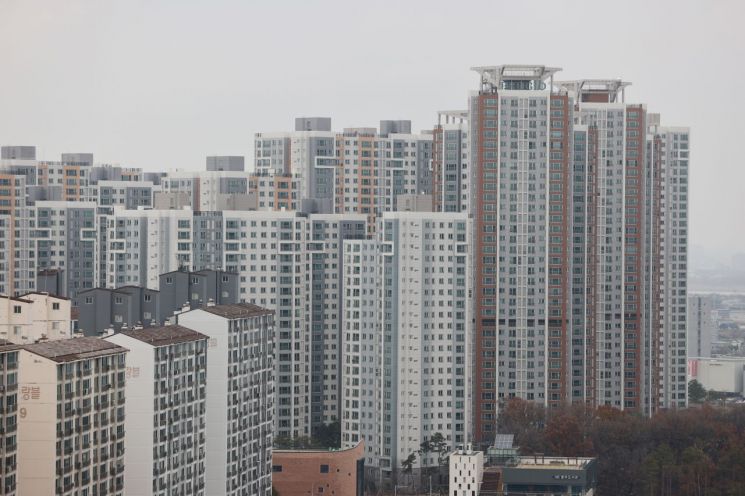
[Asia Economy Reporter Moon Jiwon] The apartment sale price growth rate in Gimpo, Gyeonggi Province, which was designated as a regulated area on the 20th, has dropped to less than half. Busan, also included in the regulated areas along with Gimpo, showed a reduced rate of increase, indicating a slowdown in buying demand.
However, the jeonse (long-term lease) market remains unstable. Although the government announced the '11·19 Jeonse Measures' to address the jeonse shortage, apartment jeonse prices in Seoul continued to rise at the same rate as the previous week, and the rate of increase in local areas and Sejong actually grew larger.
Gimpo Apartment Price Growth Rate Plummets from 2.73% to 0.98%
According to the weekly apartment price trend for the fourth week of November released by the Korea Real Estate Board on the 26th, as of the 23rd, apartment sale prices in Gimpo rose by 0.98% compared to the previous week. Although this is a relatively large increase compared to other regions, it is a significant reduction from the previous week's 2.73%.
Similarly, Busan (0.54%), designated as a regulated area, also saw a reduced rate of increase compared to the previous week (0.72%). However, areas with weaker regulations such as Busanjin-gu (1.03%) and Geumjeong-gu (0.94%) experienced price increases mainly in regions with development prospects.
The Ministry of Land, Infrastructure and Transport designated seven new regulated areas on the 19th after deliberation by the Residential Policy Deliberation Committee, including Gimpo in Gyeonggi Province (excluding Tongjin-eup, Wolgot, Haseong, and Daegot-myeon), Busan's Haeundae, Suyeong, Dongnae, Yeonje, and Nam-gu, and Daegu's Suseong-gu.
After the designation as regulated areas, buying sentiment in Gimpo and Busan weakened significantly, leading to a flood of apartment listings. Areas designated as regulated zones face strengthened regulations on capital gains tax for multi-homeowners and comprehensive real estate tax.
On the other hand, Paju (1.06%), which escaped regulation this time, saw a significant rise mainly in the Unjeong New Town area due to expectations of transportation improvements.
Apartment sale prices in Seoul rose by 0.02%, the same as the previous week. Market stabilization policies, including the announcement of credit loan management measures on the 13th, continued, and the burden of comprehensive real estate tax increased, leading to a cautious stance mainly in high-priced complexes. However, mid- to low-priced complexes and those with high redevelopment potential continued to rise.
Gangnam-gu (0.03%), which had been stable until recently, turned to an upward trend mainly in Apgujeong-dong, where redevelopment expectations are high. Seocho-gu (0.02%) rose mainly in Banpo-dong. Songpa-gu (0.02%) increased around some redevelopment areas in Sincheon-dong and large complexes in Jamsil-dong, and Gangdong-gu (0.01%) rose centered on new complexes in Godeok-dong.
Sejong, where housing prices have risen sharply due to the National Assembly relocation issue, saw its sale price growth rate expand from 0.23% to 0.27%.
 Minister of Land, Infrastructure and Transport Kim Hyun-mi visited a purchased rental housing located in Eunpyeong-gu on the 22nd, completed an on-site inspection, and delivered a greeting. (Photo by Yonhap News)
Despite Jeonse Measures Announcement... Seoul Jeonse Prices Continue to Rise
Seoul apartment jeonse prices rose by 0.15% compared to the previous week. Over the past five weeks, the rate of increase has grown from 0.08% → 0.10% → 0.12% → 0.14% → 0.15%, maintaining the same rate as the previous week this time.
The Korea Real Estate Board explained, "Despite the announcement of residential stability support measures to resolve the jeonse shortage, the shortage of listings continues due to low interest rates, waiting demand for subscription, and strengthened residency requirements, leading to price increases mainly in school districts and areas near subway stations (in Seoul)."
In Seoul, jeonse prices rose significantly in the Gangnam area. Seocho and Songpa-gu (0.23%) had the highest growth rates, and Gangdong-gu (0.23%) rose sharply mainly in Dunchon-dong, where remodeling relocation demand exists. Gangnam-gu (0.20%) increased mainly in complexes with good school districts such as Daechi and Yeoksam-dong.
Dongjak and Mapo-gu (0.20%), Yongsan-gu (0.16%), and Seongbuk-gu (0.14%) also showed high growth rates.
In the metropolitan area, the jeonse price growth rate slightly decreased from 0.26% to 0.25%, while local areas (0.33% → 0.34%), eight provinces (0.24% → 0.25%), and Sejong (1.15% → 1.36%) saw an increase in the rate of growth.
Gimpo (1.01%) saw significant jeonse price increases mainly in new complexes in Hangang New Town and areas near subway stations such as Pungmu and Sau-dong. Goyang Ilsandong-gu (0.46%), Deogyang-gu (0.46%), Gwangmyeong-si (0.39%), and Ansan Danwon-gu (0.38%) also continued their upward trend.
Ulsan (0.75%) rose mainly in new and mid- to low-priced complexes in Nam-gu (0.94%) and Jung-gu (0.70%), and Daejeon (0.49%) also rose significantly in Yuseong-gu (0.95%) and Seo-gu (0.40%), where living conditions are favorable.
In Sejong, the jeonse price growth rate expanded from 1.15% to 1.36%. The Korea Real Estate Board explained, "Prices rose mainly in low-priced complexes in Goun and Dodam-dong within the Happy City and in Jochiwon-eup, leading to an overall expansion in the rate of increase compared to last week."
© The Asia Business Daily(www.asiae.co.kr). All rights reserved.
![Clutching a Stolen Dior Bag, Saying "I Hate Being Poor but Real"... The Grotesque Con of a "Human Knockoff" [Slate]](https://cwcontent.asiae.co.kr/asiaresize/183/2026021902243444107_1771435474.jpg)

















