Statistics Korea Announces Wage Worker Job Trends for Q2
[Sejong=Asia Economy Reporter Kim Hyun-jung] Wage employment jobs in the second quarter of this year showed a slight increase of about 1% compared to the same period last year. However, when examined by age group, jobs for the youth generation aged 30 and under decreased by more than 160,000, while jobs for those aged 60 and over increased by more than 220,000, indicating no improvement in terms of productivity.
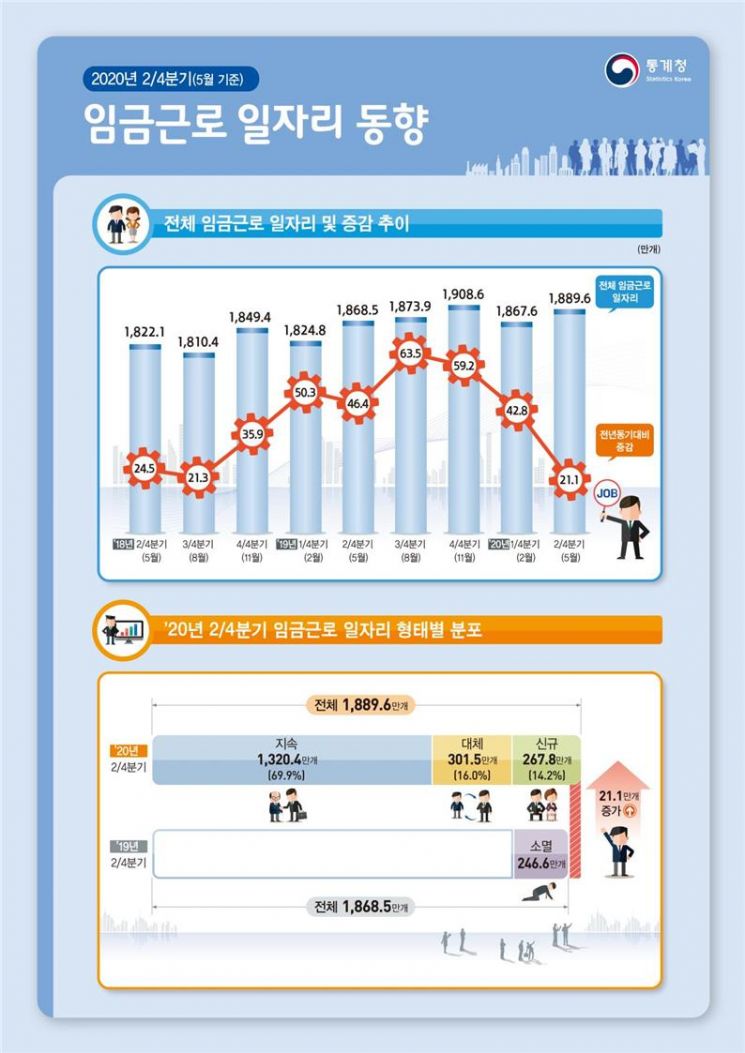
According to the 'Second Quarter Wage Employment Job Trends' announced by Statistics Korea on the 26th, the number of wage employment jobs in the second quarter of this year (as of May) was 18,896,000, an increase of 211,000 (1.1%) compared to the previous year. The increase was less than half of the 428,000 increase in the first quarter, affected by the aftermath of the novel coronavirus infection (COVID-19). Newly created jobs were 2,678,000 (14.2%), and jobs that disappeared were 2,466,000.
By age group, jobs for those aged 20 and under decreased by 82,000 (-2.5%) compared to last year, and jobs for those in their 30s also decreased by 82,000 (-1.9%). Wage employment jobs for those aged 20 and under recorded a decrease for two consecutive quarters compared to the same period last year after declining for the first time since statistics began in the first quarter, with the decrease expanding significantly compared to the first quarter (-13,000).
However, jobs for the middle-aged and older groups increased significantly. Wage jobs for those aged 60 and over increased by 225,000 (9.7%), jobs for those in their 50s increased by 128,000 (3.1%), and jobs for those in their 40s increased by 22,000 (0.5%). Regarding this, Manager Kim explained, "Jobs mainly decreased in industries with a high share of people in their 20s and 30s, such as manufacturing and accommodation/food services," adding, "On the other hand, industries where jobs increased, such as health and social welfare and public administration, have a large proportion of people in their 50s and 60s."

By industry, manufacturing, which has the largest share of jobs at 21.9%, lost 65,000 jobs. In manufacturing, which has shown a decline compared to the same period last year since the fourth quarter of last year due to economic downturn, decreases were notable in automobiles (-10,000), electronics and telecommunications (-9,000), and machinery equipment (-9,000).
In accommodation and food services, which saw a slight increase in jobs in the first quarter, jobs decreased by 26,000 due to the impact of COVID-19. On the other hand, health and social welfare created 116,000 jobs, and public administration created 72,000 jobs.
By gender, male jobs (10,991,000) increased by 76,000, and female jobs (7,905,000) increased by 136,000. The gender share of total jobs was 58.2% male and 41.8% female.
Among all wage employment jobs, continuous jobs held by the same workers as in the same period last year accounted for 13,204,000 (69.9%), and jobs replaced by workers due to retirement or job change accounted for 3,015,000 (16.0%).
© The Asia Business Daily(www.asiae.co.kr). All rights reserved.
![Clutching a Stolen Dior Bag, Saying "I Hate Being Poor but Real"... The Grotesque Con of a "Human Knockoff" [Slate]](https://cwcontent.asiae.co.kr/asiaresize/183/2026021902243444107_1771435474.jpg)












