Proving Fire Resistance of Wooden Buildings... A Step Toward Easing Regulations on Tall Wooden Structures
'250kg per 1㎡' Carbon Absorption... Wood Reappraised as Eco-Friendly Material in Developed Countries
Sanlimcheong Promotes Wood-Friendly Cities... Establishing Carbon Neutral Urban Soil with 'Sanlim New Deal'
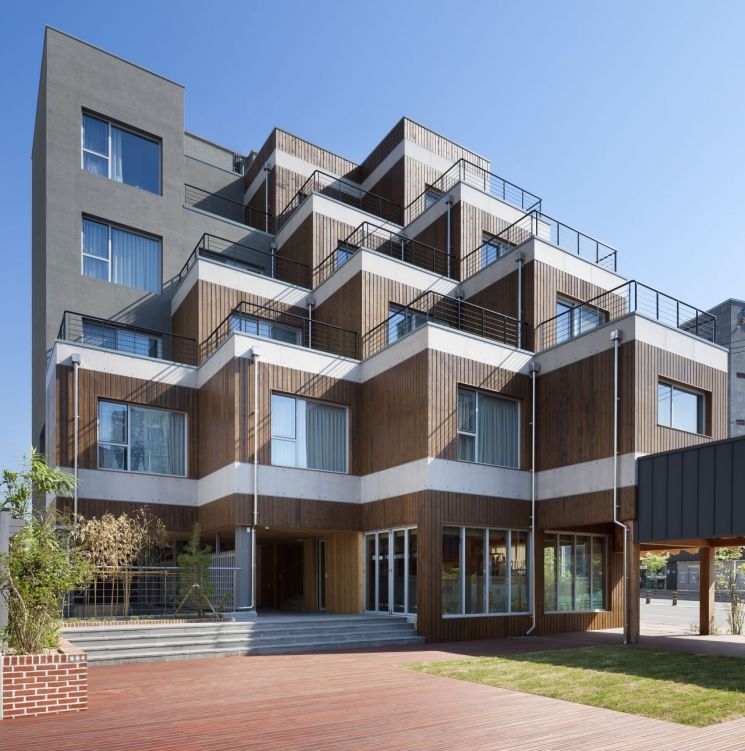 Exterior view of Hangreen Wooden Building, a wooden structure in Yeongju, Gyeongbuk. Provided by Korea Forest Service
[Asia Economy (Daejeon) Reporter Jeong Il-woong] Wooden architecture is expected to make a significant mark on 21st-century architectural culture. This is due to the shift in architectural trends from reinforced concrete culture to wood utilization culture. Wooden architecture has recently gained attention amid environmental issues such as global warming and policies promoting wood use in developed countries.
◆ Improvement of ‘Height and Scale Regulations’ for Domestic Wooden Architecture = According to the Korea Forest Service on the 27th, the main building materials of the 20th century were highly durable reinforced steel and concrete, which allowed mass production and mass consumption.
In particular, there has been a strong preference for apartment culture in Korea, and policies have imposed many restrictions on the construction of wooden buildings. The ‘Enforcement Rules of the Building Act (Article 9-3)’ is a representative example explaining the latter. Enacted in 2005, this regulation set limits such as a roof height of 18m, eaves height of 15m, and a scale of 3,000㎡. Essentially, it imposed regulations that prevented the construction of high-rise wooden buildings from the outset.
However, voices from the industry calling for the improvement (abolition) of these regulations grew louder, and the government recently reflected these industry opinions, leading to an analysis that a foundation for the activation of wooden architecture has been established. In fact, the Ministry of Land, Infrastructure and Transport included the relaxation of wooden building regulations in its short-term regulatory improvement plan in April, thereby removing constraints that had followed domestic wooden buildings.
The Korea Forest Service explained that a joint study conducted by the National Institute of Forest Science and the Fire Safety Research Institute of the Korea Institute of Civil Engineering and Building Technology (2017?2019) also played a role in the government’s regulatory improvements. The original Enforcement Rules of the Building Act (Article 9-3) were created because wooden buildings did not meet the fire resistance performance required by the Building Act and other laws. On the other hand, the joint study proved that the fire resistance performance of wooden buildings is not inferior to that of reinforced concrete buildings, eliminating the justification for maintaining related regulations.
◆ Environmental Advantage: ‘Wood = The Best Building Material’ = Apart from regulatory improvements, wooden architecture is rapidly emerging due to the environmental advantages of wood, its main material. The Korea Forest Service estimates that approximately 6.4 billion tons of carbon are emitted annually on Earth, while nature absorbs only about 3 billion tons. In other words, unless 3.4 billion tons of carbon are reduced or absorption sources are expanded, humanity cannot be free from global warming and climate change (or climate crisis) in the future.
This is a common problem faced by the international community, including Korea, and countries worldwide are actively pursuing both carbon emission reductions and increasing carbon absorption through forest resources. Increasing wooden architecture to replace reinforced concrete buildings is in the same context. In fact, the international community is paying attention to the fact that wooden buildings can store 250 kg of carbon per 1㎥ through photosynthesis.
Examples by country include Spain’s Metropol Parasol, considered the world’s largest wooden building, Germany’s wooden tower in Munich, and Japan’s planned 70-story wooden building scheduled for completion in 2041, all of which are attracting international attention. These serve as barometers indicating that wooden architecture is already being activated and wood is being commercialized as a building material, especially in developed countries.
◆ Domestic Efforts to Promote Wooden Architecture = The Korea Forest Service is promoting urban space design using wood as a material to establish and activate wooden architecture culture domestically. The core idea is to create a virtuous cycle of resources by producing wood from locally grown trees, processing it in local factories, constructing buildings, and forming wooden architecture streets.
The so-called wood-friendly ‘Wooden City’ was newly established as a regional specialized model included in this year’s government Urban Regeneration New Deal project. Based on this, the Korea Forest Service is drawing a big picture to lead a ‘large-scale woodification project’ including ▲ establishing a value chain network for local wood production → processing → utilization ▲ creating wood-specialized streets using streetlights, benches, guardrails, etc. ▲ constructing new public wooden buildings such as daycare centers, nursing homes, and public offices ▲ revitalizing local communities through citizen woodworking programs in wooden cities.
A Korea Forest Service official said, “To create wooden cities, the Korea Forest Service plans to prepare long-term plans and build a network that can share the entire promotion process with local communities.” He added, “Ultimately, wooden cities will activate domestic wooden architecture culture and lay the foundation for becoming carbon-neutral cities.”
© The Asia Business Daily(www.asiae.co.kr). All rights reserved.
![Clutching a Stolen Dior Bag, Saying "I Hate Being Poor but Real"... The Grotesque Con of a "Human Knockoff" [Slate]](https://cwcontent.asiae.co.kr/asiaresize/183/2026021902243444107_1771435474.jpg)
















