Bank of Korea Raises Growth Forecasts for This Year and Next
Despite Strengthened Social Distancing,
Consumption Shock Less Severe Than Initially,
Manufacturing Export Recovery Faster
COVID-19 Uncertainty Remains
US and Europe’s Pandemic Control Success Key
Full Lockdown Would Inevitably Reduce Exports
Vaccine Success Also Crucial
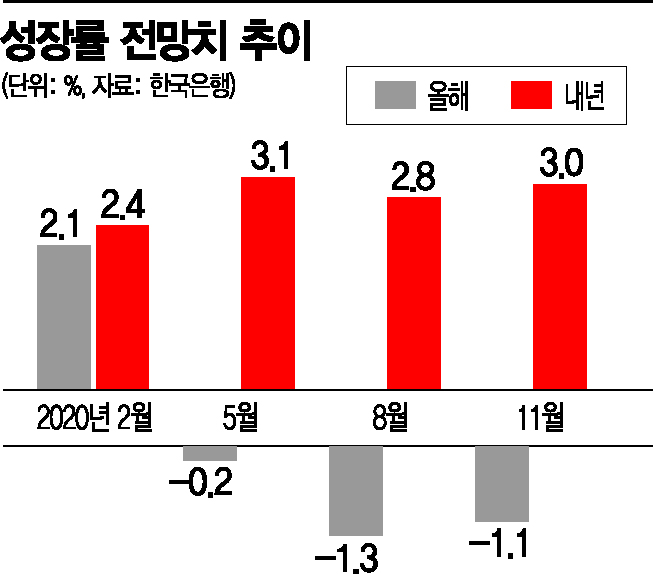
[Asia Economy Reporters Eunbyeol Kim and Sehee Jang] On the 26th, the Bank of Korea raised its growth forecast despite the resurgence of COVID-19, and the reason behind this is exports. Although there is a domestic demand shock due to the resurgence of COVID-19 and the elevation of social distancing levels, the recovery speed of manufacturing exports is evaluated to be fast enough to offset this. When the Bank of Korea released its growth forecast for this year (-1.3%) in August, the export recovery that began around September was not yet reflected. The fact that people are finding ways to coexist with COVID-19 and that the consumption shock caused by social distancing is less severe than initially expected also contributed to the upward revision of the growth forecast. The problem remains the persistent 'uncertainty.' It is impossible to be certain that the shock from the COVID-19 resurgence this winter will be small. The biggest variable is how successful the U.S. and Europe will be in controlling the pandemic this winter. A full lockdown for quarantine purposes would directly lead to a decrease in exports. The fact that daily domestic COVID-19 cases are approaching 600 and the uncertainty over the success of vaccine development are also cited as uncertainties.
Faster-than-expected export recovery... Will it continue into next year?
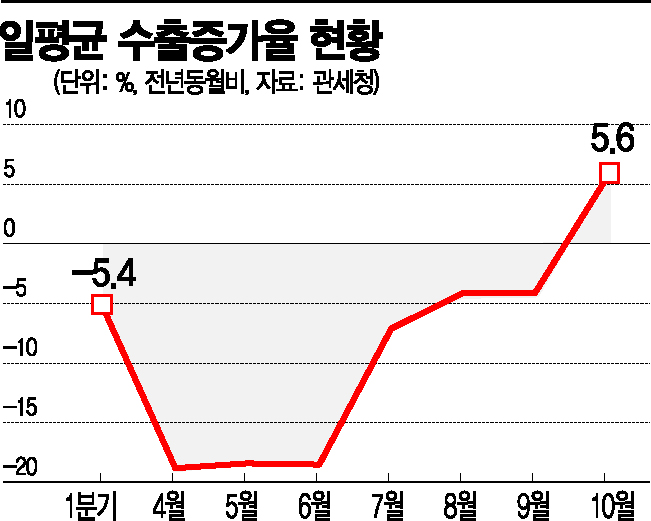
The surprising growth of 1.9% quarter-on-quarter in the third quarter GDP was driven by exports. In September, export value turned positive compared to the same month last year, and in October, the average daily exports adjusted for working days increased by 5.6% year-on-year, marking a positive figure for the first time in nine months. Exports up 11.1% compared to the same period last year as of the 20th of this month also raised expectations for fourth-quarter growth.
The Bank of Korea expects that a sharp decline in exports like that seen in April-May this year is unlikely to recur next year. Even if COVID-19 spreads further, it is expected that lockdown measures will not be implemented. However, depending on overseas conditions, whether exports will continue to show strong performance through December and into next year remains a variable. Professor Donghyun Ahn of Seoul National University’s Department of Economics said, "Trade volume is unlikely to increase sharply next year either," adding, "If lockdown measures are implemented overseas, consumption will decrease, which could affect our exports." The ongoing U.S.-China rivalry even after President-elect Joe Biden’s inauguration and the rapidly declining KRW-USD exchange rate, which burdens the export competitiveness of Korean companies, are also concerns.
Consumption, employment, and vaccines are variables everywhere
The reduced impact of the COVID-19 resurgence on consumption is another reason for the upward revision of the growth forecast. Retail sales in September increased by 4.4% year-on-year, and even in August, when the resurgence occurred, they rose by 0.3%. The increase in goods consumption due to reductions in individual consumption tax lessened the retail sales shock, and people learning to consume through online shopping and other methods during the COVID-19 era had a positive effect.
However, opinions are still divided on whether a 'COVID-19 resilience' has developed in the consumption sector. Since only about a week has passed since the social distancing level was raised, consumption shocks are being gauged only through card approval amounts and department store sales. Another issue is that companies are delaying employment due to uncertainty despite improved performance, causing employment recovery?a lagging economic indicator?to be slow. If employment remains sluggish, the pace of consumption recovery will inevitably slow down. Professor Inho Lee of Seoul National University’s Department of Economics said, "Achieving the hoped-for 3% growth next year is difficult," adding, "At best, growth in the 2% range is possible, and it would be fortunate just to avoid a prolonged L-shaped recession."
The globally anticipated COVID-19 vaccine may also cause differences in response among countries depending on side effects and supply availability. Professor Ahn said, "Even if there are no side effects, economic recovery will proceed first in advanced countries that have secured vaccine supplies," adding, "If political turmoil overlaps with vaccine distribution issues, it could hinder the speed of economic recovery."
Base interest rate likely to remain unchanged until next year
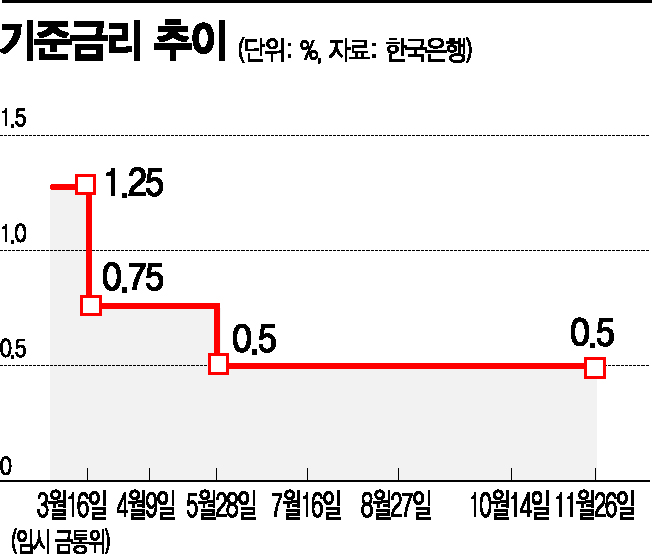
Given the various uncertainties, the Bank of Korea is highly likely to keep the base interest rate unchanged next year as well. Even if economic recovery appears, the recovery speed is expected to differ by industry, class, and income, showing a 'K-shaped recovery,' making it burdensome to raise interest rates again. The market sees room for one more rate cut, but with asset markets showing signs of overheating, further cuts are also difficult.
The Bank of Korea’s Monetary Policy Committee stated in its policy direction document, "The increase in household loans has expanded, and housing prices have continued to rise both in the metropolitan area and provinces." This reflects concerns about asset market concentration. It added, "Going forward, we will operate monetary policy to support the recovery trend and ensure that inflation stabilizes at the target level in the medium term, while paying attention to financial stability," and "With the domestic economy expected to recover moderately, and demand-side inflationary pressures remaining low, we will maintain an accommodative monetary policy stance."
© The Asia Business Daily(www.asiae.co.kr). All rights reserved.



















