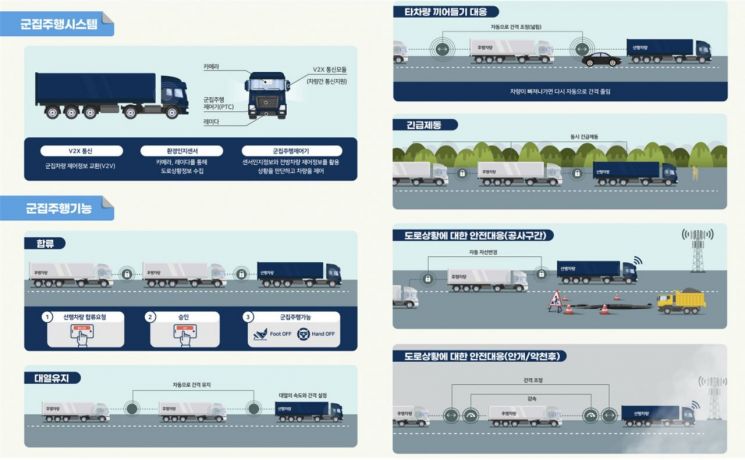
 Conceptual Diagram of Freight Truck Platooning Demonstration (Provided by the Ministry of Land, Infrastructure and Transport)
[Asia Economy Reporter Chunhee Lee] The Ministry of Land, Infrastructure and Transport announced on the 26th that on the 27th, it will demonstrate for the first time a platooning of freight trucks based on autonomous cooperative driving on public roads where general vehicles operate, showcasing an advanced stage of autonomous cooperative driving technology.
Autonomous cooperative driving is a technology that enables autonomous vehicles and general vehicles to cooperate with infrastructure to ensure safe road driving. Currently, it is being serviced nationwide over a 600 km section including Seoul and Jeju using the WAVE method.
Freight truck platooning utilizes this autonomous cooperative driving technology to allow following vehicles to automatically follow the lead vehicle at a fixed interval, operating as a single unit. The Ministry of Land, Infrastructure and Transport has been developing related technologies since 2018 under the traffic logistics research project.
The freight truck platooning demonstration held on this day takes place on an 8 km section of the Jungbu Naeryuk Expressway from Seoyeoju IC to Yeoju JCT and on the Yeoju test road. Hyundai's Xcient trucks are deployed as demonstration vehicles.
Through this, on public roads, three freight trucks form a platoon on a highway where general vehicles are operating, maintaining the formation and demonstrating stable driving. Using driving information received via vehicle-to-vehicle communication (V2V), the following vehicles drive autonomously without the driver’s hands on the steering wheel or feet on the pedals, adjusting speed and direction while following the lead vehicle.
When another vehicle cuts into the platoon during platooning, the vehicles exchange this information to widen the spacing and maintain the formation, and after completing the operation, the platoon is disbanded as part of the demonstration.
On the test road, safety services such as lane changes and emergency braking are demonstrated by utilizing vehicle-to-infrastructure communication (V2I) technology, which transmits unexpected road situation information to vehicles through roadside base stations by setting up virtual hazardous scenarios.
When the demonstration vehicle enters a virtual fog zone, it receives weather information and increases the vehicle spacing while driving. In construction zones, the vehicle changes lanes to avoid the area and ensure safety. In a scenario where wildlife suddenly appears, if the lead vehicle brakes abruptly, this deceleration information is synchronized with the following vehicles, enabling them to perform emergency braking simultaneously to prevent rear-end collisions.
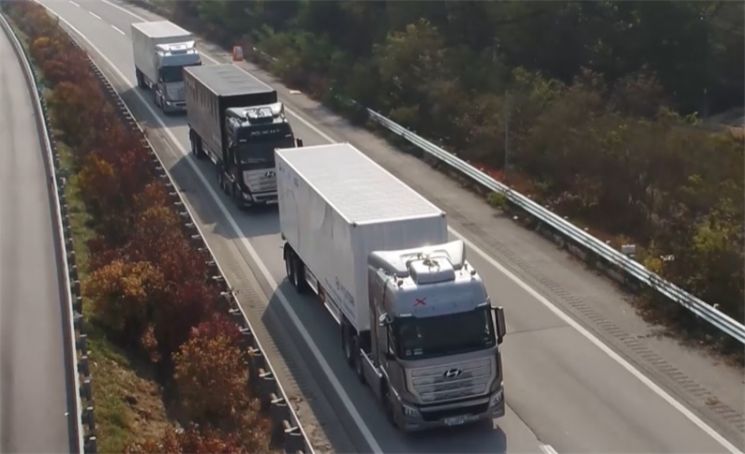 Cargo truck platooning demonstration scene (Provided by the Ministry of Land, Infrastructure and Transport)
This demonstration is considered significant by the Ministry of Land, Infrastructure and Transport because one additional freight truck was added compared to last year’s demonstration, and it is conducted not only on the test road but also on public roads. Additionally, the driving speed was increased from 70 km/h to 80 km/h, and the vehicle spacing was reduced from 16.7 m to 15.6 m, showcasing more advanced technological achievements.
The Ministry plans to demonstrate next year the operation of four freight trucks at 90 km/h over a wider range of public roads. Also, a mobile application will be introduced that matches vehicles wishing to participate in platooning based on vehicle specifications and route information and guides them to the merging point.
Once freight truck platooning is commercialized, it is expected to reduce driver fatigue through automatic driving systems and significantly decrease major accidents caused by drowsy driving. Moreover, when multiple freight trucks operate maintaining narrow gaps, air resistance is reduced, improving fuel efficiency, which is expected to lower logistics costs and reduce carbon dioxide (CO2) emissions and fine dust.
Yoon Jin-hwan, Director of Vehicle Management at the Ministry, said, "Freight truck platooning technology is an example that shows autonomous cooperative driving technology can bring significant transformation not only to passenger transport but also to various service fields such as logistics transport." He added, "Through autonomous cooperative driving technology, we will go beyond the launch of Level 3 autonomous vehicles and strive to open the world’s first commercial Level 4 autonomous vehicle era in 2027, fully preparing infrastructure and legal systems for the era of complete autonomous driving."
© The Asia Business Daily(www.asiae.co.kr). All rights reserved.
![Clutching a Stolen Dior Bag, Saying "I Hate Being Poor but Real"... The Grotesque Con of a "Human Knockoff" [Slate]](https://cwcontent.asiae.co.kr/asiaresize/183/2026021902243444107_1771435474.jpg)

















