From 0.02% in February to 4.2% in October
Concerns Over Abuse of 'Last Loan'
[Asia Economy Reporter Kim Hyo-jin] It has been revealed that the rate at which the Korea Inclusive Finance Agency (KIFA) repays on behalf of borrowers who fail to repay their loans under the low-income financial product 'Haetsalron17' exceeded 4% last month.
Haetsalron17 saw such high demand that its supply performance surpassed 1 trillion won within a year of its launch. However, it is known that some borrowers abused the system by entering debt adjustment procedures without even paying the principal and interest of the first installment. This is interpreted as evidence of the severely worsened financial situation of low-income people, compounded by the already structured recession and the impact of the novel coronavirus disease (COVID-19).
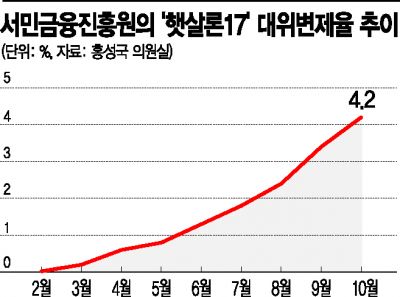
According to data analyzed by Hong Seong-guk, a member of the Democratic Party of Korea, who received it from KIFA on the 26th, the subrogation repayment rate of Haetsalron17, which was 0.02% at the end of February this year, soared to 4.2% at the end of October. The subrogation repayment rate is the ratio of the amount requested by banks for subrogation repayment from KIFA to the total Haetsalron17 loans. If arrears continue up to the fourth installment, banks can request subrogation repayment from KIFA.
Haetsalron17 was launched in September last year as an alternative product 100% guaranteed by the National Happiness Fund under KIFA to include low-credit borrowers, who have no choice but to use high-interest loans from private lenders or illegal private financing, into the formal financial sector. Those with an annual income of 35 million won or less, or 45 million won or less with a credit rating between 6 and 10, can receive support of up to 14 million won at a fixed interest rate of 17.9% per annum. As of last month, there have been a total of 170,990 applications for Haetsalron17, with support amounting to 1.1552 trillion won.
Representative Hong pointed out, "There is concern that the recent reduction in the legal maximum interest rate may tighten financial companies' lending attitudes toward low-credit borrowers," and said, "Until the private sector fully launches mid- to high-interest loan products using new credit evaluation methods, policy-based low-income financial products like Haetsalron17 are indispensable."
He added, "The rising subrogation repayment rate of Haetsalron17, which has only been launched for one year, clearly shows the current situation of financially vulnerable groups," emphasizing, "The government must fully focus on preventing the resurgence of COVID-19 while seriously recognizing the economic conditions of vulnerable groups."
Cases of Debt Adjustment Without Paying Even the First Installment Principal and Interest
KIFA is concerned whether the current rapid increase in the subrogation repayment rate might hinder future fund management and product handling. In particular, it is wary of 'moral hazard' where Haetsalron17 is abused as a de facto 'last loan,' with borrowers receiving support but not paying principal and interest even once, instead relying on debt adjustment procedures.
Accordingly, KIFA recently requested the Financial Services Commission to improve the system so that for policy low-income financial products, debt reduction through personal rehabilitation or personal workout is only possible after repaying the loan for a certain period. However, the Financial Services Commission did not accept the proposal, stating that it is unreasonable to consider failure to repay even once as moral hazard. They explained that repayment may be impossible due to unavoidable deterioration in repayment ability immediately after the loan, and some borrowers may have lacked repayment ability from the outset.
In cases where non-payment due to moral hazard is confirmed, the creditor's recovery rights are sufficiently guaranteed regardless of whether the debtor applies to the Credit Counseling and Recovery Service (CCRS), and in debt adjustment by CCRS, creditor financial institutions can exercise veto rights. Therefore, if the debtor's moral hazard is serious, it can be countered by veto, which is another reason the Financial Services Commission did not accept the proposal.
© The Asia Business Daily(www.asiae.co.kr). All rights reserved.
![Clutching a Stolen Dior Bag, Saying "I Hate Being Poor but Real"... The Grotesque Con of a "Human Knockoff" [Slate]](https://cwcontent.asiae.co.kr/asiaresize/183/2026021902243444107_1771435474.jpg)











