Public Institution Committee under the Tripartite Commission Reaches Government-Labor Agreement
Acceleration of 'Public Institution Operation Act' Amendment... Implementation Possible as Early as Next Year
Wage System Reform Based on Labor-Management Agreement... Autonomous and Gradual Promotion
[Asia Economy Reporters Sunmi Park and Bokyung Kim] The push for the labor director system, where workers participate in management, appears to be gaining momentum. The government and labor groups agreed on the need for legislative amendments to introduce the labor director system in public institutions. However, there are concerns that under the current adversarial labor-management relations, the labor director system could reduce management efficiency and exacerbate labor disputes, causing side effects.
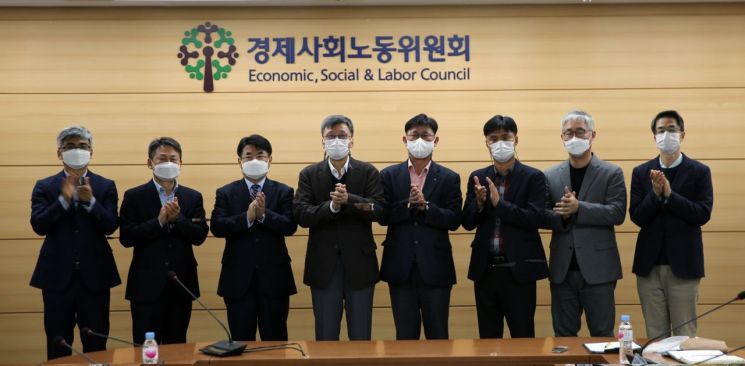
The Public Institution Committee under the Presidential Economic, Social and Labor Council announced on the 25th that it had reached an "Agreement for the Sustainable Development of Public Institutions." Key points of the agreement include ▲ urging the National Assembly to promptly discuss legislative amendments to introduce the labor director system in public institutions ▲ prioritizing the introduction of the worker council observer system and the labor union recommended director system before the labor director system ▲ and pursuing wage system reform autonomously and gradually through labor-management agreement.
The labor director system allows worker representatives to participate in the board of directors and exercise voting rights. Korea Electric Power Corporation (KEPCO) has expressed its intention to adopt the system. A KEPCO official told Asia Economy on the 26th, "We plan to proceed with related procedures in accordance with government guidelines after the legislative amendment is made." KEPCO CEO Kim Jong-gap also expressed a positive stance on the introduction of the labor director system in August, saying, "If we consider introducing the labor director system in public enterprises, I would like to raise my hand and try it once."
Industrial Bank of Korea (IBK) will begin negotiations on the labor union recommended director system next month, ahead of the expiration of outside directors' terms in February and March next year. IBK labor and management agreed in a joint declaration in January to actively discuss and promote the labor union recommended director system with relevant organizations. IBK President Yoon Jong-won said regarding the labor union recommended director system, "It is a matter with both expectations and concerns, and the results can vary greatly depending on how it is operated," adding, "I think it is important for the labor union to recommend excellent professionals and for those individuals to accumulate cases of constructive roles in the bank's development."
If IBK opens the way, financial public institutions such as KDB Industrial Bank and Export-Import Bank, which previously attempted but failed to promote the labor director system through labor unions, are expected to gain momentum in pushing for the labor director system in line with the expiration of outside directors' terms next year. The Korea Asset Management Corporation (KAMCO) labor union, which attempted the labor union recommended director system in August, plans to conduct candidate recommendation work by the end of next month or early next year.
Three bills to amend the "Public Institution Operation Act," focusing on the introduction of the labor director system, have been proposed in the National Assembly led by ruling party lawmakers. If the dominant ruling party pushes for the passage of the bills, implementation could begin as early as next year.
The labor director system is actively implemented in some European countries. However, in South Korea, where labor-management relations are adversarial, the system is more likely to cause side effects such as reduced management efficiency and intensified labor disputes rather than positive effects like securing management transparency. There are also concerns that worker representatives may excessively infringe on management rights by participating in decision-making on management strategies and personnel matters.
Meanwhile, in this labor-government agreement, the issue of reforming the wage system in public institutions to focus on the job-based pay system was deprioritized. The agreement states, "The reform of the job-based pay system will be pursued autonomously and gradually through labor-management agreements at individual public institutions."
The government has been promoting the transition from the existing seniority-based step system to a job-based pay system based on job characteristics, difficulty, and value for several years. This is to address side effects such as inefficient management in public institutions, labor rigidity, and wage disparities. However, this agreement has made wage system reform more difficult. In fact, labor-management agreement has been the biggest obstacle within public institutions that announced plans to introduce the job-based pay system. Nevertheless, the Economic, Social and Labor Council praised it as a "historic grand compromise between public institution labor unions and the government."
© The Asia Business Daily(www.asiae.co.kr). All rights reserved.

















