After the Implementation of the 'Fine Dust Seasonal Management System' in November 2019
Second Winter Shutdown of Coal Power Plants... One More Unit than Last Year
Fine Dust Down 5.6% Compared to Previous Year, 43% Decrease Compared to Winter Two Years Ago
Reduction of Low-Cost Coal Power Increases Electricity Price Factors
Public 'Electricity Peak Reduction Target System'... Private 'Keep 20℃' Campaign
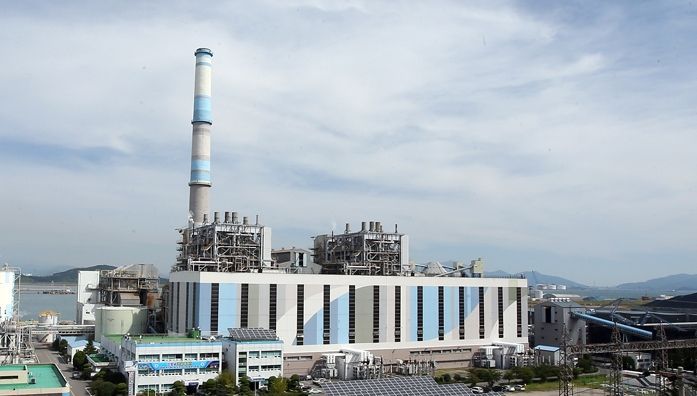
[Asia Economy Reporter Moon Chaeseok] The government has decided to shut down up to 16 coal power plants this winter to reduce fine dust during the winter season. This is one more plant than the maximum of 15 plants that were shut down for the first time last year. On weekends, when outdoor activities are frequent, the output of all coal power plants except those that are shut down will be limited to 80%, creating the effect of shutting down up to 25 plants. A pilot program for the 'Electricity Peak Reduction Target System' will be implemented for public institutions, and a new campaign to maintain the 'appropriate indoor temperature (20℃)' will be promoted for the private sector.
On the 26th, the government held a National Affairs Inspection and Coordination Meeting chaired by Prime Minister Chung Sye-kyun at the Sejong Government Complex and reviewed and finalized the 'Winter Electricity Supply and Demand and Coal Power Reduction Measures' with these contents. The government explained, "It is expected to reduce fine dust by 2,289 tons compared to December 2018 to February last year, before the seasonal management system was implemented, and by 181 tons compared to December last year to February this year, when it was first implemented," adding, "The electricity supply reserve rate will be maintained at 15% or higher."
The government has designated the period from December 1st this year to February 28th next year as the 'Winter Electricity Supply and Demand Measures Period' and plans to shut down 9 to 16 coal power plants during this period. This includes shutting down 2 to 4 old coal plants, 1 to 13 for preventive maintenance, and an additional 1 to 9 plants. This will be one more plant than the maximum of 15 plants set last year, when the seasonal management system, which defines December to March as the 'high fine dust concentration period,' was first implemented. There are a total of 60 coal power plants in the country. Shutting down 16 plants this winter means that 26% of the total coal power generation will be stopped.
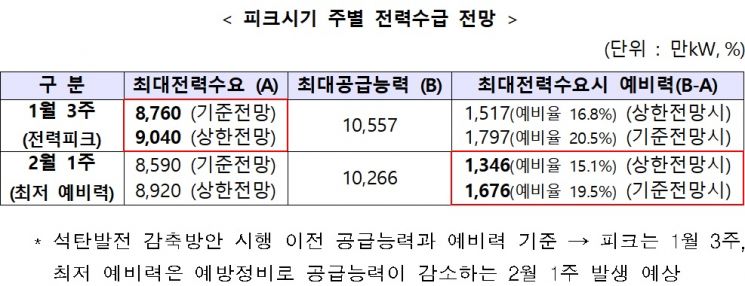
The Ministry of Trade, Industry and Energy forecasted that the maximum electricity demand during the winter electricity supply and demand measures period will be around 87.6 million kW under the baseline scenario and around 90.4 million kW under the extreme cold scenario. These figures do not consider the shutdown of coal power plants. The baseline scenario is calculated based on the average temperature of the 72 hours before the annual electricity peak over the past 30 years, using the lowest 10 years' average (-5.7℃), and the extreme cold scenario uses the lowest 3 years' average (-8.6℃).
The third week of January has been designated as the 'electricity peak period.' The supply capacity during the peak period is forecasted to be the highest ever at 105.57 million kW, with a reserve margin of 13.46 million kW (16.76 million kW in extreme cold). After implementing coal power reduction, the plan is to maintain a reserve margin of over 10 million kW (10GW). Coal power plants not subject to shutdown will operate at up to 80% output within the remaining reserve margin. In particular, on weekends, the output of all coal power plants not subject to shutdown will be limited to 80%.
The Ministry of Trade, Industry and Energy expects that if the plan is implemented, fine dust emissions this winter can be reduced to 3,031 tons. This is a 5.6% (181 tons) reduction compared to 3,212 tons from December last year to February this year. Compared to 5,320 tons from December 2018 to February last year, before the seasonal management system was implemented, it is expected to achieve a 43% (2,289 tons) reduction in fine dust.
Reducing coal power, which has a relatively low generation cost, inevitably raises concerns about electricity price increases. When the government first introduced the seasonal management system and winter coal power reduction measures last year, it stated, "During the first half of this year, we will calculate the costs incurred due to the application of coal power reduction measures and review the necessity and detailed plans for electricity price adjustments." However, as of the end of the Korea Electric Power Corporation (KEPCO) board meeting on the 25th, no electricity price reform plan has been disclosed.
According to the Korea Power Exchange's Electricity Statistics Information System (EPSIS), as of the latest record in August, the generation cost per kWh for bituminous coal was 79.9 won. This was cheaper than liquefied natural gas (LNG) at 103.5 won and pumped storage at 126.4 won, but more expensive than nuclear power at 69.7 won.
During the winter electricity supply and demand measures period, the government will establish a supply and demand situation room with the Power Exchange, KEPCO, and power generation companies to monitor and manage the electricity supply and demand situation. Depending on the reserve margin level, additional reserve resources of 9.1 million to 13.84 million kW will be promptly deployed if necessary. Additionally, 3.06 million tons of liquefied natural gas (LNG) have been secured to enhance electricity supply stability.
The public sector will pilot the peak reduction target system in winter as well as in summer. This system assigns electricity peak reduction targets for winter and summer to energy-intensive public institutions and evaluates their performance individually. The full-scale project is planned to start next summer. For the private sector, a campaign to maintain the appropriate indoor temperature (20℃) will be promoted. The Ministry of Trade, Industry and Energy explained, "The goal is to convey to the public that maintaining an appropriate temperature is an act of responding to climate change and protecting the Earth, thereby forming a consensus."
Furthermore, the Korea Disease Control and Prevention Agency and medical institutions will conduct special inspections of power facilities to ensure that there are no power supply disruptions at the forefront of COVID-19 response.
Support for socially vulnerable groups will be increased. The budget for the 'Energy Voucher,' which supports heating costs for energy-vulnerable groups, will be expanded from 66.7 billion won to 72 billion won. The number of beneficiary households will increase from 654,000 to 673,000. The average support amount per household will rise from 102,000 won to 107,000 won.
© The Asia Business Daily(www.asiae.co.kr). All rights reserved.


















